
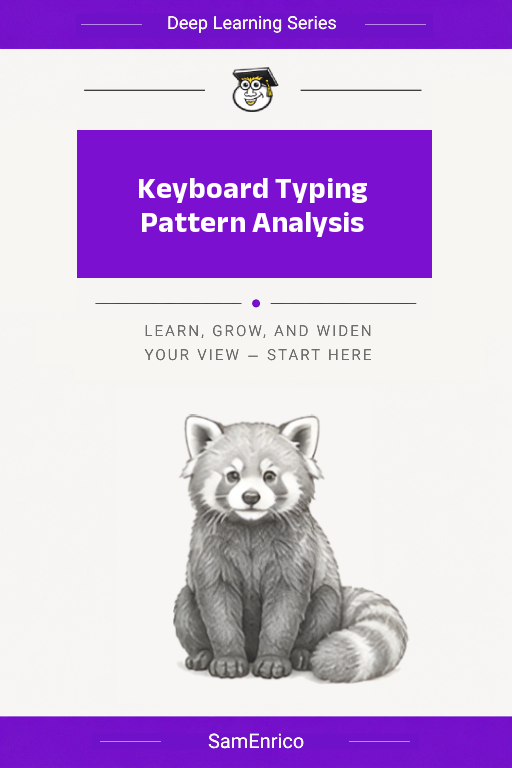
Keyboard Typing Pattern Analysis eBook
Understand how AI analyzes your typing rhythm and
by Roby Jaye
Understand how AI analyzes your typing rhythm and keystroke patterns to verify identity during online exams.
Formats
Free sample
Chapter 1: The Ghost in Your Fingers--Every time you touch a keyboard, you leave behind a ghost. Not a specter of smoke and shadow, but something far more tangible—a precise, millisecond-by-millisecond record of your neuromuscular timing, etched into the digital fabric of every email, every search, every password you type. This ghost cannot be seen or heard. It does not appear on any screen or in any mirror. But it exists, nonetheless, and for the first time in human history, machines are learning to read it.Consider, for a moment, the seemingly simple act of typing the word "the." Your left index finger presses 't,' then your right ring finger moves to 'h,' and finally your left ring finger finds 'e.' Between each press, there are microscopic pauses—durations so brief that your conscious mind never registers them.
For a fast typist, the dwell time (how long a key remains depressed) might be 80 milliseconds. The flight time (the gap between releasing one key and pressing the next) might be 50 milliseconds. For a slower typist, those numbers might double. But here is the crucial insight: within those tiny windows, your body performs a signature more unique than your handwritten name.This chapter is about that signature. It is about how behavioral biometrics—specifically keystroke dynamics—has emerged from academic laboratories to become one of the most promising, controversial, and misunderstood technologies in the world of online identity verification.
By the time you finish reading, you will understand not only what keystroke dynamics is, but why it represents a fundamental shift in how we think about authentication, privacy, and trust in the digital age.The Crisis That Made Typing Matter To understand why keystroke dynamics has suddenly become a billion-dollar conversation, you need to rewind to March 2020. That month, the world's education system did something unprecedented: it went entirely remote, almost overnight. Universities that had spent decades perfecting in-person proctoring found themselves staring at a terrifying reality. They had no reliable way to know who was actually taking their exams.The immediate solution was video proctoring. Services like Proctor U, Honorlock, and Exam Soft rushed to fill the gap, installing software that watched students through their webcams, monitored their screens, and sometimes even required them to show their rooms with a mirror.
But the backlash was swift and brutal. Students reported feeling violated. Privacy advocates pointed out that these systems captured bedroom walls, family members walking by, and intimate details of students' living situations. False positives skyrocketed—a student glancing at the ceiling in thought was flagged as looking at a cheat sheet. And for all their intrusiveness, video proctoring systems were surprisingly easy to fool.
A printed photograph of an empty chair could trick motion detection. A second monitor hidden behind the laptop's camera blind spot went unnoticed.The result was a crisis of confidence. By 2022, nearly 70% of university administrators surveyed believed that academic integrity had declined during remote learning, according to a study published in the Journal of Educational Technology. But the same survey found that 65% of students reported feeling "uncomfortable" or "extremely uncomfortable" with video proctoring. The trade-off seemed impossible: either you invade privacy or you accept cheating.Enter keystroke dynamics.Unlike video proctoring, which watches the external world, keystroke dynamics watches the internal world—the unique rhythm of your typing.
It requires no camera, no room scan, and no intrusive monitoring. It works silently in the background, continuously verifying your identity as you type naturally. And because it operates on behavior rather than physical appearance, it is nearly impossible to spoof with a photograph or a second monitor.But here is what most people misunderstand: keystroke dynamics is not a single technology. It is a family of techniques, ranging from simple statistical comparisons to sophisticated deep learning models. Some methods work best for short, fixed texts like passwords.
Others excel at continuous authentication across long essay exams. The choice between them has profound implications for accuracy, fairness, and privacy.A Brief History of Telling People Who You Are Before we dive into the mechanics of keystroke dynamics, it helps to understand where it fits in the broader history of authentication. For most of human civilization, proving who you were meant showing your face or producing a signed document. The digital world complicated things enormously.The first digital authentication method was simple: the password. A user types a secret string, and the system checks if it matches.
This is known as "something you know." It worked well enough for early mainframes and dial-up bulletin boards, but it has two fatal flaws: passwords can be stolen, and they can be shared. A student can text their password to a friend. A hacker can purchase millions of passwords from a dark web marketplace. By 2025, the average person had over 100 passwords to remember, and the average password could be cracked in less than one second by a modern GPU.The second major method was "something you have"—physical tokens like RSA Secur ID key fobs, smart cards, or more recently, mobile authenticator apps. These are harder to steal at scale, but they can be lost, borrowed, or physically taken.
A student could hand their phone to a friend before an exam. A sophisticated attacker could clone a hardware token.The third method is "something you are"—biometrics. Fingerprint scanners, iris recognition, facial recognition, and voice authentication all fall into this category. Biometrics seemed like the holy grail because they are difficult to steal (you cannot borrow someone else's fingerprint) and impossible to forget (you always have them with you). But they have their own problems.
Fingerprints can be lifted from surfaces and replicated. Facial recognition can be fooled by photographs or deepfakes. And once a biometric is compromised, you cannot change it. You cannot get a new fingerprint.This is where the distinction between physiological and behavioral biometrics becomes crucial. Physiological biometrics are based on static physical traits: the ridge pattern of your finger, the geometry of your iris, the arrangement of your facial features.
These are powerful identifiers, but they are also permanently exposed every time you touch a surface or appear on a video call. Behavioral biometrics, by contrast, are based on dynamic actions: how you walk (gait), how you speak (voice), how you type (keystroke dynamics). They are not static features to be stolen; they are performances to be imitated. And imitating a performance is exponentially harder than copying a physical pattern.Imagine trying to forge a signature. You can trace the outline perfectly, but the pressure, the speed, the hesitation—those are nearly impossible to replicate.
The same principle applies to typing. A friend could watch you type your password and learn the letters, but they cannot replicate the 85-millisecond pause you unconsciously insert between the 'p' and 'a' of "password." That pause is not a choice. It is a product of your unique neuromuscular wiring, your typing training, even the subtle fatigue in your specific fingers on a specific day.The Physics of a Single Keypress To truly understand keystroke dynamics, you need to zoom in—way in. Let us examine what happens when you press a single key, say the 'A' key on a standard…
This is the end of the free sample. Get the eBook to keep going. Buy now
About this book
Details
- Author
- Roby Jaye
- Publisher
- SamEnrico
- Language
- English
- Genre
- Non-Fiction, Student's Shortcut, Keystroke Analysis, Identity Verification
- Released
- 2026-06-01
- Pages (approx.)
- 144
- Available as
- eBook, Audiobook

Read better in the ZLOADR app
Your eBooks on your phone or tablet. Sign in with your SamEnrico account and start reading.
More by Roby Jaye
 Outdoor HIIT Park WorkoutsRoby Jaye$11.99
 Mobile Gacha Games Recovery GuideRoby Jaye$11.99
 Opioid Orphan MemoirRoby Jaye$11.99
 Vision Loss Emotional AdjustmentRoby Jaye$11.99
 Boredom Smoking Replacement PlanRoby Jaye$11.99
 Echoes from the Cosmic Dawn: Antarctica’s Window to the Big BangRoby Jaye$11.99
 Dress Code B2B Selling GuideRoby Jaye$12.99
 Engineering Program ManagerRoby Jaye$11.99
 How to Start a Hobby in Neuro Linguistic ProgrammingRoby Jaye$11.99
 Understanding Cardiomyopathy, Fatal Fetal, Due to Myocardial CalcificationRoby Jaye$17.99