
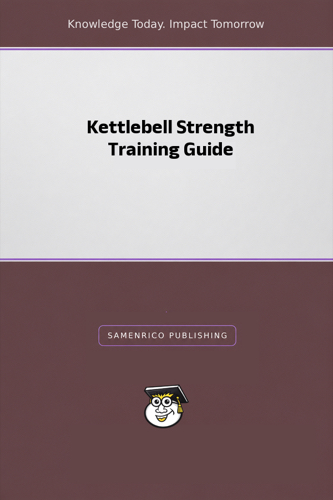
Non-FictionHealth & WellnessKettlebell Training
Kettlebell Strength Training Guide eBook
Swing clean and snatch your way to explosive power
by Harp Shan
Swing clean and snatch your way to explosive power and grip strength.
Formats
Free sample
Chapter 1: The Loaded Spring--–- The first thing you must understand about the kettlebell is that it does not care about your gym resume. It does not care that you can bench press twice your body weight or that you have deadlifted four plates. The kettlebell has a single question, and it will ask it on the very first rep of your very first swing: Do you actually know how to use your hips, or have you just been squatting everything?Most people fail this question immediately. They approach the kettlebell as if it is a small, awkward dumbbell. They squat down, grab the handle, and try to muscle it up with their lower back and shoulders.
Within a few swings, they feel a twinge in their lumbar spine, a burning in their forearms, and a vague sense that they must be doing something wrong. They are correct. The problem is not their effort or their strength. The problem is that they are trying to solve a ballistic problem with grinding mechanics.This entire book rests on a single biomechanical distinction, and if you absorb nothing else from this chapter, absorb this: the hip hinge is not a squat. The squat is a vertical movement.
The hip hinge is a horizontal movement. In a squat, your hips drop straight down, your knees track forward, and your torso remains relatively upright. In a hip hinge, your hips push straight back, your knees bend only slightly, and your torso folds forward from the hips while maintaining a neutral spine. The kettlebell swing, clean, and snatch are all hinging movements. If you squat them, you will hurt yourself.
If you hinge them, you will unlock power you did not know you possessed.This chapter will teach you the anatomy of the hinge, the physics of ballistic power, and the grip mechanics that separate a smooth swing from a forearm-smashing disaster. By the end, you will understand why the kettlebell swing is not just an exercise but a diagnostic tool for the entire posterior chain.The Anatomy of the Hinge: Why Your Hamstrings Are Your Secret Weapon Stand up right now. Place your hands on your hip bones — the bony protrusions at the front of your pelvis. Now, without bending your knees more than a few degrees, push your hips straight backward as if you are trying to close a car door with your glutes. Feel how your torso tilts forward?
That is the hinge. Now, from that position, drive your hips forward to return to standing. That explosive forward drive is where power comes from.The muscles that make this possible are the hamstrings, glutes, and spinal erectors — collectively known as the posterior chain. In a properly executed hinge, the hamstrings act like rubber bands. During the backswing, as your hips travel backward, the hamstrings stretch under load.
This stretch stores elastic energy, much like pulling back a slingshot. During the upswing, that stored energy is released, snapping your hips forward with force that far exceeds what your muscles could produce through a slow, voluntary contraction.This is the loaded stretch reflex or plyometric effect. It is the same mechanism that allows a kangaroo to hop enormous distances with minimal muscular effort and a plyometric box jump to launch you higher than a squat ever could. The kettlebell swing harnesses this reflex. When you hinge correctly, the bell appears to float at the top of the swing not because you lifted it with your arms but because your hips launched it like a catapult.The Squatty Swing: A Cautionary Tale The most common mistake beginners make is turning the swing into a squat.
Instead of pushing the hips back, they drop the hips down. The knees travel far forward, the torso becomes vertical, and the bell swings low between the legs like a pendulum under a bridge. This feels safer because it resembles movements they already know, but it is biomechanically disastrous for three reasons.First, the squatty swing transfers the load from the hamstrings to the quadriceps. The quadriceps are powerful muscles, but they are not designed for the rapid stretch-shortening cycle of ballistic movement. You will fatigue faster and generate less power.
Second, the squatty swing places the lumbar spine in flexion at the bottom of the movement. As the hips drop and the torso remains upright, the lower back rounds. Repeated under ballistic load, this rounding is a direct path to disc herniation. Third, the squatty swing changes the arc of the bell. Instead of traveling in a predictable horizontal arc from behind the hips to chest height, the bell travels in a deep U-shape, smacking into the thighs on the way down and the forearms on the way up.The fix is simple but requires patience.
Practice the hinge without a kettlebell. Stand two inches from a wall, facing away from it. Push your hips back until your glutes touch the wall. Your knees should bend only slightly — no more than fifteen degrees. Your spine should remain completely neutral, neither arched nor rounded.
That is the hinge. That is the position from which all power flows.Projection and Float: The Physics of Ballistic Power Once you understand the hinge, you need to understand what happens when you apply it to a kettlebell. Two concepts are essential: projection and float.Projection is the transfer of force from your hips to the bell. When your hips explode forward, they create a wave of energy that travels up your spine, through your packed shoulders, and into the bell. The bell does not swing because you lifted it with your arms.
It swings because your hips threw it. A simple test: if your arms are sore after a set of swings, you are muscling the bell instead of projecting it. Your arms should be nothing more than chains connecting your torso to the weight.The sensation of correct projection is unmistakable. At the bottom of the hinge, the bell rests behind your heels. As your hips snap forward, the bell launches upward.
For a split second, your arms go weightless. This is float — the millisecond at the top of the swing when the bell is no longer moving upward but has not yet begun to fall. During float, your grip can relax. Your shoulders can reset. Your breath can be taken.
Float is not a flaw; it is the reward for perfect projection.In a properly executed swing, float lasts just long enough for you to rebrace your core and initiate the next hinge. In a sloppy swing, there is no float. The bell travels in a jerky, uneven arc, and you feel like you are fighting it every inch of the way. Float is your feedback mechanism. If you do not feel float, your hinge is not explosive enough.The Arc Question: Low, High, and Why It Matters A common point of confusion is where the bell should travel.
Some coaches teach a high arc, with the bell rising to eye level or overhead. Others teach a low arc, stopping at chest height. Both have their place, but they serve different purposes, and confusing them is a common source of injury.For the…
This is the end of the free sample. Get the eBook to keep going. Buy now
About this book
Details
- Author
- Harp Shan
- Publisher
- SamEnrico
- Language
- English
- Genre
- Non-Fiction, Health & Wellness, Kettlebell Training
- Released
- 2026-06-06
- Pages (approx.)
- 139
- Available as
- eBook, Audiobook

Read better in the ZLOADR app
Your eBooks on your phone or tablet. Sign in with your SamEnrico account and start reading.
More by Harp Shan
 Body Scan For Better SleepHarp Shan$11.99
 Daily Review for ManagersHarp Shan$11.99
 Shin Splints Prevention StretchHarp Shan$11.99
 The Tunguska Enigma: When Siberia Shook the WorldHarp Shan$11.99
 The Last Broadcast: The Day the World Listened to Apollo 11Harp Shan$11.99
 Understanding Hypobetalipoproteinaemia Ataxia Hearing LossHarp Shan$17.99
 Private BankerHarp Shan$11.99
 Spatial Biology TechnologiesHarp Shan$12.99
 Family Office Job Search WorkbookHarp Shan$12.99
 How to Start a Pavement Artist Business (Beginners Guide)Harp Shan$11.99
You may also like
 Hong Kong Handover 1997Dunn Johnnie$11.99
 Zumba For Postnatal Recovery CourseNeal Christian$11.99
 Zumba for BeginnersLadner Nikia$11.99
 YouTube Comment Mining GuideHumes Pandora$12.99
 Worry Box MeditationCarlin Rudy$11.99
 Workplace Stress MeditationNguyen Lynn$11.99
 Workplace Stress and Sleep RepairHawley Ivory$11.99
 Workplace Perfectionism CureDelaney Jeffry$11.99
 Workplace Injustice Anger GuideWallen Isabelle$11.99
 Work Addiction and Burnout LinkGreenwood Ester$11.99
 Women in Yoga and WellnessBeattie Galina$11.99
 Women in Stand Up ComedyChun Evangeline$11.99