
Non-FictionHealth & WellnessKettlebell
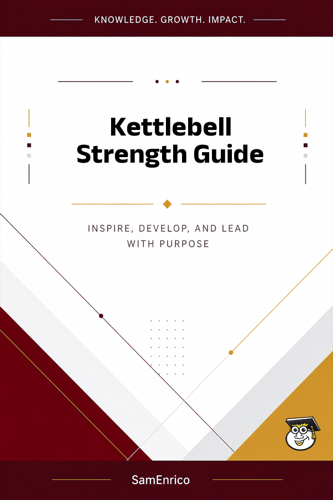
Kettlebell Strength Guide eBook
Teaches swings, cleans, and snatches for power dev
Teaches swings, cleans, and snatches for power development.
Formats
Free sample
Chapter 1: The 80/20 Revelation--–- You have been lied to. Not maliciously, not with ill intent, but lied to nonetheless. The lie is this: that you need thirty-seven different kettlebell exercises, a wall full of bells in every color of the rainbow, and forty-five minutes of mobility drills before you are "ready" to train. The fitness industry has convinced you that complexity equals expertise, that more movements mean more results, and that if you aren't doing Turkish Get-Ups with a 32kg bell while balancing on a foam roller, you aren't really trying.This book exists to undo that lie.Welcome to Kettlebell Strength Guide: The Triad of Power. Before we throw a single kilogram of iron around your body, we need to establish a foundation so obvious that you will wonder why no one told you sooner.
Here it is: three lifts produce approximately eighty percent of the power-development results. The Swing, the Clean, and the Snatch. That is the Triad. Everything else—the figure-eights, the haloes, the overhead lunges with a bell balanced on your fist—is decoration. Nice decoration, perhaps.
Fun decoration, absolutely. But decoration nonetheless.This chapter is called "The 80/20 Revelation" because it is going to change how you see every kettlebell workout for the rest of your life. By the time you finish reading these pages, you will understand why elite athletes, special forces operators, and world-class strength coaches all return to the same three movements. You will understand why the hip hinge is the true engine of athletic power—not the squat, not the deadlift, not the bench press. And you will walk away with a clarity that most kettlebell enthusiasts never achieve: the knowledge that mastery of a few things beats familiarity with many things every single time.The Circus Trick Epidemic Walk into any commercial gym that offers kettlebells, and you will witness a strange phenomenon.
There will be someone swinging a bell between their legs while twisting their torso like a corkscrew. There will be someone lying on their back, pressing a bell overhead with one hand while extending the opposite leg. There will be someone attempting a one-legged deadlift while passing the bell behind their back. These are not exercises. They are circus tricks wearing the costume of functional fitness.Here is the uncomfortable truth that no Instagram influencer wants to admit: complexity sells, but simplicity works.The fitness industry has a financial incentive to make you believe that you need variety.
If you are doing the same three lifts every week, why would you buy the second book? Why would you hire the coach for the "advanced" program? Why would you purchase the "kettlebell flow" DVD with seventeen new movements you have never seen before? The answer is that you would not. And so the industry churns out new variations, new "systems," new challenges—each one promising that this is the missing piece.But let us look at the evidence.
Consider the training logs of the most powerful kettlebell athletes in the world. Look at the daily routines of Strong First certified instructors. Examine the programs used by Soviet special forces when kettlebells were a state secret. What do you find? The Swing.
The Clean. The Snatch. Sometimes the Jerk. Rarely anything else. These people are not bored.
They are not plateaued. They are not missing out. They are simply wise enough to know that chasing the next new thing is the fastest path to nowhere.I am not telling you that Turkish Get-Ups are useless. They have value. I am not telling you that goblet squats are a waste of time.
They are excellent for mobility and blood flow. But here is the distinction that changes everything: there is a difference between exercises that are good and exercises that are essential. The Triad—Swing, Clean, Snatch—is essential for power development. Everything else is optional.The Science of the Hip Hinge To understand why these three lifts dominate power development, you must first understand the hip hinge. This is not the same as a squat.
A squat is a vertical movement: your hips drop down, your knees bend, and your torso stays relatively upright. A squat builds the quadriceps, the glutes to some degree, and the lower back as a stabilizer. It is a wonderful movement. It is not, however, the king of explosive power.The hip hinge is a horizontal movement. Your hips move backward, your torso folds forward, and your knees bend only slightly—just enough to unlock the joint.
The primary movers are the glutes and hamstrings, working together as a single elastic band. When you hinge correctly, you stretch those posterior chain muscles like a rubber band being pulled back. When you reverse the hinge, you release that stored elastic energy explosively.This is exactly how you jump. Watch a basketball player preparing for a vertical leap. Do they squat down with their knees traveling far forward over their toes?
No. They push their hips backward, load the hamstrings, and then explode upward. Watch a sprinter leaving the starting blocks. The same pattern: hips back, then hips forward with violent intent. Watch a football lineman delivering a block.
Watch a gymnast launching into a flip. Watch a mother catching a falling child and driving upward to protect them. The hip hinge is encoded into human movement because it is the most efficient way to produce horizontal and vertical power simultaneously.The Swing, the Clean, and the Snatch are all hip hinges. Every single one. If you cannot hinge, you cannot perform any of these lifts correctly.
If you hinge incorrectly, you will feel the movement in your lower back (where you do not want it) rather than in your glutes and hamstrings (where you do). This is why the very next chapter in this book—Chapter 1.5—is a complete, standalone tutorial on the hip hinge. Do not skip it. Do not skim it. Do not assume you already know how to hinge because you have been swinging a kettlebell for years.
I have watched certified trainers hinge incorrectly. Humility in the face of fundamentals is the first mark of a true athlete.The Triad Defined: Swing, Clean, Snatch Now let us introduce the three lifts that will occupy the next several hundred pages of this book. Each one serves a distinct purpose in the development of power. Each one builds upon the previous. And each one, when mastered, unlocks something new in your athletic potential.The Swing: Foundation The Swing is where you learn to generate power.
The bell travels from between your legs to approximately eye level (the Russian Swing, which we will champion in Chapter 3), and the entire force comes from your hips. Your arms are merely ropes connecting the bell to your torso. If your shoulders are tired after a set of swings, you are doing them wrong. If your lower back is sore, you are hinging too early or too late. If your hamstrings are on fire the next day, congratulations—you have discovered what a proper swing feels like.The Swing teaches you the fundamental rhythm of ballistic kettlebell training: the sharp exhale at the top, the passive inhale on the way…
This is the end of the free sample. Get the eBook to keep going. Buy now
About this book
Details
- Author
- Best Adelaida
- Publisher
- SamEnrico
- Language
- English
- Genre
- Non-Fiction, Health & Wellness, Kettlebell
- Released
- 2026-06-05
- Pages (approx.)
- 134
- Available as
- eBook, Audiobook

Read better in the ZLOADR app
Your eBooks on your phone or tablet. Sign in with your SamEnrico account and start reading.
More by Best Adelaida
 Shoe Polish Nitrobenzene RiskBest Adelaida$11.99
 Putin and the Russian MafiaBest Adelaida$11.99
 Cocaine Cravings and Compassionate SolutionsBest Adelaida$11.99
 The Foster Care CASA VolunteerBest Adelaida$11.99
 Recycling Center FounderBest Adelaida$11.99
 Remote Work Progress TrackingBest Adelaida$11.99
 Slave Trade North AmericaBest Adelaida$11.99
 Silk and Shadows: The Spymasters of the Silk RoadBest Adelaida$11.99
 The Hammer and the Horse: Charlemagne’s Crusade Against the MagyarsBest Adelaida$11.99
 A Collector's Handbook to the Mg Tf 1250Best Adelaida$11.99
 Service Providers Guide to Petting ZoosBest Adelaida$11.99
 How to Produce LoungewearBest Adelaida$11.99
You may also like
 Hong Kong Handover 1997Dunn Johnnie$11.99
 Zumba For Postnatal Recovery CourseNeal Christian$11.99
 Zumba for BeginnersLadner Nikia$11.99
 YouTube Comment Mining GuideHumes Pandora$12.99
 Worry Box MeditationCarlin Rudy$11.99
 Workplace Stress MeditationNguyen Lynn$11.99
 Workplace Stress and Sleep RepairHawley Ivory$11.99
 Workplace Perfectionism CureDelaney Jeffry$11.99
 Workplace Injustice Anger GuideWallen Isabelle$11.99
 Work Addiction and Burnout LinkGreenwood Ester$11.99
 Women in Yoga and WellnessBeattie Galina$11.99
 Women in Stand Up ComedyChun Evangeline$11.99