
Non-FictionHealth & WellnessDigestive Health
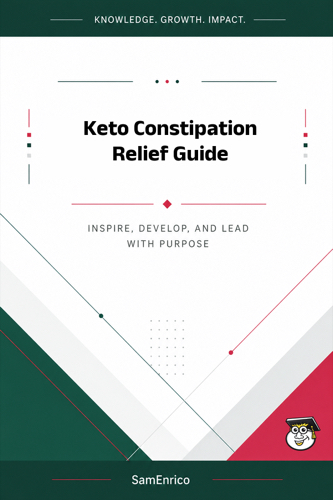
Keto Constipation Relief Guide eBook
Manage digestive issues on low carb using this pra
by Shore Wes
Manage digestive issues on low carb using this practical fiber and hydration workbook.
Formats
Free sample
Chapter 1: The Empty Colon Panic--If you are reading this sentence while sitting on a toilet, legs slightly numb, having scrolled through seventeen articles about “keto flu” and “fat adaptation” – let me tell you something no one else has. You are not broken. You are not “doing keto wrong.” And that feeling of sitting there with nothing to show for it, despite eating more vegetables than a rabbit and drinking enough water to fill a small aquarium? That is not a sign to quit. It is a sign that no one explained the single most important rule of low-carb digestion: on keto, the rules of normal bowel movements completely change.
And most advice – even from well-meaning doctors and keto influencers – makes things worse.The Terrifying Silence of a Low-Carb Gut It usually happens between day three and day seven of starting keto. You wake up, drink your morning coffee (maybe with MCT oil, because you heard it helps), and wait for the familiar morning urge. Nothing. You go about your day. Still nothing.
By day four, you start to worry. By day five, you are googling “keto constipation emergency.” By day six, you are seriously considering whether a pound of sugar-free gummy bears is a reasonable laxative (it is not – ask anyone who has made that mistake).Here is what is actually happening inside your body, and why it feels so alarming despite often being completely normal.When you eat a standard high-carb diet, your colon is constantly processing bulk. Grains, legumes, starchy vegetables, fruits – these leave behind a significant amount of indigestible residue. Your body adapts to that volume. The enteric nervous system – sometimes called your “second brain” because it contains over 500 million neurons – runs on a schedule.
It expects a certain amount of material moving through at predictable times. Motilin, a hormone that drives the migrating motor complexes (wave-like contractions that sweep the small intestine between meals), stays active because carbohydrates trigger its release.Then you start keto.Carbohydrate intake drops below 50 grams, often below 20 grams. The indigestible residue that once filled your colon – the fiber from bread, rice, beans, oats, and fruit – disappears almost overnight. Your colon, which was used to processing a certain volume, suddenly has very little to work with. Motilin levels decrease because there are fewer carbohydrate-induced signals.
The migrating motor complexes slow down. This is not disease. This is adaptation.But your brain does not know that. Your brain only knows that yesterday you pooped, and today you did not, and the day before you pooped, and now three days have passed and nothing. Fear sets in.
And fear – specifically the stress hormone norepinephrine – directly inhibits colonic motility. In other words, worrying about constipation makes actual constipation more likely.The Bristol Scale: Your New Best Friend Before we go any further, we need to establish a common language for what is actually happening in your bowel movements. Because the word “constipation” means very different things to different people. To some, it means going every other day instead of every day. To others, it means painful straining with hard pellets.
To a gastroenterologist, it means something else entirely.The Bristol Stool Scale is a medical tool developed at the University of Bristol in the 1990s, and it is the single most useful thing you can learn for understanding your own digestion. It classifies stool into seven types:Type 1: Separate hard lumps, like nuts (hard to pass)Type 2: Sausage-shaped but lumpy Type 3: Like a sausage but with cracks on the surface Type 4: Like a smooth, soft sausage or snake Type 5: Soft blobs with clear-cut edges (passed easily)Type 6: Fluffy pieces with ragged edges, mushy Type 7: Watery, no solid pieces, entirely liquid Here is the critical insight that most keto resources get wrong: Types 1 and 2 are constipation. Types 3 and 4 are normal. Types 5, 6, and 7 are increasingly loose, with Types 6 and 7 being diarrhea.Notice what is NOT on that list: frequency.The Bristol Scale does not care if you go three times a day or three times a week. It cares about consistency and ease of passage.
You can go every three days and have a perfect Type 4 – smooth, soft, passed without strain. That is not constipation. That is a low-residue diet. You can go twice a day and have painful Type 1 pellets. That is constipation, despite higher frequency.This distinction is everything.
Most people who think they are constipated on keto are actually experiencing perfectly normal low-frequency bowel movements. Their stool consistency is fine. Their transit time is simply longer because there is less material to move. The problem is not medical – it is psychological. They have been conditioned to believe that “daily” equals “healthy,” and anything less equals “blockage.”Of course, some people on keto do develop true constipation – hard, dry, painful Type 1 or Type 2 stools with straining.
That is real, and later chapters will address it comprehensively. But a significant number of readers will discover, after tracking their stool for just one week, that they were never constipated at all. They were just experiencing the normal physiological response to a low-carb diet.The Three Drivers of True Keto Constipation For those who do have true constipation – and for those who want to prevent it before it starts – we need to understand the three distinct mechanisms that cause hard, dry stool on a ketogenic diet. These are not the same causes as constipation on a high-carb diet. That is why standard advice (“eat more fiber, drink more water”) often fails or makes things worse.Driver One: The Electrolyte-Water Mismatch This is the biggest factor and the most misunderstood.
When you eat a very low-carb diet, insulin levels drop. Low insulin signals the kidneys to excrete sodium. Without adequate sodium in your bloodstream, the water you drink follows the sodium out through your urine. You can drink a gallon of water and still be functionally dehydrated at the tissue level – including the colon.Your stool requires water to stay soft. That water does not come from what you drink in the moment.
It comes from your body’s ability to retain fluid in the bowel lumen, which requires an osmotic gradient. Sodium and magnesium provide that gradient. Without them, water zips right through you and into the toilet bowl, leaving your stool dry and hard.Driver Two: The Wrong Kind of Fiber Fiber is not a single substance. It is a broad category of plant carbohydrates that humans cannot fully digest. Some fiber – soluble, gel-forming fiber – holds water like a sponge and lubricates stool.
Other fiber – insoluble, bulking fiber – adds physical mass but requires significant water to move smoothly. On a high-carb diet, insoluble fiber works fine because you are eating plenty of water-holding starches. On keto, without those starches, insoluble fiber can act like dry sawdust in your colon – packing together into a hard mass.Many keto dieters, trying to be healthy, load up on raw kale, cauliflower rice, broccoli, and Brussels sprouts. These are all high in insoluble fiber. Without enough soluble fiber and water to balance them, they can worsen constipation rather than relieve it.Driver Three: Fat Timing and Gastric Emptying A ketogenic diet is high in fat.
Fat delays gastric emptying – meaning food sits in your stomach longer. This is normal and even beneficial for satiety.…
This is the end of the free sample. Get the eBook to keep going. Buy now
About this book
Details
- Author
- Shore Wes
- Publisher
- SamEnrico
- Language
- English
- Genre
- Non-Fiction, Health & Wellness, Digestive Health
- Released
- 2026-06-09
- Pages (approx.)
- 157
- Available as
- eBook, Audiobook

Read better in the ZLOADR app
Your eBooks on your phone or tablet. Sign in with your SamEnrico account and start reading.
More by Shore Wes
 TCM Stroke RecoveryShore Wes$11.99
 Pokemon Go Outdoor BalanceShore Wes$11.99
 Formerly Incarcerated EsteemShore Wes$11.99
 The Legend of Juan 'El Rey' Machete: The Birth of Latin American BoxingShore Wes$11.99
 How to Start a Pipes and Fittings Made of Ceramics Business (Beginners Guide)Shore Wes$11.99
 How to Produce Chemical Machinery and EquipmentShore Wes$11.99
 AI Profit Margin Analysis ToolsShore Wes$12.99
 Reliability Program ManagerShore Wes$11.99
You may also like
 Hong Kong Handover 1997Dunn Johnnie$11.99
 Zumba For Postnatal Recovery CourseNeal Christian$11.99
 Zumba for BeginnersLadner Nikia$11.99
 YouTube Comment Mining GuideHumes Pandora$12.99
 Worry Box MeditationCarlin Rudy$11.99
 Workplace Stress MeditationNguyen Lynn$11.99
 Workplace Stress and Sleep RepairHawley Ivory$11.99
 Workplace Perfectionism CureDelaney Jeffry$11.99
 Workplace Injustice Anger GuideWallen Isabelle$11.99
 Work Addiction and Burnout LinkGreenwood Ester$11.99
 Women in Yoga and WellnessBeattie Galina$11.99
 Women in Stand Up ComedyChun Evangeline$11.99