
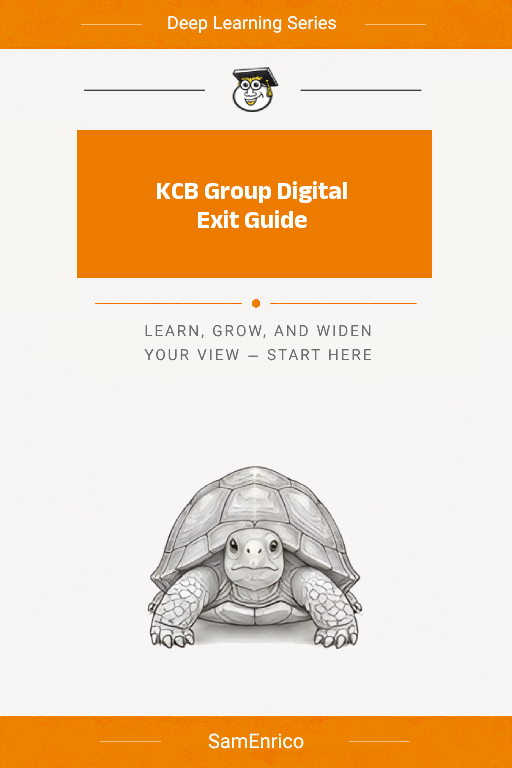
KCB Group Digital Exit Guide eBook
Sell African digital lending startups to KCB Group
Sell African digital lending startups to KCB Group or competitors, understanding bank valuation of consumer credit platforms.
Formats
Free sample
Chapter 1: The Corridor Lie--–- On a humid Tuesday morning in Nairobi’s Upper Hill district, the founder of a seven-million-dollar digital lending startup sat across from KCB Group’s Head of M&A. He had spent three months preparing his pitch deck. His loan book was clean. His NPL ratio was a respectable twelve percent. His technology worked flawlessly.
He walked into that room believing he would walk out with an offer north of twelve million dollars.He walked out with four.The banker didn’t even look at his loan book. Didn’t ask about his default rates. Didn’t want a demo of his underwriting algorithm. What the banker wanted—what he kept circling back to, again and again—was a single question: “Which markets outside Kenya can you turn on tomorrow?”The founder had no answer. He had built a beautiful lending machine for Kenyan borrowers.
He had never thought about Uganda. Never stress-tested his system for Rwanda’s mobile money interoperability rules. Never translated his compliance documentation into French for a potential DRC expansion. In the banker’s mind, that made him not a strategic asset but a feature—a slightly better version of something KCB could build internally for a fraction of the price.That founder’s name is not important. What happened to him happens every month in Nairobi, Lagos, and Johannesburg.
Fintech founders spend years perfecting their underwriting models, obsessed with the false god of loan book quality, only to discover that banks do not buy loan books. Banks buy corridors.This book exists because that founder—and hundreds like him—deserved to know the truth before they walked into that room. The truth is simple, brutal, and liberating: you are not selling a lending app. You are selling a digital corridor into markets your bank buyer cannot enter on their own. And if you do not understand what that means by the time you finish this chapter, you will leave millions—sometimes tens of millions—of dollars on the table.The Old Story That No One Tells You Is Dead For the past decade, the standard wisdom in African fintech has been deceptively simple: build a profitable lending platform, clean up your loan book, and a bank will acquire you for a multiple of book value.
This story has been repeated so often at Lagos Startup Week and Nairobi Fintech Forum that it has achieved the status of scripture. It is also dangerously wrong.The old story assumes that banks value your loan book the same way they value their own—as a portfolio of future interest payments, weighted by risk. But that assumption ignores a fundamental shift in banking strategy across sub-Saharan Africa. Traditional retail banking is dying. Not slowly, not gracefully, but in plain sight.
Between 2020 and 2025, KCB Group closed over forty physical branches. Equity Bank reduced its branch footprint by twenty-two percent. Cooperative Bank shifted more than half of its transaction volume to digital channels. These are not cost-cutting measures in the traditional sense. They are the visible symptoms of a deeper transformation: banks are no longer in the business of owning physical infrastructure.
They are in the business of owning digital access points to customers.When KCB acquired Riverbank Solutions in 2024, they did not pay a premium for Riverbank’s loan book. Riverbank had a modest lending operation at best. What KCB paid for—what they valued at nearly three times Riverbank’s book value—was the payment infrastructure and the agency banking network. Specifically, they wanted Riverbank’s “Swipe” network: forty-seven thousand airtime sellers, small shopkeepers, and roadside vendors who had been converted into human ATMs. Each of those forty-seven thousand agents represented a physical touchpoint that KCB could use to disburse loans, collect payments, and onboard customers in places where building a branch would cost half a million dollars.That is the corridor.
Not a piece of code. Not a loan book. A corridor is the combination of technology, agent networks, regulatory approvals, and customer relationships that allows a bank to enter a new market segment or geography without building from scratch. Riverbank gave KCB a corridor to the informal merchant segment. Pesapal gave KCB a corridor to small business transaction data.
The hypothetical lender that KCB’s Head of M&A rejected that Tuesday morning had no corridor—just a loan book. And a loan book without a corridor is just a spreadsheet with a heartbeat.The Gateway Theory: Your Startup as a Toll Road To understand what banks actually want, you need to abandon the vocabulary of lending and adopt the vocabulary of logistics. Think of yourself not as a fintech founder but as a toll road operator. Your technology is the pavement. Your customer relationships are the on-ramps.
Your regulatory licenses are the permits. And the bank is a trucking company that needs to move goods—in this case, capital—from Point A to Point B faster and cheaper than their competitors.This is what I call the Gateway Theory, and it is the single most important concept in this entire book. A gateway asset is any digital lending platform that gives a bank access to a customer segment or geographic market that the bank cannot reach efficiently on its own. The value of the gateway is not measured by the loans you have already originated. It is measured by the loans you could originate tomorrow—in a new city, a new country, or a new customer demographic—using the infrastructure you have already built.Let me give you a concrete example drawn from the actual term sheet of a transaction I advised on in 2025.
A Kenyan digital lender had built a consumer lending product specifically for public sector employees—teachers, nurses, police officers. Their loan book was only six million dollars, modest by any standard. But their technology allowed them to verify employment and salary data in real time through an API integration with the Teachers Service Commission. That API integration had taken eighteen months to negotiate and build. It was a nightmare of red tape, data protection reviews, and bureaucratic inertia.A South African bank looking to enter the Kenyan market valued that API integration at nearly four million dollars on its own.
Why? Because building the same integration from scratch would have taken the bank at least two years and cost them more than five million in legal fees, engineering time, and lost opportunity. The lender’s loan book was almost incidental to the deal. The bank was paying for the gateway.The Gateway Theory applies across three distinct dimensions, and you need to understand all three before you walk into any negotiation.The first dimension is geographic. A digital lender built specifically for the Kenyan market has limited value to a bank that already operates in Kenya.
But a digital lender built with regional scalability in mind—one that can be turned on in Uganda, Tanzania, and Rwanda within ninety days—has immense value to a bank trying to execute a regional expansion strategy. This is why KCB has been aggressively acquiring fintechs that can serve as beachheads into the DRC and Ethiopia. They are not buying loan books. They…
This is the end of the free sample. Get the eBook to keep going. Buy now
About this book
Details
- Author
- Cisneros Kris
- Publisher
- SamEnrico
- Language
- English
- Genre
- Non-Fiction, Business Brief
- Released
- 2026-06-01
- Pages (approx.)
- 133
- Available as
- eBook, Audiobook

Read better in the ZLOADR app
Your eBooks on your phone or tablet. Sign in with your SamEnrico account and start reading.
More by Cisneros Kris
 Depressant Recovery PlanCisneros Kris$11.99
 Palace for SeniorsCisneros Kris$11.99
 EQ For Musicians Performance GuideCisneros Kris$11.99
 Mindfulness Meditation for Teachers GuideCisneros Kris$11.99
 The Failed Exam CopingCisneros Kris$11.99
 The Loci Exam SimulatorCisneros Kris$11.99
 Bipolar Medication Adherence WorkbookCisneros Kris$11.99
 183 Day Rule ApplicationCisneros Kris$11.99
 Neith’s Veil: The Weaver of Fate and WarCisneros Kris$11.99
 The Moon Landing Conspiracy: A Time Traveler's RevelationCisneros Kris$11.99
 The Siege of Pyongyang: Fire and Steel in the Hermit Kingdom (1592)Cisneros Kris$11.99
 The Mineral Guide to Coltan (Short For Minerals of The Columbite Group)Cisneros Kris$11.99
You may also like
 Hong Kong Handover 1997Dunn Johnnie$11.99
 Zumba For Postnatal Recovery CourseNeal Christian$11.99
 Zumba for BeginnersLadner Nikia$11.99
 YouTube Comment Mining GuideHumes Pandora$12.99
 Worry Box MeditationCarlin Rudy$11.99
 Workplace Stress MeditationNguyen Lynn$11.99
 Workplace Stress and Sleep RepairHawley Ivory$11.99
 Workplace Perfectionism CureDelaney Jeffry$11.99
 Workplace Injustice Anger GuideWallen Isabelle$11.99
 Work Addiction and Burnout LinkGreenwood Ester$11.99
 Women in Yoga and WellnessBeattie Galina$11.99
 Women in Stand Up ComedyChun Evangeline$11.99