
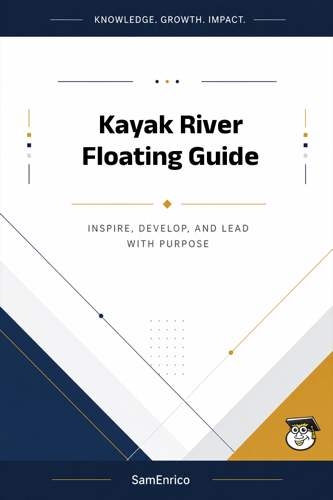
Kayak River Floating Guide eBook
Drifts downstream, feeling gentle current and bird
Drifts downstream, feeling gentle current and bird calls.
Formats
Free sample
Chapter 1: The River’s Whisper...--The first time I truly floated—not paddled, not fought, not navigated, but simply drifted—I heard something I had missed on a hundred previous trips. It was not a bird. It was not the water. It was the absence of my own effort.For years, I had approached rivers like problems to be solved. I gripped my paddle too tightly, planned every stroke, and measured success in miles covered.
Then one afternoon on a lazy stretch of Wisconsin’s Namekagon River, I did something radical: I stopped. I let my paddle rest across my thighs. I leaned back against my seat’s backband. And I did absolutely nothing.The current took over.For the next twenty minutes, I moved downstream without moving a muscle. A great blue heron lifted off from a gravel bar fifty feet away—so close I could hear the wind through its primary feathers.
A turtle the size of a dinner plate slid off a sunning log with a soft plop that barely rippled the surface. And somewhere in the trees, a kingfisher rattled a call that I had heard a thousand times but never listened to.That was the day I stopped being a paddler and became a floater.This book is for everyone who wants to have that same experience. Not the whitewater adrenaline junkie looking for the next Class IV rush. Not the fitness paddler counting strokes per minute. Not the racer chasing a personal best.
This book is for the person who buys a kayak, puts it on the car, drives to a river, and then wonders: Now what do I actually do out there?The answer is simpler and harder than you think. You do almost nothing.The Great Misunderstanding Most kayak instruction is built on a flawed premise: that the goal of being on the water is to go somewhere. Paddling manuals teach you how to move faster, turn tighter, and roll up from a capsize. They treat the river as an obstacle to be overcome, a distance to be covered, a workout to be completed.But there is another way.The word "kayak" comes from the Inuit qajaq, meaning "hunter's boat." The original kayak was not a fitness device or a thrill machine. It was a platform for stillness.
Hunters would drift for hours, silent and patient, waiting for a seal to surface or a bird to come within range. Their success depended not on how hard they paddled but on how completely they could surrender to the current while maintaining just enough control to stay safe.That is the heart of this book. I call it surrender with control—the paradoxical skill of letting the river do the work while keeping yourself out of trouble. It is the difference between fighting the current and dancing with it. Between arriving at your take-out exhausted and arriving refreshed.
Between seeing the river as a task and experiencing it as a gift.Why Floating Is Harder Than Paddling Here is a confession that surprises most beginners: learning to float well is harder than learning to paddle hard.When you paddle aggressively, you mask your mistakes. A strong forward stroke can correct a bad line. A powerful sweep stroke can overcome poor boat trim. Speed covers a multitude of sins. But when you stop paddling—when you commit to drifting—every error becomes instantly visible.
Your kayak yaws left because your gear is uneven. You spin in circles because your seat is crooked. You get pushed into a sweeper because you failed to read the current ten seconds ago.Floating reveals you.I have watched experienced whitewater paddlers fall apart on Class I rivers precisely because they could not stop working. They over-corrected. They back-paddled furiously.
They fought the very current that was trying to help them. One friend, a competent Class III boater, spent an entire five-mile float so exhausted from unnecessary strokes that he could barely lift his paddle for the final mile. Meanwhile, his twelve-year-old daughter—who had never taken a lesson—drifted effortlessly past him, having discovered by accident the secret he was too busy to find: the current knows where it is going.This chapter, and this book, will teach you to trust that knowledge.Who This Book Is For (And Who It Is Not For)Let me be clear about the reader I am writing for and the reader I am not.This book is for you if:You own a recreational kayak or sit-on-top and want to use it on slow-moving rivers (Class I and II).You are more interested in birds, quiet, and scenery than in speed, spray, and adrenaline.You want to finish your trip feeling less stressed, not more.You have ever stopped paddling just to listen, and wished you could do that more often.You are willing to learn a few technical skills (reading water, bracing, self-rescue) for the sake of safety, not for their own sake.This book is not for you if:You are planning to paddle whitewater above Class II (rapids with waves and obstacles but no significant danger).You want to learn how to roll a kayak (I will not teach it).You believe that a workout without suffering is not worth doing.You think "slow" is a four-letter word.There is nothing wrong with whitewater paddling, hard workouts, or speed. But those activities require different skills, different gear, and a different mindset than the one this book teaches. If you want to conquer rivers, put this book down and find a whitewater instructor.
If you want to listen to rivers, read on.A Note on River Classifications Throughout this book, I will refer to Class I and Class II rivers. These are the International Scale of River Difficulty categories that apply to safe, slow floating.Class I: Moving water with small waves, no significant obstacles, clear channels, easy eddies. Most slow rivers in the eastern United States, the lower Midwest, and gentle western valleys are Class I. Think of a river you could safely swim in (though you should not, as Chapter 9 explains).Class II: Straightforward rapids with wide, clear channels. Waves may be irregular but are non-hazardous.
Eddies are easy to catch. Some maneuvering is required, but a beginner with basic skills can navigate Class II safely. Think of a river where you might see small wave trains and occasional rocks to avoid.If you are unsure of a river's classification, check American Whitewater's online database or ask at a local paddling shop. When in doubt, assume it is harder than it looks. Chapter 11 will teach you how to research river flows and classifications before you go.One more thing: classification changes with water level.
A Class I river at normal flow can become Class II+ after heavy rain. A Class II river at low water can become a scrape-fest of exposed rocks. Always check the current flow rate using the USGS gauge method in Chapter 11.The Self-Assessment: Are You a Paddler or a Floater?Before we go any further, take thirty seconds to answer these five questions honestly. There are no wrong answers, but your responses will tell you…
This is the end of the free sample. Get the eBook to keep going. Buy now
About this book
Details
- Author
- Tan Nicolette
- Publisher
- SamEnrico
- Language
- English
- Genre
- Non-Fiction, Self-Help, Kayak
- Released
- 2026-06-07
- Pages (approx.)
- 136
- Available as
- eBook, Audiobook

Read better in the ZLOADR app
Your eBooks on your phone or tablet. Sign in with your SamEnrico account and start reading.
More by Tan Nicolette
 Stress and Allergies GuideTan Nicolette$11.99
 Affirmations for HSPsTan Nicolette$11.99
 Swing at SunsetTan Nicolette$11.99
 Flow in CookingTan Nicolette$11.99
 The Deep Work ScorecardTan Nicolette$11.99
 Martial Artist's HypnosisTan Nicolette$11.99
 ABCDE for Project ManagersTan Nicolette$11.99
 Whale Sharks: Largest FishTan Nicolette$11.99
 The Wolfpack Strikes: U-Boats and the Atlantic Shadow War (1940-1943)Tan Nicolette$11.99
 The Golden Girls of Algiers: How African Athletes Defied Colonialism on the World StageTan Nicolette$11.99
 Youth Cooperative Formation GuideTan Nicolette$12.99
 Chinese Supplier Exclusivity PlaybookTan Nicolette$12.99
You may also like
 Hong Kong Handover 1997Dunn Johnnie$11.99
 Zumba For Postnatal Recovery CourseNeal Christian$11.99
 Zumba for BeginnersLadner Nikia$11.99
 YouTube Comment Mining GuideHumes Pandora$12.99
 Worry Box MeditationCarlin Rudy$11.99
 Workplace Stress MeditationNguyen Lynn$11.99
 Workplace Stress and Sleep RepairHawley Ivory$11.99
 Workplace Perfectionism CureDelaney Jeffry$11.99
 Workplace Injustice Anger GuideWallen Isabelle$11.99
 Work Addiction and Burnout LinkGreenwood Ester$11.99
 Women in Yoga and WellnessBeattie Galina$11.99
 Women in Stand Up ComedyChun Evangeline$11.99