
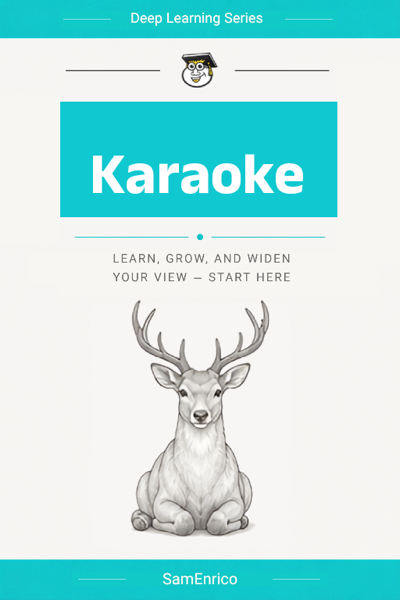
Non-FictionInformativeEducational
Karaoke eBook
A Coursebook on Karaoke
A Coursebook on Karaoke
Formats
Free sample
Chapter 1: The Seventy Percent Solution--–- On a Tuesday night in a half-empty bar called The Lucky Strike, a fifty-three-year-old accountant named Harold did something remarkable: he closed his eyes, gripped a microphone like it was the last rail on a sinking ship, and sang “Sweet Caroline” so badly that the drummer from a local cover band put down his beer to watch. Harold missed every key change, forgot the second verse entirely (substituting “something, something, baby” with the confidence of a man who believed the audience would fill in the blanks), and when he reached the “BAH BAH BAH” part, he pointed the microphone at the room like a conductor demanding a crescendo. Seventeen strangers — none of whom had spoken to each other all night — shouted back “BAH BAH BAH” with the unified enthusiasm of a church congregation. When Harold finished, the applause was not polite. It was real.
A woman in a denim jacket bought him a shot of whiskey. The KJ (Karaoke Jockey, a term we will dissect in Chapter 3) shook his hand and said, “That was terrible. Do another one.”Harold had not sung in public since his wedding twenty-two years prior, and even then, it was an accident involving an open bar and a misguided attempt at “Brown Eyed Girl.” He had no training, no range, no rhythm. What he had was something far more important, and this entire book is built around that single, counterintuitive truth: karaoke does not reward good singing. It rewards sincere participation.
You can sing like a grammatically correct computer and bore an entire room into checking their phones. Or you can sing like Harold — off-key, terrified, wholly committed — and become a local legend for forty-five seconds.This book will teach you how to be Harold. Not by making you a better singer, though we will spend time on vocal basics in Chapter 4. Not by teaching you stagecraft, though Chapter 6 will get you moving like you mean it. But by fundamentally rewiring what you believe success looks like when you hold a microphone in a bar full of strangers who have already decided they are on your side.Before we go any further, we need to get one thing straight.
You are about to read twelve chapters of practical advice, cultural history, vocal technique, and strategic song selection. But none of it will work if you do not accept the central argument of this book, stated here and repeated only when absolutely necessary: Success in karaoke is not measured by how well you sing. It is measured by whether you and at least one other person in the room feel something because you tried. That is it. Not a standing ovation.
Not a perfect score on a phone app. Not validation from the table of strangers who are filming you. One moment of genuine connection between your effort and someone else’s response. That is the seventy percent solution. The rest is technique.Why seventy percent?
Because the remaining thirty percent is preparation, song choice, and knowing how to hold a microphone without looking like you are strangling a small animal. But the majority — the overwhelming majority — of your success is determined before you open your mouth. It is determined by your willingness to be bad in public. And that, more than any high note or clever song choice, is what separates the people who have fun from the people who spend the car ride home replaying their mistakes.The Invention of the Thing That Changed Nothing (Until It Changed Everything)To understand why karaoke rewards sincerity over skill, we have to go back to where it started — not because history lessons are inherently interesting (they are not), but because the origin story reveals something deeply counterintuitive about the activity itself. Karaoke was not invented by musicians.
It was not invented by singers. It was invented by a man who could not read music and, by most accounts, was not particularly good at his own instrument.In 1971, a Japanese drummer named Daisuke Inoue was working in a host bar in Kobe, Japan. Host bars, for those unfamiliar, are establishments where businessmen go after work to be entertained by hostesses who pour drinks, light cigarettes, and engage in conversation. Music was part of the atmosphere, but live bands were expensive. Sometimes, a customer would want to sing along with a record, and Inoue would play the song on a tape deck.
The problem was that customers had terrible timing. They would start too early, end too late, or forget that verses existed between choruses.Inoue’s solution was not technological genius. It was pragmatic laziness. He took a car stereo, an 8-track tape player, a coin box, and a small amplifier, and he rigged them together into a machine that played instrumental versions of popular songs. For a fee — originally one hundred yen, about seventy American cents — a customer could sing into a microphone while the machine played the backing track.
Inoue called it the “8-Juke” (eight because of the 8-track, juke because it resembled a jukebox). He did not patent it. He did not trademark the word “karaoke,” which is a contraction of the Japanese words for “empty” (kara) and “orchestra” (okesutora). He rented the machines to bars and moved on with his life.Here is the crucial detail that most karaoke histories get wrong: Inoue was not trying to help people sing well. He was trying to help people sing at all.
The 8-Juke was not a tool for improving vocal performance. It was a tool for removing the barrier between a drunk businessman and his desire to hear his own voice projected through a loudspeaker. The empty orchestra was not a judgment on the quality of the singing. It was an invitation.This distinction matters because the entire karaoke industry that followed — the home machines, the private rooms, the competitive leagues, the pitch-scoring apps — has spent decades trying to convince you that karaoke is about accuracy. It is not.
Accuracy is a feature of karaoke the technology, not karaoke the experience. The technology can tell you if you hit the right note at the right time. The experience does not care. The experience, as Harold discovered, cares if you closed your eyes during the chorus.The Geography of Fear: Why Your Hands Shake and Why That Is Fine Before we can teach you how to sing, we have to teach you how to survive walking onto a stage that is not actually a stage — a sticky patch of floor near a speaker that someone definitely spilled a gin and tonic on twenty minutes ago. Most people never get that far.
They sit at the bar, watch the KJ’s rotation list, talk themselves into signing up, talk themselves out of signing up, and then go home having consumed six dollars worth of courage and produced zero dollars worth of memory.This is not a personality flaw. It is a biological fact. Your brain is a three-pound organ that has not updated its software in approximately two hundred thousand years. When you step onto a raised platform in front of a group of faces that are looking at you, your amygdala…
This is the end of the free sample. Get the eBook to keep going. Buy now
About this book
Details
- Author
- Norwood Maurine
- Publisher
- SamEnrico
- Language
- English
- Genre
- Non-Fiction, Informative, Educational
- Released
- 2026-05-08
- Pages (approx.)
- 135
- Available as
- eBook, Audiobook

Read better in the ZLOADR app
Your eBooks on your phone or tablet. Sign in with your SamEnrico account and start reading.
More by Norwood Maurine
 Keto For Dental Health GuideNorwood Maurine$11.99
 Overland Jordan Wadi Rum Bedouin WayNorwood Maurine$11.99
 Rehab Facility SelectionNorwood Maurine$11.99
 Men's Bone Density WorkoutNorwood Maurine$11.99
 Baldr’s Blood Oath: The Norse God Who Walked Among GreeksNorwood Maurine$11.99
 How to Produce Candy ToysNorwood Maurine$11.99
 How to Start a Mine Detectors (electronic) Business (Beginners Guide)Norwood Maurine$11.99
 Tiered Pricing to Protect Profit MarginsNorwood Maurine$12.99
You may also like
 Hong Kong Handover 1997Dunn Johnnie$11.99
 Zumba For Postnatal Recovery CourseNeal Christian$11.99
 Zumba for BeginnersLadner Nikia$11.99
 YouTube Comment Mining GuideHumes Pandora$12.99
 Worry Box MeditationCarlin Rudy$11.99
 Workplace Stress MeditationNguyen Lynn$11.99
 Workplace Stress and Sleep RepairHawley Ivory$11.99
 Workplace Perfectionism CureDelaney Jeffry$11.99
 Workplace Injustice Anger GuideWallen Isabelle$11.99
 Work Addiction and Burnout LinkGreenwood Ester$11.99
 Women in Yoga and WellnessBeattie Galina$11.99
 Women in Stand Up ComedyChun Evangeline$11.99