
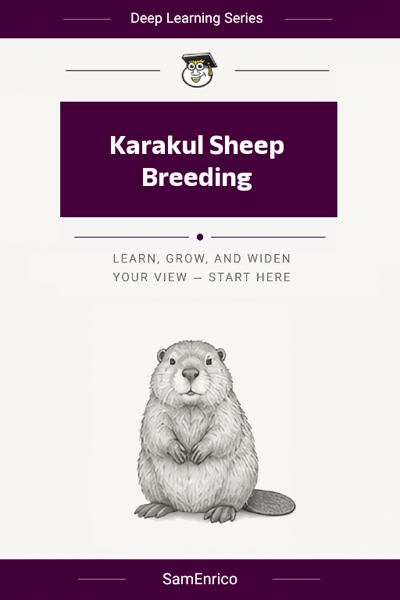
Non-FictionInformativeEducational
Karakul Sheep Breeding
A Coursebook on Karakul Sheep Breeding
by Niles Freeda
A Coursebook on Karakul Sheep Breeding
Formats
About this book
Free sample
Chapter 1: The Black Sheep’s Secret--–- The Karakul ewe stood motionless at the far end of the dusty paddock, her Roman nose lifted slightly into a wind that carried the scent of creosote bush and dry earth. She was not beautiful by conventional standards. Her wool hung in long, lustrous ringlets that had faded from jet black to a striking silver-grey—a transformation that had taken four years and would continue for four more. Her tail, broad and heavy with fat, dragged low behind her, and her ears drooped past her jawline like pendants of weathered leather. A commercial sheep breeder might have walked past her without a second glance, dismissing her as primitive, ungainly, or simply outdated.That breeder would have been wrong.
And that mistake, repeated across continents for nearly a century, is why the Karakul has become one of agriculture's most misunderstood and undervalued assets.The ewe in that paddock—let us call her Soraya, a Persian name meaning "princess" or "wealth"—carried in her genetics a suite of survival traits that modern industrial sheep breeds have largely lost. She could thrive on forage that would starve a Merino. She could walk miles to water and go days longer than any Suffolk. She could lamb unassisted in the rocks and scrub, defend her offspring with a ferocious circling defense, and raise twins on rations that would send a commercial ewe into metabolic crisis. And yet, Soraya's breed sits on the conservation watchlists of three continents, its global population a fraction of what it was fifty years ago.The contradiction at the heart of the Karakul story is simple: the same qualities that made this breed a cornerstone of pastoral economies for four thousand years have made it nearly invisible to modern agriculture.
The Karakul was too efficient, too hardy, too self-sufficient to fit into the industrial model that demands uniformity, confinement, and high-input outputs. It was bred out, not because it failed, but because it refused to fail on human terms.This chapter is an invitation to reconsider that judgment. Before we dive into the genetics of…
This is the end of the free sample. Get the eBook to keep going. Buy now
Contents
- Chapter 1
- Chapter 2
- Chapter 3
- Chapter 4
- Chapter 5
- Chapter 6
- Chapter 7
- Chapter 8
- Chapter 9
- Chapter 10
- Chapter 11
- Chapter 12
Details
- Author
- Niles Freeda
- Publisher
- SamEnrico
- Language
- English
- Genre
- Non-Fiction, Informative, Educational
- Released
- 2026-06-02
- Pages (approx.)
- 143
- Available as
- eBook, Audiobook

Read better in the ZLOADR app
Your eBooks on your phone or tablet. Sign in with your SamEnrico account and start reading.
More by Niles Freeda
 Investment Banker Stress GuideNiles Freeda$11.99
 The College Application AnxietyNiles Freeda$11.99
 The Climate Tech Event Planner GuideNiles Freeda$11.99
 Dreams And Drowning TraumaNiles Freeda$11.99
 DBT For 911 DispatchersNiles Freeda$11.99
 The Silent Kicks: Europe's Forgotten Football PioneersNiles Freeda$11.99
 Understanding Takayasu ArteritisNiles Freeda$17.99
 Pop Up Design London GuideNiles Freeda$12.99
 Humanities PhD Without PapersNiles Freeda$12.99
 How to Start a Pancake Making Business (Beginners Guide)Niles Freeda$11.99
You may also like
 Hong Kong Handover 1997Dunn Johnnie$11.99
 Zumba For Postnatal Recovery CourseNeal Christian$11.99
 Zumba for BeginnersLadner Nikia$11.99
 YouTube Comment Mining GuideHumes Pandora$12.99
 Worry Box MeditationCarlin Rudy$11.99
 Workplace Stress MeditationNguyen Lynn$11.99
 Workplace Stress and Sleep RepairHawley Ivory$11.99
 Workplace Perfectionism CureDelaney Jeffry$11.99
 Workplace Injustice Anger GuideWallen Isabelle$11.99
 Work Addiction and Burnout LinkGreenwood Ester$11.99
 Women in Yoga and WellnessBeattie Galina$11.99
 Women in Stand Up ComedyChun Evangeline$11.99