
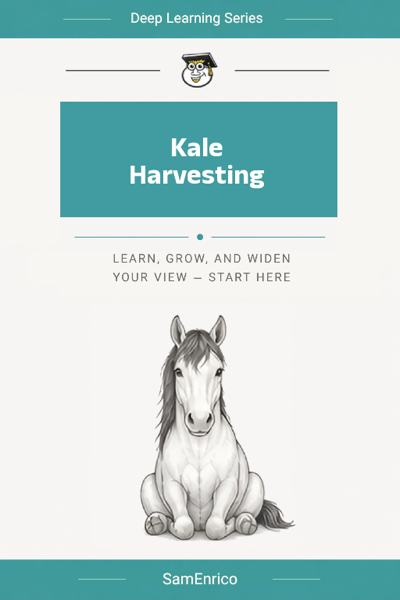
Non-FictionInformativeEducational
Kale Harvesting
A Coursebook on Kale Harvesting
A Coursebook on Kale Harvesting
Formats
About this book
Free sample
Chapter 1: The Living Plant--The first mistake most kale growers make is thinking about harvesting as something you do at the end. They imagine a single triumphant day when they walk into the garden with a basket and scissors, collect their reward, and call it finished. This is wrong in ways that will cost you pounds, flavor, and months of potential production.Harvesting is not an event. It is a conversation that begins the moment a seed touches soil. Every decision you make before that first cut—the variety you choose, the temperature you maintain, the water you provide, the care you take with the growing tip—determines whether you will harvest once or twenty times from the same plant.
This chapter rewires how you think about kale. You will learn the plant's language, its needs, its limits, and its remarkable capacity for generosity when treated correctly.Understanding the botanical identity of kale is not academic trivia. It is the key to predicting how your plants will behave. Kale, classified as Brassica oleracea var. sabellica, belongs to the same species as cabbage, broccoli, cauliflower, and Brussels sprouts.
This is crucial because all members of this species share certain traits: they prefer cool weather, they tolerate frost better than heat, and they have an indeterminate growth habit that is the foundation of multiple harvests.The term "indeterminate growth habit" sounds technical, but it describes something simple and valuable. Unlike a head of lettuce that grows to a fixed size and then stops, or a carrot that sends up a single root and then flowers, kale continues producing new leaves as long as conditions allow. The plant maintains an apical bud—the central growing tip at the crown—that constantly generates fresh leaf tissue from its meristem. Remove a lower leaf, and the apical bud keeps growing. Remove the apical bud, and the plant stops.
That single fact governs every harvesting decision you will make.This growth habit is not a human invention. It is the plant's natural architecture, evolved over millennia to survive browsing animals. In the wild, when a deer eats a…
This is the end of the free sample. Get the eBook to keep going. Buy now
Contents
- Chapter 1
- Chapter 2
- Chapter 3
- Chapter 4
- Chapter 5
- Chapter 6
- Chapter 7
- Chapter 8
- Chapter 9
- Chapter 10
- Chapter 11
- Chapter 12
Details
- Author
- Rutherford Alaina
- Publisher
- SamEnrico
- Language
- English
- Genre
- Non-Fiction, Informative, Educational
- Released
- 2026-06-02
- Pages (approx.)
- 156
- Available as
- eBook, Audiobook

Read better in the ZLOADR app
Your eBooks on your phone or tablet. Sign in with your SamEnrico account and start reading.
More by Rutherford Alaina
 Progressive Overload Explained ManualRutherford Alaina$11.99
 Sugar Reset Thirty DaysRutherford Alaina$11.99
 Genetic Testing for Hair LossRutherford Alaina$11.99
 Parent Death in Pandemic IsolationRutherford Alaina$11.99
 The Infinity Pool EdgeRutherford Alaina$11.99
 The Jade Phoenix’s Last Flight: China’s Forgotten FirebirdRutherford Alaina$11.99
 The Frozen Frontier: Unlocking the Secrets of EnceladusRutherford Alaina$11.99
 How to Start a Printing on Labels or Tags Business (Beginners Guide)Rutherford Alaina$11.99
 Understanding Gloomy Face SyndromeRutherford Alaina$17.99
 Payroll Tax Deposit TrapRutherford Alaina$12.99
 Excel for A Level EconRutherford Alaina$12.99
You may also like
 Hong Kong Handover 1997Dunn Johnnie$11.99
 Zumba For Postnatal Recovery CourseNeal Christian$11.99
 Zumba for BeginnersLadner Nikia$11.99
 YouTube Comment Mining GuideHumes Pandora$12.99
 Worry Box MeditationCarlin Rudy$11.99
 Workplace Stress MeditationNguyen Lynn$11.99
 Workplace Stress and Sleep RepairHawley Ivory$11.99
 Workplace Perfectionism CureDelaney Jeffry$11.99
 Workplace Injustice Anger GuideWallen Isabelle$11.99
 Work Addiction and Burnout LinkGreenwood Ester$11.99
 Women in Yoga and WellnessBeattie Galina$11.99
 Women in Stand Up ComedyChun Evangeline$11.99