
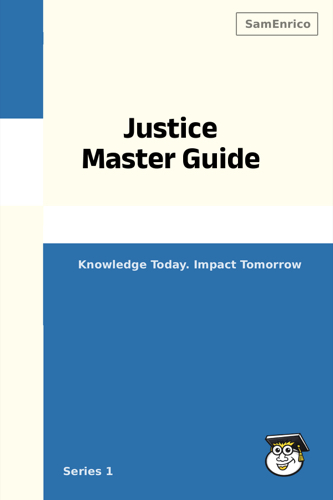
Justice Master Guide eBook
Complete collection of Supreme Court justice biogr
by Hook Odell
Complete collection of Supreme Court justice biographies.
Formats
Free sample
Chapter 1: The Weakest Branch...--–- In the winter of 1790, when the Supreme Court of the United States assembled for the first time in New York City’s Royal Exchange Building, the most powerful jurists in the land could not find a single case to hear. For two weeks, six men in powdered wigs and silk robes sat in a drafty second-floor room, waiting. No litigants appeared. No attorneys knocked. The building’s lower floor hummed with the commerce of merchants selling tobacco and grain, while above them, the third branch of the new American government waited for a job to do.
One justice, John Rutledge of South Carolina, grew so bored that he resigned after less than a year, complaining that the Court had “no energy, no weight, no efficacy.” Another, James Wilson of Pennsylvania, took to riding circuit through the wilderness on horseback, trying cases in taverns and barns because the Court lacked even a proper courthouse. This was not a failure of men. It was a failure of design. The Founding Fathers, so meticulous in crafting the powers of Congress and the presidency, had left the judiciary as an afterthought—Article III of the Constitution is shorter than the list of amendments proposed by a single state ratifying convention. The Supreme Court was, in the words of Alexander Hamilton (who defended it in Federalist No.
78), the “least dangerous” branch, possessing “neither force nor will, but merely judgment.” Hamilton meant this as reassurance. He did not realize he had written an epitaph.The story of the Supreme Court is not a story of inevitable power. It is a story of theft, improvisation, and audacity. Every ounce of authority the Court possesses today—the power to strike down laws passed by Congress, to overturn presidential actions, to reshape American society from schoolhouses to bedrooms—was seized, not granted. And the man who did the seizing was not the first Chief Justice.
He was the fourth. His name was John Marshall, and he was a cousin of Thomas Jefferson, a political rival of Thomas Jefferson, and the man who would define American law more than any president or legislator. This chapter tells the story of the Court’s first fifteen years—from the forgotten justices of the 1790s to the seismic rupture of Marbury v. Madison in 1803. It introduces the central argument of this book: the Supreme Court’s power is never static.
It must be claimed in every generation, surrendered in moments of crisis, and reclaimed in acts of judicial statesmanship. What follows is the story of the first great seizure.The Men Who Almost Weren't: The First Court When George Washington appointed the first six justices of the Supreme Court in 1789, he faced a problem that would haunt the Court for its first decade: nobody wanted the job. The Chief Justice position paid less than a decent law practice. The work required “riding circuit”—traveling on horseback through mud and snow across thousands of miles of unpaved American wilderness to hear trial cases, often sleeping in taverns next to drunkards and livestock. One justice, Thomas Johnson of Maryland, resigned after eight months, writing to Washington that the physical toll had “seriously impaired” his health.
Another, James Iredell of North Carolina, died of exhaustion at the age of forty-eight. The first Chief Justice, John Jay of New York, served for six years before resigning to become governor of his home state—a job he considered a promotion. When Washington offered the Chief Justice position to a second candidate after Jay’s departure, the man declined. When Washington offered it to a third, that man also declined. The fourth, Oliver Ellsworth of Connecticut, accepted reluctantly and spent much of his tenure suffering from kidney stones so severe that he could barely sit through oral arguments.This is not the portrait of an institution destined for greatness.
It is the portrait of a judicial afterthought.The early Court’s docket was laughably thin. Between 1790 and 1800, the justices heard fewer than one hundred cases total—about ten per year. For comparison, the modern Supreme Court receives over seven thousand certiorari petitions annually and hears about seventy cases. But the problem was not merely the quantity of litigation. The problem was the Constitution itself.
Article III granted the Court jurisdiction over “cases arising under this Constitution” and “controversies between two or more states”—but it did not explicitly grant the Court the power to declare federal laws unconstitutional. That power, known as judicial review, was a theoretical possibility discussed by Hamilton in Federalist No. 78, but it remained unproven. In the 1790s, most legal scholars assumed that Congress and the president would interpret the Constitution for themselves, with the Court serving as a minor referee on minor disputes.The first test of judicial power came in 1792, when Congress passed a law requiring the Court to hear pension claims from Revolutionary War veterans. The justices refused.
They wrote a letter to President Washington explaining that the law was “unconstitutional” because it required them to perform non-judicial duties. But note what the justices did not do: they did not issue a formal ruling striking down the law. They did not assert a general power of judicial review. Instead, they quietly registered their objection and waited for Congress to change the law. This pattern—asserting power indirectly, avoiding direct confrontation, preserving institutional legitimacy—would become the Court’s signature strategy.
But in the 1790s, it was not a strategy. It was survival.The Ghost of John Jay: Why the First Chief Justice Quit John Jay was not a mediocre man. He had negotiated the treaty that ended the Revolutionary War. He had co-authored the Federalist Papers. He had served as the first Chief Justice of the United States with intelligence and dignity.
But Jay understood something that later justices would take decades to learn: the Supreme Court was a trap. Its power was theoretical. Its prestige was nonexistent. Its work was exhausting. And its future depended on the goodwill of presidents and Congresses who had no reason to respect it.In 1795, Jay resigned to become governor of New York.
When President John Adams later offered to reappoint him as Chief Justice in 1800, Jay declined in a letter that should be carved into the walls of the Supreme Court building as a warning. “I left the bench,” Jay wrote, “perfectly convinced that under a system so defective, the Court would not obtain the energy, weight, and dignity which were essential to its affording due support to the national government.” Translation: the Court was a joke, and Jay wanted no part of it.The “defective system” Jay referred to was not just the lack of cases or the misery of circuit riding. It was the fundamental ambiguity of the Court’s role. Could the Court strike down a law passed by Congress? Nobody knew.
Could the Court order the president to do something? Probably not. Could the Court enforce its own rulings without the help of the executive branch? Certainly not. In the 1790s, the Court was a paper tiger.
And John Jay, the tiger’s first keeper, walked away because he saw no future in feeding it.Adams, desperate to fill…
This is the end of the free sample. Get the eBook to keep going. Buy now
About this book
Details
- Author
- Hook Odell
- Publisher
- SamEnrico
- Language
- English
- Genre
- Non-Fiction, Biography, Complete
- Released
- 2026-06-06
- Pages (approx.)
- 151
- Available as
- eBook, Audiobook

Read better in the ZLOADR app
Your eBooks on your phone or tablet. Sign in with your SamEnrico account and start reading.
More by Hook Odell
 Prosecution Case Sheppard MurderHook Odell$11.99
 Workplace Chemical Exposure GuideHook Odell$11.99
 Social Media and Body NeutralityHook Odell$11.99
 Low FODMAP Restaurant GuideHook Odell$11.99
 Breath for Remote WorkersHook Odell$11.99
 Teeth Falling Out DreamsHook Odell$11.99
 Offshore Oil Rig WorkerHook Odell$11.99
 Ford Personal LifeHook Odell$11.99
 The Van Gogh Heist: A Forger’s MasterpieceHook Odell$11.99
 The Lioness of Dahomey: War, Wisdom, and the Women Who Shaped an EmpireHook Odell$11.99
 The Sleeping Epidemic: When a Town Forgot to Wake UpHook Odell$11.99
 Growing SwainsoniaHook Odell$11.99
You may also like
 Hong Kong Handover 1997Dunn Johnnie$11.99
 Zumba For Postnatal Recovery CourseNeal Christian$11.99
 Zumba for BeginnersLadner Nikia$11.99
 YouTube Comment Mining GuideHumes Pandora$12.99
 Worry Box MeditationCarlin Rudy$11.99
 Workplace Stress MeditationNguyen Lynn$11.99
 Workplace Stress and Sleep RepairHawley Ivory$11.99
 Workplace Perfectionism CureDelaney Jeffry$11.99
 Workplace Injustice Anger GuideWallen Isabelle$11.99
 Work Addiction and Burnout LinkGreenwood Ester$11.99
 Women in Yoga and WellnessBeattie Galina$11.99
 Women in Stand Up ComedyChun Evangeline$11.99