
Non-FictionTrue CrimeForensic Science
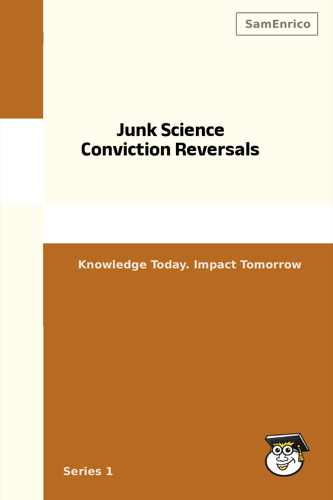
Junk Science Conviction Reversals eBook
Expose discredited forensic methods overturned by
Expose discredited forensic methods overturned by the Innocence Project through DNA evidence.
Formats
Free sample
Chapter 1: The Wizard’s Curtain...--–- On a humid Virginia morning in 1982, a young Navy sailor named Keith Allen Harward reported for duty aboard the USS Dwight D. Eisenhower. He was a heavy metal enthusiast with a tattoo of a snake on his arm, a man who spent his free time drinking beer and playing pool. He had no criminal record. He had never been in serious trouble.
By nightfall, he would be the prime suspect in a brutal murder, and within two years, he would be sentenced to life in prison based on the word of a man who had never published a single scientific study. The man who put him there was not a detective, not a prosecutor, not an eyewitness. He was a dentist.This is not a story about one bad apple. It is a story about how the American justice system spent nearly a century trusting people in lab coats who had no business calling themselves scientists. It is a story about the rise of subjective speculation disguised as objective truth, about the psychological tricks that made juries believe in magic, and about the slow, painful process of watching that magic dissolve under the cold light of DNA evidence.
Keith Harward was one of the lucky ones. He got out. But before we can understand how he—and hundreds like him—were finally freed, we must first understand how they were locked up in the first place.The Invention of Certainty For most of the 20th century, American courtrooms treated forensic "experts" as though they were infallible. A man in a lab coat with a title like "Forensic Odontologist" or "Microscopic Hair Analyst" could take the stand and declare, with absolute certainty, that a bite mark on a murder victim's arm matched the teeth of the defendant—and the jury would believe him. Not because the science was sound.
Not because the methods had been validated. But because the appearance of science was enough.The phenomenon has a name: the halo effect. When a jury sees an expert witness—someone with credentials, a fancy title, and the confident bearing of authority—they instinctively attribute to that person a range of positive qualities: intelligence, honesty, rigor, objectivity. The lab coat becomes a cloak of infallibility. The jargon becomes proof of expertise.
And the jury stops asking the most important question of all: What is the actual evidence that this method works?The problem was amplified by popular culture. In the 1980s and 1990s, television shows like Quincy, M.E. and later the CSI franchise created a generation of jurors who believed that forensic science was a magical truth-detecting machine. On television, the crime lab always had the answer. The technician always knew.
The evidence never lied. When real-life experts walked into the courtroom, jurors were already primed to trust them completely—not because of anything the expert said, but because of everything television had taught them.The result was a perfect storm of misplaced confidence. Judges, who were supposed to act as gatekeepers, routinely admitted forensic testimony without asking basic questions about its validity. Prosecutors, who had every incentive to secure convictions, eagerly presented that testimony as rock-solid truth. And juries, who had been trained by Hollywood to believe in forensic magic, nodded along.By the time the first DNA exonerations began rolling in during the 1990s, a shocking pattern emerged.
When the Innocence Project began analyzing wrongful convictions, they found that nearly half of all DNA exonerations involved misapplied or fraudulent forensic science. Not eyewitness error. Not false confessions. Not bad lawyering—though those played a role too. Junk science.
Method after method, case after case, the same story repeated: an expert with no data, no validation, and no accountability had sent an innocent person to prison based on nothing more than subjective speculation dressed up in scientific clothing.The Many Births of Junk Science It is important to understand that junk science did not emerge all at once, from a single source, at a single moment in history. Different forensic disciplines were invented at different times, by different people, under different circumstances. But they all share the same fatal flaw.Some of the oldest junk disciplines date back to the 1920s. Microscopic hair comparison, for example, was pioneered by law enforcement officers who noticed that human hairs looked different under a microscope. That observation was true.
The problem was that no one had ever studied how distinctive those differences actually were. Could two different people have hairs that looked the same? Could the same person have hairs that looked different? No one knew. But that didn't stop experts from testifying that a hair found at a crime scene "matched" a hair taken from a suspect.
Jurors heard "match" and thought "certainty." What the experts should have said was: I looked at these two hairs and they look similar, but I have no idea how common these characteristics are or how likely it is that someone else would have the same features. That honest statement would have been scientifically accurate. It also would have been useless to prosecutors, so it was never uttered.Arson investigation followed a similar trajectory. For decades, firefighters and self-taught "experts" claimed they could identify the origin of a fire by looking at "burn patterns" on the floor. Certain patterns, they said, indicated the use of accelerants like gasoline.
Certain "alligatoring" of wood—the formation of large blisters on burned surfaces—supposedly proved a fire was deliberately set. These claims were passed down from mentor to apprentice, repeated in training manuals, and presented in courtrooms as settled science. They were, in fact, nothing more than old wives' tales. When actual fire scientists finally began studying the question in the 1990s, they discovered that the supposed patterns were meaningless. Wood blisters the same way regardless of how the fire started.
But by then, dozens of people had been convicted of arson—and some had been executed—based on folklore masquerading as expertise.Then came the 1970s and 1980s, when a new wave of junk disciplines emerged. The most egregious of these was bite mark analysis, or "forensic odontology," which would become the central villain of this book's early chapters. A small group of dentists, without any population studies, error-rate data, or peer-reviewed validation, declared themselves capable of identifying a perpetrator by a bruise on a victim's skin. They testified to "virtual certainty." They claimed that a human bite was as unique as a fingerprint. They had absolutely no data to support this claim.
They still don't. But that didn't stop them.Other disciplines from this era include blood spatter analysis (pioneered by a criminalist named Herbert Mac Donell, who had no formal training in physics or fluid dynamics and whose methods were never validated), voice spectrometry (which claimed that a person's voiceprint was as unique as a fingerprint—a claim that has been thoroughly debunked), and shoeprint and tire print analysis (which suffers from the same problem as hair comparison: experts can say two prints look similar, but they cannot say how rare those characteristics are).Each of these disciplines emerged from a different corner of the forensic world. Each was invented by different…
This is the end of the free sample. Get the eBook to keep going. Buy now
About this book
Details
- Author
- Springer Mariann
- Publisher
- SamEnrico
- Language
- English
- Genre
- Non-Fiction, True Crime, Forensic Science
- Released
- 2026-06-06
- Pages (approx.)
- 153
- Available as
- eBook, Audiobook

Read better in the ZLOADR app
Your eBooks on your phone or tablet. Sign in with your SamEnrico account and start reading.
More by Springer Mariann
 Retirement Home Appraisal Disputes ManualSpringer Mariann$11.99
 Outsourcing for Sales TeamsSpringer Mariann$11.99
 Men's Plant Sterol Cholesterol CourseSpringer Mariann$11.99
 The Silent Takeover: How a Tech Titan Bought HollywoodSpringer Mariann$11.99
 The Whalebone Hunters: Unveiling the Leviathans of the Indian OceanSpringer Mariann$11.99
 Understanding Chromosome 12p DeletionSpringer Mariann$17.99
 Anti Corruption Vendor GuideSpringer Mariann$12.99
 Cloud Storage RetentionSpringer Mariann$12.99
 How to Start a Automatic Gun Business (Beginners Guide)Springer Mariann$11.99
 StonemasonSpringer Mariann$11.99
You may also like
 Hong Kong Handover 1997Dunn Johnnie$11.99
 Zumba For Postnatal Recovery CourseNeal Christian$11.99
 Zumba for BeginnersLadner Nikia$11.99
 YouTube Comment Mining GuideHumes Pandora$12.99
 Worry Box MeditationCarlin Rudy$11.99
 Workplace Stress MeditationNguyen Lynn$11.99
 Workplace Stress and Sleep RepairHawley Ivory$11.99
 Workplace Perfectionism CureDelaney Jeffry$11.99
 Workplace Injustice Anger GuideWallen Isabelle$11.99
 Work Addiction and Burnout LinkGreenwood Ester$11.99
 Women in Yoga and WellnessBeattie Galina$11.99
 Women in Stand Up ComedyChun Evangeline$11.99