
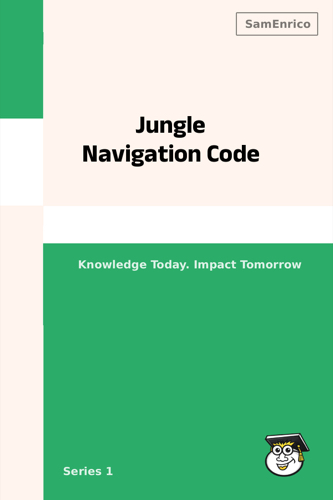
Jungle Navigation Code eBook
Decode complex routes using wisdom from Amazon exp
Decode complex routes using wisdom from Amazon explorers who hacked through uncharted terrain.
Formats
Free sample
Chapter 1: The Blank Screen--The GPS screen was white. Not blue with a blinking dot. Not gray with the words “signal lost.” White. Empty. A perfect rectangle of nothing, as if the device had forgotten it was ever meant to show anything at all.The hiker stared at it for thirty seconds, then shook it.
Nothing. He held it above his head, angling for a gap in the canopy. A sliver of sunlight pierced through the ceiba trees, hit the antenna, and the screen flickered—once, twice—then went white again. He was standing in the middle of the Amazon Basin, one hundred kilometers from the nearest road, and his $800 navigation device was a brick.He had done everything right. He had downloaded the maps before leaving Manaus.
He had packed spare batteries. He had marked his starting coordinates. But the jungle had done what jungles always do: it had reached up and swallowed the sky. The canopy here was forty meters high, a living ceiling of leaves, vines, and epiphytes so dense that the forest floor received less than one percent of the sunlight above. Satellite signals, which travel 20,000 kilometers from orbit to Earth, could not penetrate those final forty meters of vegetation.The hiker was not stupid.
He was a software engineer from Seattle, and he had solved impossible problems before. He had debugged code that three hundred engineers had given up on. He had restructured databases that had crashed multinational corporations. But now, standing in the wet heat with a useless GPS in his hands, he realized something terrifying: he had no idea where he was. Not in the philosophical sense.
In the literal, physical, cartographic sense. He could have been ten meters from a village or ten days from one. The white screen told him nothing, and the green world around him told him everything—but he had forgotten how to read it.This is the Canopy Problem.The Architecture of Blindness Every navigation system has a point of failure. For GPS, it is the canopy. For maps, it is the terrain that has changed since the last survey.
For compasses, it is magnetic interference from iron-rich soil. For the human eye, it is the darkness that falls in the jungle at four in the afternoon, when the canopy turns the sky from blue to black in twenty minutes.But the most dangerous navigation system is not the one that fails. It is the one that you trust so completely that you stop paying attention to everything else.Call this instrument myopia: the tendency to trust a single data source even when it contradicts observable reality. Instrument myopia is what kills explorers, crashes airplanes, and bankrupts companies. It is the pilot who flies into a mountain because the altimeter said he was higher than he was.
It is the CEO who launches a failed product because the focus groups said it would succeed. It is the hiker in the Amazon who walks deeper into the jungle because the GPS said there was a trail—and never looks up to see that the trail ended a kilometer ago.The word “myopia” comes from the Greek myein (to close) and ops (eye). Instrument myopia is the voluntary closing of your own eyes. You have the data. You have the senses.
But you choose to believe the machine instead.Paul Colinvaux, the American paleoecologist who spent decades exploring the Amazon before GPS existed, understood instrument myopia intuitively. He never called it that. He called it “listening to the tool instead of the forest.” In his memoir Amazon Expeditions, he described watching a young researcher spend forty-five minutes trying to get a satellite phone to work while standing directly under a tree that had clear scratch marks from a jaguar’s claws. “The boy was about to be eaten,” Colinvaux wrote, “and he was worried about his ringtone.”Colinvaux’s point was not that technology is useless. It was that technology is only useful when you remember its limitations.
A GPS works perfectly in an open field. It works poorly under a canopy. A compass works perfectly away from iron deposits. It fails completely on a ship made of steel. A map works perfectly if the cartographer had good information.
It fails completely if the river changed course last season.The first step in navigation is not reaching for a tool. The first step is asking: What am I not seeing?Defining True North Before we go any further, we need to agree on what we are trying to find. This book promises to help you “find True North in business and life,” but that phrase has been used so often that it has lost its meaning. Leadership books use it to mean purpose. Spiritual books use it to mean enlightenment.
Self-help books use it to mean happiness. These are all fine things, but they are not navigation points. You cannot plot a course to “happiness” any more than you can sail to “Tuesday.”Here is what True North means in the Jungle Navigation Code:True North is your non-negotiable destination. Not where you have been. Not a feeling.
A fixed point you can actually reach.That’s it. True North is not your life’s purpose. It is not your deepest values. It is the specific, concrete outcome that you are trying to achieve. For an explorer in the Amazon, True North might be a particular river junction at a particular latitude and longitude.
For a startup founder, True North might be $10 million in annual recurring revenue. For a new parent, True North might be getting the baby to sleep through the night. For a person in recovery, True North might be one year sober.True North has three properties:It is measurable. You know when you have arrived because the world tells you so. The river junction is there or it is not.
The revenue is $10 million or it is not. The baby sleeps or it does not. The sobriety is 365 days or it is not.It is fixed. True North does not move while you are trying to reach it. If your destination changes every week, you are not navigating; you are wandering.
Wandering is fine for poetry. It is fatal for survival.It is external. True North exists outside your head. It is not a feeling, a hope, or a dream. It is a fact in the world.
You can find it because it is there, whether you believe in it or not.Here is what True North is not:Not your starting point. Some people confuse True North with “going back to how things were.” That is not navigation. That is nostalgia. Navigation moves forward.Not a feeling. You may feel happy when you reach True North.
You may feel terrified. Feelings are irrelevant to navigation. The only question is: Are you there yet?Not someone else’s destination. You cannot navigate to your boss’s True North, your spouse’s True North, or your culture’s True North. You can choose to help someone else reach their destination.
But that is a different journey.We will return to True North in every chapter of this book. By the time…
This is the end of the free sample. Get the eBook to keep going. Buy now
About this book
Details
- Author
- Martel Demetria
- Publisher
- SamEnrico
- Language
- English
- Genre
- Non-Fiction, Biography, Geography
- Released
- 2026-06-05
- Pages (approx.)
- 121
- Available as
- eBook, Audiobook

Read better in the ZLOADR app
Your eBooks on your phone or tablet. Sign in with your SamEnrico account and start reading.
More by Martel Demetria
 The Anger and Betrayal HealingMartel Demetria$11.99
 Sugar Alternatives for Sweet CravingsMartel Demetria$11.99
 Gas Warfare First UseMartel Demetria$11.99
 Caregiving For Alcoholic ParentMartel Demetria$11.99
 Confucius Institute Scholarship GuideMartel Demetria$12.99
 SNRI VenlafaxineMartel Demetria$11.99
 Social Media Shopping PressureMartel Demetria$11.99
 Cholesterol Lowering FoodsMartel Demetria$11.99
 The Invisible Light: Huygens and the Birth of Wave TheoryMartel Demetria$11.99
 The Witches of Quebec: Hysteria, Justice, and the Power of FearMartel Demetria$11.99
 How to Produce Holiday Ornament HooksMartel Demetria$11.99
 How to Start a Edible Oil and Fat Processing Machinery Business (Beginners Guide)Martel Demetria$11.99