
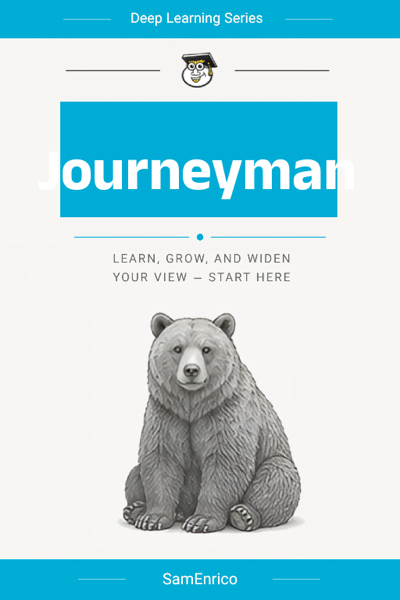
Non-FictionInformativeEducational
Journeyman eBook
A Coursebook on Journeyman
A Coursebook on Journeyman
Formats
Free sample
Chapter 1: The Certification Lie...--–- You have a license in your wallet. You passed the exam. Maybe you even framed the certificate and hung it in your garage. And yet, something feels wrong. You show up to job sites with your shiny new credential, and the first time you encounter a situation the exam never covered – a foundation that's two inches out of square, a homeowner who changed their mind three times before lunch, a general contractor who expects miracles on a budget that wouldn't cover your truck payment – you feel exactly like you did as a first-year apprentice.
Lost. Exposed. Waiting for someone to realize you don't actually know what you're doing.That feeling has a name. It's called the certification gap, and every newly licensed journeyman falls into it. The gap is the distance between what your exam proved you know – code references, safety protocols, basic theory – and what you actually need to survive on a real job site.
The exam is a snapshot of minimum competence. The job site is a living, breathing chaos machine that will punish you for treating it like a textbook.This chapter exists to close that gap. Not by teaching you new tricks – you'll get plenty of those in later chapters – but by reframing everything you thought you knew about what it means to be a journeyman. The license is not an achievement. It is a permission slip.
It is the trade's way of saying, "Congratulations, you are now qualified to begin learning what we couldn't teach you in school."If that sounds harsh, good. The single most expensive mistake you can make as a new journeyman is believing that passing the exam made you an expert. It didn't. It made you eligible to become one. The difference between eligibility and expertise is measured in callbacks, in bruised knuckles, in jobs that went twenty percent over budget, and in the quiet humiliation of realizing that the apprentice you're supposed to be leading just asked a question you cannot answer.The good news is that the certification gap is temporary.
It lasts about eighteen to twenty-four months for most journeymen, provided they approach it correctly. The bad news is that most journeymen never actually close the gap – they just learn to fake it well enough to avoid getting fired. They become what the industry calls "perpetual intermediates": competent enough to pass inspection, but never truly excellent. They are the ones who still charge by the hour at fifty years old because they never learned to price value. They are the ones whose bodies give out at fifty-five because they never learned to work smart.
They are the ones who blame the apprentice, the general contractor, the homeowner, the supplier – anyone but themselves.You are not going to be one of those journeymen. That is why you are reading this book.This chapter will teach you three things. First, why the exam lied to you – not maliciously, but inevitably – and what the exam actually measures versus what the job actually requires. Second, the real relationship between speed and quality, and why believing they trade off against each other has cost you more money than you realize. Third, the single most powerful tool you already own but have been using wrong: the checklist, and why experts depend on it while amateurs dismiss it as beginner stuff.By the end of this chapter, you will understand why the most successful journeymen you know seem to work slower than everyone else but finish faster.
You will know why the old-timer who measures twice and cuts once is not being cautious – he is being efficient. And you will have a new definition of proficiency: not the ability to do something right once, but the ability to do it right every time, at speed, without thinking, while the world burns down around you.Let us begin.What the Exam Actually Measures The journeyman exam is not designed to create great tradespeople. It is designed to create safe ones. There is a difference, and understanding that difference is the first step out of the certification gap.The exam tests your knowledge of the code – the National Electrical Code, the International Plumbing Code, the International Residential Code, depending on your trade. It tests your ability to calculate loads, size pipes, determine venting requirements, and identify prohibited installations.
It tests your memory of safety protocols and your understanding of basic physics as it applies to your trade.What the exam does not test is equally important. It does not test your ability to read a set of plans that were drawn by an architect who has never swung a hammer. It does not test your ability to manage a customer who changes their mind after the wall is closed. It does not test your ability to lead an apprentice who is hungover, distracted, or simply untrained. It does not test your ability to estimate how long a job will actually take, accounting for the fifteen trips to the truck, the forty-five minutes spent looking for a tool you just set down, and the two hours lost to a supplier who sent the wrong part.The exam assumes a perfect world.
The job site is not a perfect world. The exam assumes you have unlimited time to consult the code book. The job site assumes you have a general contractor asking, "Are you done yet?" every forty-five minutes. The exam assumes you are working with new materials in ideal conditions. The job site assumes you are retrofitting a hundred-year-old house where nothing is square, nothing is level, and the previous tradesperson appears to have been working blindfolded.Here is the truth that no trade school will tell you: the exam is a test of minimum competence for a reason.
The licensing board does not care if you are a great tradesperson. They care if you are a dangerous one. Their job is to keep the public safe from people who do not know which wire carries current or which pipe carries sewage. Your job – now that you have the license – is to become great. The exam got you to the starting line.
It did not run the race for you.This is not an indictment of the licensing system. The system works exactly as intended. It filters out the truly incapable and gives the rest of you permission to work. But permission is not preparation. A driver's license does not make you a race car driver, and a journeyman license does not make you a master of your craft.
It makes you legally eligible to practice. What you do with that eligibility is entirely up to you.The most dangerous mindset you can adopt at this stage is the belief that the license is the finish line. It is not. It is the starting line. The real race – the one that separates the journeymen who retire wealthy from the ones who retire broken – is just beginning.The Speed Trap: Why Faster Is Not Better There is a persistent myth in the trades that speed and quality are enemies.
The myth says you can work fast, or you can work well, but you cannot do both. This myth is…
This is the end of the free sample. Get the eBook to keep going. Buy now
About this book
Details
- Author
- Okeefe Jeraldine
- Publisher
- SamEnrico
- Language
- English
- Genre
- Non-Fiction, Informative, Educational
- Released
- 2026-05-11
- Pages (approx.)
- 150
- Available as
- eBook, Audiobook

Read better in the ZLOADR app
Your eBooks on your phone or tablet. Sign in with your SamEnrico account and start reading.
More by Okeefe Jeraldine
 Mindful Listening PracticeOkeefe Jeraldine$11.99
 Solntsevskaya Bratva GuideOkeefe Jeraldine$11.99
 One Month Spending Fast CourseOkeefe Jeraldine$11.99
 Sugar Addiction in Recovery from AlcoholOkeefe Jeraldine$11.99
 Dream Career Guidance JournalOkeefe Jeraldine$11.99
 The Last Waltz: A Love Story in the Shadows of WarOkeefe Jeraldine$11.99
 The Kite That Soared: Ancient Southeast Asia's First Flight PioneersOkeefe Jeraldine$11.99
 Local Manufacturing AdvantageOkeefe Jeraldine$12.99
 Assessment Method CompareOkeefe Jeraldine$12.99
 Understanding Congenital Adrenal Hyperplasia, LipoidOkeefe Jeraldine$17.99
 How to Start a Motors for Aircraft Business (Beginners Guide)Okeefe Jeraldine$11.99
You may also like
 Hong Kong Handover 1997Dunn Johnnie$11.99
 Zumba For Postnatal Recovery CourseNeal Christian$11.99
 Zumba for BeginnersLadner Nikia$11.99
 YouTube Comment Mining GuideHumes Pandora$12.99
 Worry Box MeditationCarlin Rudy$11.99
 Workplace Stress MeditationNguyen Lynn$11.99
 Workplace Stress and Sleep RepairHawley Ivory$11.99
 Workplace Perfectionism CureDelaney Jeffry$11.99
 Workplace Injustice Anger GuideWallen Isabelle$11.99
 Work Addiction and Burnout LinkGreenwood Ester$11.99
 Women in Yoga and WellnessBeattie Galina$11.99
 Women in Stand Up ComedyChun Evangeline$11.99