
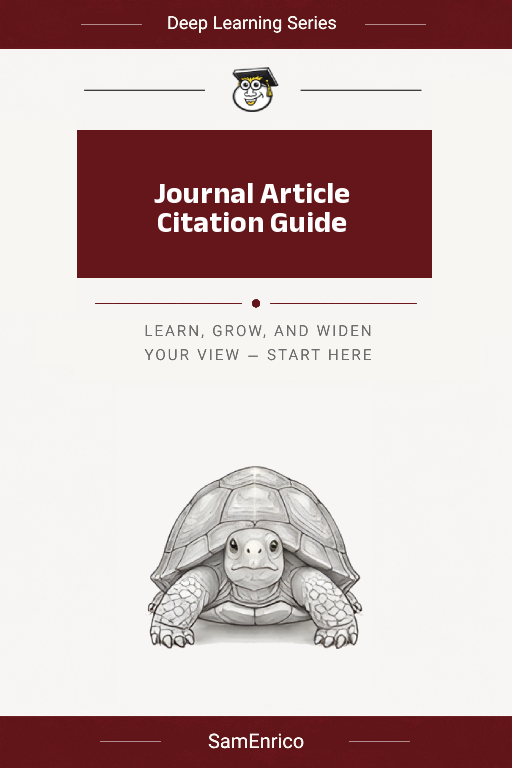
Journal Article Citation Guide
Cite print and online journal articles with DOI or
Cite print and online journal articles with DOI or URL in any style.
Formats
About this book
Free sample
Chapter 1: The Author Labyrinth--Every citation begins with a name. It seems simple enough, yet this single element—the author—is where more citations go wrong than anywhere else. Students lose points, researchers face rejection letters, and editors sharpen their red pens all because someone typed “et al.” too early, reversed the order of initials, or misread a hyphenated surname. The irony is that the rules for authors are entirely logical once you understand that each style guide answers one question differently: How many names do I list before I stop?This chapter solves the Author Problem once and for all. By the end, you will know exactly how to handle one author, three authors, ten authors, institutional authors, and even that nightmare scenario of a Hungarian surname with two hyphens and a roman numeral suffix.
You will also understand why “et al.” is simultaneously the most useful and most abused abbreviation in academic writing.The Five-Style Framework Before diving into the rules, a quick reminder of the five styles covered throughout this book: APA (American Psychological Association, 7th edition), MLA (Modern Language Association, 9th edition), Chicago (Chicago Manual of Style, 17th edition, notes-bibliography system), AMA (American Medical Association, 11th edition), and ACS (American Chemical Society, 3rd edition). Each style was developed for a different discipline, which explains why they treat authors differently.APA is used in psychology, education, and the social sciences. It prioritizes publication date because those fields value timeliness. MLA is used in literature and languages; it prioritizes the author’s full name because humanities scholars care deeply about who said what. Chicago is used in history and some social sciences; it offers flexibility between notes and author-date systems.
AMA is used in medicine; it demands extreme efficiency because medical references are numerous. ACS is used in chemistry; it requires precision and uses semicolons where others use commas.You do not need to memorize every rule today. You do need to know where to look and how to apply the rule to your specific situation.The One-Author Citation Let us start with the simplest case: a single author. Every style…
This is the end of the free sample. Get the eBook to keep going. Buy now
Contents
- Chapter 1
- Chapter 2
- Chapter 3
- Chapter 4
- Chapter 5
- Chapter 6
- Chapter 7
- Chapter 8
- Chapter 9
- Chapter 10
- Chapter 11
- Chapter 12
Details
- Author
- Koenig Margrett
- Publisher
- SamEnrico
- Language
- English
- Genre
- Non-Fiction, Student's Shortcut
- Released
- 2026-05-30
- Pages (approx.)
- 142
- Available as
- eBook, Audiobook

Read better in the ZLOADR app
Your eBooks on your phone or tablet. Sign in with your SamEnrico account and start reading.
More by Koenig Margrett
 The Team Idea SaturationKoenig Margrett$11.99
 Thunberg Climate Activism RiseKoenig Margrett$11.99
 Student Fear of Failure GuideKoenig Margrett$11.99
 Pilot Program Validation MethodKoenig Margrett$11.99
 Stay at Home Parent BurnoutKoenig Margrett$11.99
 Defensive Adjustments MasteryKoenig Margrett$11.99
 The Power of Spoken AffirmationsKoenig Margrett$11.99
 Hubert Humphrey HappyKoenig Margrett$11.99
 Habit Research GuideKoenig Margrett$11.99
 The Timbuktu Calculators: How African Scholars Tamed the Numbers of the CosmosKoenig Margrett$11.99
 The Silent Plague: How a Forgotten Physician Outsmarted the Black DeathKoenig Margrett$11.99
 Smugglers' Moon: The Untold Story of the 1972 Cocaine CoupKoenig Margrett$11.99
You may also like
 LSE Online Program LengthAgee Letisha$11.99
 Harvard Extension School for Working AdultsRoush Yer$11.99
 LSE Online Reading ListAshford Ludivina$11.99
 LSE Online Language RequirementsWhitten Daphine$11.99
 LSE Online Class SizeHughey Garret$11.99
 LSE Online Alumni MentorshipWild Lyla$11.99
 London School of Economics Alumni NetworkDutton Chantal$11.99
 Harvard Extension School Student SupportCantrell Christene$11.99
 Harvard Extension School Library AccessSantana Adah$11.99
 Harvard Extension School Degree CompletionBray Wyatt$11.99
 Harvard Extension School Course AuditingAbbott Craig$11.99
 Harvard Extension School Extension DiplomaNew Joane$11.99