
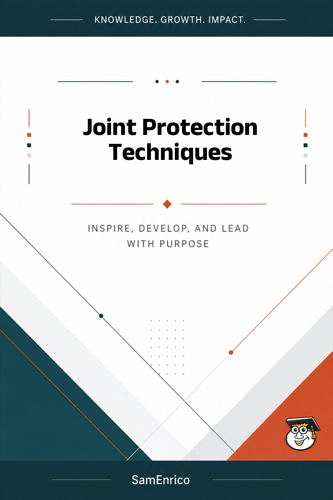
Joint Protection Techniques eBook
Learn ergonomic ways to perform daily tasks while
by Ring August
Learn ergonomic ways to perform daily tasks while preserving arthritic joints.
Formats
Free sample
Chapter 1: The Pain Lie...--–- Margaret was 54 years old when she cried in a pharmacy parking lot. Not because of the diagnosis—she had already accepted that. Not because of the medication costs—insurance covered most of it. Margaret cried because she had just spent twelve minutes trying to open the child-proof cap on her own prescription bottle. Twelve minutes.
Her fingers, twisted by fifteen years of rheumatoid arthritis, simply would not cooperate. A woman who had once sutured wounds in an emergency room, who had held surgical forceps for twelve-hour shifts, who had delivered thirty-seven babies with her own two hands—that same woman sat in a Honda Civic, weeping over a plastic bottle because she could not summon the grip strength to access her own medicine.This is not a story about weakness. This is a story about the lie we have all been told.The lie is simple, seductive, and everywhere. It whispers: Pain is your enemy. Push through it.
No pain, no gain. If it hurts, you are doing something right. Pain is weakness leaving the body. We hear it from gym trainers, from well-meaning spouses, from that one coworker who proudly describes finishing a marathon on a fractured foot. We hear it so often that we stop questioning it.
We internalize it. We build identities around it.But for the fifty-eight million Americans living with arthritis—and the billions worldwide—this lie is not just false. It is dangerous. It is destructive. It is the reason Margaret’s fingers now look like twisted tree roots when they could have been preserved with different habits started twenty years ago.
The lie tells us that pain is a wall to smash through. The truth—the truth this entire book is built upon—is that pain is a signal. And learning to read that signal is the single most important skill you will ever develop.This chapter is called The Pain Lie because we need to start by unlearning. Before we talk about ergonomic keyboards, jar openers, or the perfect way to get out of bed, we need to talk about what pain actually is, what arthritis actually does to your body, and why everything you think you know about “pushing through” is slowly destroying your joints.The Anatomy of a Joint: Your Body’s Engineering Miracle Let us begin with a simple fact: your joints are not designed to last forever. They are designed to last about as long as a human being would naturally live in the absence of modern medicine—roughly forty to fifty years.
The fact that many of us live into our eighties and nineties is a triumph of medicine, sanitation, and nutrition. But it also means our joints are being asked to perform beyond their evolutionary warranty. This is not a design flaw. It is a timeline mismatch.A joint, in its simplest definition, is where two bones meet. But calling it a “meeting” is like calling a Formula One pit crew a “group of people standing near a car.” What actually happens inside a healthy joint is a symphony of interdependent systems, each one exquisitely tuned to reduce friction, absorb shock, and distribute load.Cartilage is the first and most famous component.
It is that smooth, white, glistening tissue that caps the ends of your bones. Cartilage has no blood supply of its own—it is avascular, meaning it receives no direct blood flow. Instead, it is bathed in synovial fluid, which we will discuss in a moment. Cartilage is remarkable not because it is hard—it is actually softer than bone—but because it is slippery. The coefficient of friction in human cartilage is lower than that of ice on ice.
Lower than Teflon on Teflon. You could rub two pieces of healthy cartilage together for hours, and they would generate less friction than a single sheet of paper sliding across a table.But cartilage has a fatal flaw: it does not heal. Not really. Minor injuries to cartilage can be patched by the body, but once cartilage is worn away, it is gone forever. This is why osteoarthritis is called a “wear-and-tear” disease.
The cartilage thins, then cracks, then flakes away, until eventually you have bone grinding against bone. And bone, unlike cartilage, is packed with nerve endings.The synovium is the second critical component. This is the thin membrane that lines the inside of your joint capsule. It produces synovial fluid—that egg-white-like liquid that nourishes cartilage and provides lubrication. In a healthy joint, the synovium produces just enough fluid to keep things moving smoothly.
In rheumatoid arthritis, however, the synovium becomes inflamed. It thickens. It produces too much fluid, then the wrong kind of fluid. The joint swells. The fluid becomes inflammatory rather than protective.
Over time, this chronic inflammation does not just hurt—it actively destroys cartilage, erodes bone, and loosens ligaments.Ligaments are the third player. These are tough, fibrous bands that connect bone to bone, holding the joint together like industrial-strength rubber bands. Ligaments are not very stretchy—they are designed to be taut, providing passive stability. When ligaments are damaged by chronic inflammation or repeated injury, the joint becomes loose. Unstable.
This is why people with advanced arthritis often describe their joints as “giving way” or “buckling.” The ligaments can no longer do their job.Here is what most people do not understand: arthritis is not one disease. It is an entire category of conditions, each with its own mechanism, its own trajectory, and its own joint protection strategies. The two most common forms are osteoarthritis and rheumatoid arthritis, and confusing them is like confusing a house fire with a flood. Both destroy the home. Both require urgent action.
But the tools you use to fight one will not help with the other.Osteoarthritis: The Quiet Wrecking Ball Osteoarthritis is the most common form of arthritis, affecting approximately thirty-two million Americans. It is sometimes called “wear-and-tear arthritis,” but that name is misleading. It implies that OA is simply the result of using your joints too much, like the tread wearing off a tire. This is not accurate. If it were, every marathon runner would have severe OA, and every sedentary person would have pristine joints.
The reality is more complicated.Osteoarthritis begins when the delicate balance between cartilage breakdown and cartilage repair tips toward breakdown. Your body is constantly remodeling your joints—breaking down old cartilage cells and building new ones. In a healthy joint, this process is in equilibrium. In OA, something disrupts that equilibrium. Genetics play a role.
Past injuries play a massive role—a single serious knee injury increases your risk of OA in that knee by more than 400 percent. Obesity plays a role, not just because of the extra weight but because fat tissue produces inflammatory chemicals that accelerate cartilage breakdown.As OA progresses, the cartilage becomes rough and pitted. The smooth, ice-like surface becomes more like sandpaper. The body tries to compensate by growing new bone—osteophytes, or bone spurs—which actually make things worse by limiting range of motion and grinding against surrounding tissues. Eventually, the cartilage wears away completely, and you have bone-on-bone contact.
This is when the pain becomes severe, because bone is exquisitely innervated with pain fibers.Here is what you need to…
This is the end of the free sample. Get the eBook to keep going. Buy now
About this book
Details
- Author
- Ring August
- Publisher
- SamEnrico
- Language
- English
- Genre
- Non-Fiction, Health & Wellness, Ergonomics
- Released
- 2026-06-12
- Pages (approx.)
- 155
- Available as
- eBook, Audiobook

Read better in the ZLOADR app
Your eBooks on your phone or tablet. Sign in with your SamEnrico account and start reading.
More by Ring August
 Fiji Water Processor MemoirRing August$11.99Fiji Water Processor MemoirRing August$11.99
 TikTok Scroll Trap WorkbookRing August$11.99
 Burnout Recovery Therapy GuideRing August$11.99
 The Chase Bank International GuideRing August$11.99
 The Last Stand of the Sepoys: How a Mutiny Ignited a RevolutionRing August$11.99
 Undergraduate Scholarships KoreaRing August$12.99
 Coffee Traceability GuideRing August$12.99
 How to Become a Lift-slab OperatorRing August$11.99
 Understanding Severe Combined Immunodeficiency (Scid)Ring August$17.99
 Sales ClerkRing August$11.99
You may also like
 The Nap Chair Selection GuideSpringer Douglass$11.99
 Tension Headache Posture Correction GuideDyer Miquel$11.99
 Nap Chair Positioning GuideLozano Carmelo$11.99
 The Gaming Chair Posture FixGolden Gianna$11.99
 Spin Class Bike Setup BibleHibbard Hortense$11.99
 The Nap Ergonomics GuideDoherty Raye$11.99
 Restless Leg Syndrome Sleep Positioning GuideLemke Theo$11.99
 Stretching for Desk WorkersMoriarty Freddie$11.99Stretching for Desk WorkersMoriarty Freddie$11.99
 Ergonomics in OfficeBecerra Roy$11.99
 Posture Correction for Tension HeadachesGrantham Melaine$11.99
 Lifting Boxes GuideCovington Andree$11.99