
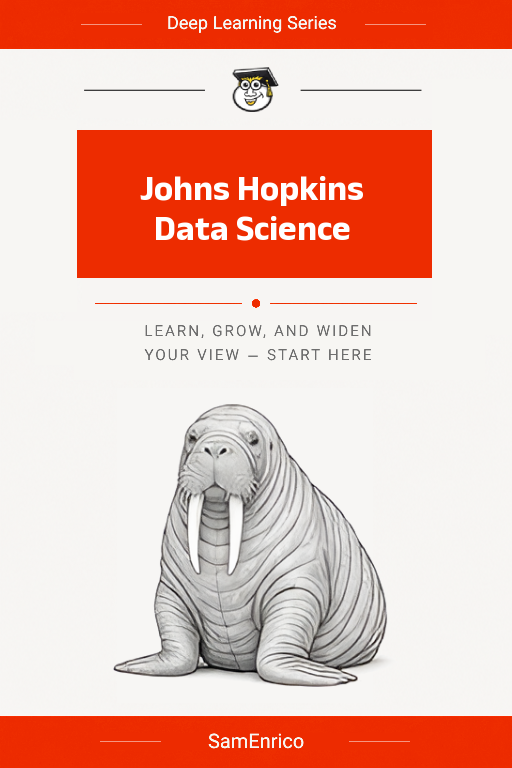
Non-FictionStudent's ShortcutHopkins
Johns Hopkins Data Science
Complete Johns Hopkins Data Science specialization
by Lamb Ross
Complete Johns Hopkins Data Science specialization on Coursera for analytics roles.
Formats
About this book
Free sample
Chapter 1: The Pipeline Paradox--You have just installed R, RStudio, and Git. You have a shiny new Git Hub account with a perfectly initialized repository. You feel prepared. You should not.The single greatest lie told to aspiring data professionals is that the job begins with writing code. It does not.
The job begins with understanding a deceptively simple question: Where do I fit? Most beginners install the tools, run a few tutorials that use pristine datasets like iris or mtcars, and assume they are ready for the workforce. Then they encounter their first real-world analytics task—a sudden drop in quarterly sales, a customer churn spike, a marketing campaign that mysteriously underperformed—and they freeze. Not because they cannot write a loop or call ggplot2, but because they have no mental model for how their work connects to a business, a team, or a decision.This chapter exists to prevent that freezing. You will install the tools—yes, that part is necessary.
But more importantly, you will learn the architecture of modern analytics work: the pipeline that turns raw data into action, the three distinct roles that collaborate on that pipeline, and the one practice (version control) that separates amateurs from professionals. By the end, you will not merely have software on your machine. You will have a map of the territory.The Data Science Pipeline: From Mess to Decision Before you write a single line of R code, you need to see the entire journey that data takes inside a company. This journey is called the data science pipeline, and every analytics task—whether you are forecasting sales, detecting fraud, or optimizing a supply chain—follows the same seven stages.Stage 1: Ask. The pipeline does not begin with data.
It begins with a question. "Why did sales drop in the Midwest last quarter?" "Which customers are most likely to cancel their subscriptions?" "Did our website redesign increase conversion rates?" The quality of your analysis is fundamentally limited by the quality of the question you ask. Vague questions produce vague answers. Specific, measurable, actionable questions produce useful work.Stage 2: Acquire.…
This is the end of the free sample. Get the eBook to keep going. Buy now
Contents
- Chapter 1
- Chapter 2
- Chapter 3
- Chapter 4
- Chapter 5
- Chapter 6
- Chapter 7
- Chapter 8
- Chapter 9
- Chapter 10
- Chapter 11
- Chapter 12
Details
- Author
- Lamb Ross
- Publisher
- SamEnrico
- Language
- English
- Genre
- Non-Fiction, Student's Shortcut, Hopkins
- Released
- 2026-06-01
- Pages (approx.)
- 160
- Available as
- eBook, Audiobook

Read better in the ZLOADR app
Your eBooks on your phone or tablet. Sign in with your SamEnrico account and start reading.
More by Lamb Ross
 My 600 Lb JourneyLamb Ross$11.99
 MMO Addiction RecoveryLamb Ross$11.99
 Cynophobia Dog Fear ReliefLamb Ross$11.99
 The Bank Vault HostageLamb Ross$11.99
 Sex Addiction and Intimacy AnorexiaLamb Ross$11.99
 Finding Purpose After Retirement GuideLamb Ross$11.99
 Bedtime Meditation For CalmLamb Ross$11.99
 Physical Health Work ImpactLamb Ross$11.99
 Anubis: The Weigher of SoulsLamb Ross$11.99
 Ticketmaster and the Third-Party TrapLamb Ross$11.99
 The Mineral Guide to AubertiteLamb Ross$11.99
 How to Start a Hobby in Gardening and PlantsLamb Ross$11.99
You may also like
 Hong Kong Handover 1997Dunn Johnnie$11.99
 Zumba For Postnatal Recovery CourseNeal Christian$11.99
 Zumba for BeginnersLadner Nikia$11.99
 YouTube Comment Mining GuideHumes Pandora$12.99
 Worry Box MeditationCarlin Rudy$11.99
 Workplace Stress MeditationNguyen Lynn$11.99
 Workplace Stress and Sleep RepairHawley Ivory$11.99
 Workplace Perfectionism CureDelaney Jeffry$11.99
 Workplace Injustice Anger GuideWallen Isabelle$11.99
 Work Addiction and Burnout LinkGreenwood Ester$11.99
 Women in Yoga and WellnessBeattie Galina$11.99
 Women in Stand Up ComedyChun Evangeline$11.99