
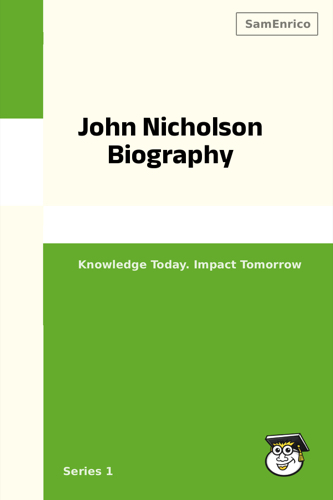
Non-FictionHistoryMilitary Biography
John Nicholson Biography eBook
Follows the brutal British officer who became a le
Follows the brutal British officer who became a legend in the rebellion.
Formats
Free sample
Chapter 1: The Ulster Inheritance...--–- John Nicholson was born twice. The first time, in Dublin on December 16, 1822, was a matter of flesh and blood—unremarkable, unrecorded in any public ledger, witnessed only by a midwife and a exhausted mother. The second birth took place thirteen years later, in a damp Lisburn parlor, when a boy of thirteen watched his father's coffin descend into Irish clay and decided, in that precise moment, that God had abandoned the world to wolves—and that someone needed to become a wolf-killer.The man who would terrify an empire, who would march four hundred miles through monsoon mud to storm the gates of Delhi, who would be called a god by the very people he conquered, began as a footnote in the margins of Anglo-Irish poverty. His story does not begin with glory. It begins with a locked door.The Ascendancy's Forgotten Children To understand John Nicholson, one must first understand the world that rejected him.
He was born into the Anglo-Irish Ascendancy—the Protestant ruling class that had controlled Ireland since the Cromwellian conquests of the seventeenth century. By the 1820s, this was a class in crisis. The Act of Union of 1800 had dissolved the Irish Parliament, drawing the Ascendancy's political power into London and leaving behind only a hollowed-out social elite. They were landlords, magistrates, and clergymen, but they lived in constant fear of the Catholic majority—eight million Irish Catholics who remembered centuries of dispossession and who, in the minds of the Protestant gentry, were never more than a whisper away from rebellion.The Nicholsons were not wealthy members of this class. They were its precarious edge.
Dr. Alexander Nicholson, John's father, was a physician—a respectable profession, but not one that conferred landed gentility. He had married a woman named Hester, and together they produced at least eight children, though records are fragmentary and many died in infancy. The family lived in Dublin for the first years of John's life, then moved north to Lisburn, a market town in County Antrim, where the linen trade had created a modest Protestant middle class.Lisburn in the 1820s was a town haunted by its own history. Just thirty years earlier, in 1798, the United Irishmen had risen in rebellion—a bloody, failed uprising that mixed Catholic and Protestant dissenters against British rule.
The rebellion had been crushed with appalling violence. Bodies hung from gibbets along the roads. Informers were paid in gold. Neighbor turned on neighbor. The memory of 1798 was not history to the people of Lisburn; it was a living wound, passed from father to son like a curse.John Nicholson was born into this atmosphere of siege.
The Protestant children of Lisburn were raised on stories of Catholic atrocities—the massacre of Protestants in 1641, the fires of Wexford in 1798, the threat of a papist conspiracy to drive them into the sea. They were taught that the world was a battlefield, that the Bible authorized the sword, and that mercy to the enemy was treason to God.But the Nicholson household was not merely fearful. It was desperate.The Death of Dr. Alexander Nicholson Alexander Nicholson died in 1835. The exact cause is unknown—perhaps typhus, perhaps tuberculosis, perhaps the slow wasting of a man who had worked too hard for too little.
What is known is that his death left the family financially ruined. Doctors in early nineteenth-century Ireland were not paid well; they were often paid in kind—eggs, potatoes, a side of bacon. There was no savings account, no life insurance, no inheritance. There was only debt.Hester Nicholson, John's mother, was left with at least six living children and no income. She was a proud woman—the daughter of a Dublin merchant, accustomed to the small dignities of the middle class.
Now she was forced to beg. She wrote letters to relatives, asking for assistance. Some helped. Most did not. The Anglo-Irish Ascendancy was not a charitable class; it was a survivalist clan, and a widow with six children was a liability, not a cause.Young John—then twelve or thirteen—watched his mother humbled.
He watched her weep over letters that went unanswered. He watched her sell the family's furniture, piece by piece, to buy bread. And something in him, something that had perhaps always been there, hardened into stone.The biographers of Nicholson have often pointed to his father's death as the key to his psychology. They are correct, but not for the reasons they think. It was not the loss of a father that scarred him; it was the loss of security.
John Nicholson learned, in the winter of 1835, that the world was a place where the weak starved and the strong survived. He decided, then and there, never to be weak again.Foxe's Book of Martyrs and the Theology of Vengeance In the months after his father's death, Nicholson discovered a book that would shape the rest of his life. It was an old copy of John Foxe's Acts and Monuments—better known as Foxe's Book of Martyrs—a massive, illustrated chronicle of Protestant persecution at the hands of Catholics. The book was a staple of Protestant households in the British Isles. It was often chained to the pulpit.
It was read aloud to children. It was, in many ways, the secular scripture of the Ascendancy.What Nicholson found in Foxe was not comfort. It was a justification for violence. The woodcuts in the book are graphic: men burned at the stake, women pressed to death, children forced to watch their parents die. The accompanying text is unsparing in its hatred of Catholicism and its glorification of those who died rather than renounce their faith.But Nicholson did not read Foxe as a call to martyrdom.
He read it as a call to war. The martyrs had died because they were weak; they had allowed themselves to be slaughtered. Nicholson, even at thirteen, had no interest in dying. He was interested in killing.Later, as a young officer in India, Nicholson would carry a Bible with him—but it was a soldier's Bible, a weapon rather than a scripture. He quoted the Old Testament constantly: an eye for an eye, the destruction of the Amalekites, the righteous wrath of a God who drowned armies.
He never quoted the Sermon on the Mount. He never spoke of turning the other cheek. The Jesus of Nicholson's imagination was not a carpenter from Galilee; he was a warlord in a bloody crown.The question that haunts Nicholson's biography is whether he actually believed any of this. Was he a sincere religious fanatic, a man who truly saw himself as God's instrument? Or was he a cynic who used religion as a mask for his own ambition?The evidence suggests neither.
Nicholson was not a theologian. He never wrote a word of spiritual reflection that did not immediately pivot to violence. But he was not a simple hypocrite either. He lived ascetically—no alcohol, no gambling, no women. He slept on a wooden cot.
He ate plain food. He demanded nothing for himself except power. This is not the profile of a fraud. It is the profile of a…
This is the end of the free sample. Get the eBook to keep going. Buy now
About this book
Details
- Author
- Burden Junita
- Publisher
- SamEnrico
- Language
- English
- Genre
- Non-Fiction, History, Military Biography
- Released
- 2026-06-09
- Pages (approx.)
- 155
- Available as
- eBook, Audiobook

Read better in the ZLOADR app
Your eBooks on your phone or tablet. Sign in with your SamEnrico account and start reading.
More by Burden Junita
 Young Widow Survival GuideBurden Junita$11.99
 Business Credit for Startups GuideBurden Junita$12.99
 Azeri Armenian EscapeBurden Junita$11.99
 Teen Walking MindfulnessBurden Junita$11.99
 Work Addiction Mindfulness PracticeBurden Junita$11.99
 The Product Manager Creativity GuideBurden Junita$11.99
 The Magician Dream FigureBurden Junita$11.99
 Pain Catastrophizing InterruptBurden Junita$11.99
 Dreams About Foster CareBurden Junita$11.99
 The Visionary and the Void: Ridley Scott’s Unseen BattlesBurden Junita$11.99
 The Calculus of Kings: How African Mathematicians Shaped the Ancient WorldBurden Junita$11.99
 Ride the Devil's Backbone: The Untold Story of the Texas Rangers' Last StandBurden Junita$11.99
You may also like
 Hong Kong Handover 1997Dunn Johnnie$11.99
 Zumba For Postnatal Recovery CourseNeal Christian$11.99
 Zumba for BeginnersLadner Nikia$11.99
 YouTube Comment Mining GuideHumes Pandora$12.99
 Worry Box MeditationCarlin Rudy$11.99
 Workplace Stress MeditationNguyen Lynn$11.99
 Workplace Stress and Sleep RepairHawley Ivory$11.99
 Workplace Perfectionism CureDelaney Jeffry$11.99
 Workplace Injustice Anger GuideWallen Isabelle$11.99
 Work Addiction and Burnout LinkGreenwood Ester$11.99
 Women in Yoga and WellnessBeattie Galina$11.99
 Women in Stand Up ComedyChun Evangeline$11.99