
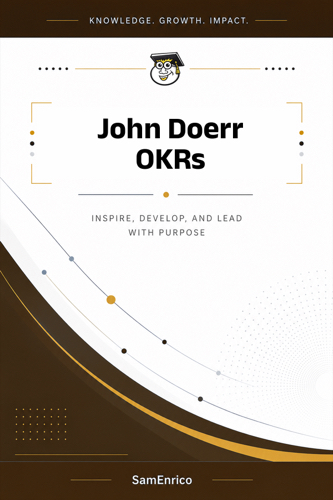
John Doerr OKRs eBook
Chronicles the Kleiner Perkins legendary investor
by Bogan Isela
Chronicles the Kleiner Perkins legendary investor who backed Google and Amazon.
Formats
Free sample
Chapter 1: The Paranoia Playbook--–- The sun had not yet risen over the Santa Clara Valley in the spring of 1974, but John Doerr was already awake. He was twenty-two years old, freshly graduated from Rice University with an electrical engineering degree, and now enrolled in a master's program at Berkeley that felt more like a holding pattern than a calling. He had grown up in St. Louis, the son of a chemical engineer and a homemaker, surrounded by the quiet expectation that he would follow a predictable path: good grades, good job, good life. But something was gnawing at him.
He had heard whispers about a strange company north of San Jose called Intel. They didn't make televisions or radios or anything a normal person could buy. They made "memory chips"—tiny slivers of silicon that could store information. It sounded boring. It sounded esoteric.
And yet, every engineer Doerr respected was desperate to work there.The reason for that desperation had a name: Andy Grove.Grove was not yet the CEO of Intel in 1974. That title belonged to Gordon Moore, the soft-spoken co-founder who would later give his name to Moore's Law. But everyone inside Intel knew who actually ran the place. Grove was the President. He was the enforcer.
He was the Hungarian immigrant with a thick accent and a thicker temper who had fled first the Nazis and then the Soviets, arriving in America with thirty dollars in his pocket and a belief that the world was fundamentally unsafe. That belief never left him. It hardened into a management philosophy that would, decades later, become the operating system for Google, Amazon, and an entire generation of Silicon Valley giants. Doerr had never met Grove. He had only read his technical papers and heard the rumors: brilliant, brutal, and incapable of suffering fools.
Doerr wanted to work for him.He drove north for the interview in a used car that smelled of stale coffee. Intel's headquarters in Mountain View was a low-slung building surrounded by orchards that still smelled of apricots. Inside, the air was different. It smelled of solder and ambition. Doerr was escorted to a small conference room where a whiteboard covered one wall, already filled with equations.
Then the door opened.Andy Grove walked in. He was forty-one years old, five foot eight, with intense brown eyes that seemed to be evaluating everything in the room—including Doerr—as a potential failure mode. He wore a short-sleeved shirt and slacks, nothing fancy. He did not smile. He shook Doerr's hand once, firmly, and then said: "Tell me something I don't know."That was the entire interview.Doerr hesitated.
He had prepared answers about his coursework, his grades, his passion for semiconductor physics. None of that would qualify as "something Grove didn't know." So Doerr took a risk. He had been reading about a new technique for manufacturing silicon wafers called "projection alignment." Most chipmakers were still using contact printing, which was cheap but produced inconsistent results. Projection alignment was expensive but promised higher yields. Doerr laid out the trade-offs in technical detail, concluding that Intel should switch within eighteen months or fall behind a Japanese competitor he named.Grove listened without interrupting.
When Doerr finished, Grove nodded once and said: "You start Monday. Don't be late."Doerr would later learn that Grove had already decided to hire him before the interview. The question—"Tell me something I don't know"—was a test not of knowledge but of courage. Grove wanted to see if Doerr would play it safe or say something uncomfortable. Doerr chose discomfort.
That choice would define his entire career.The Education of a Young Engineer Doerr's first weeks at Intel were a blur of unfamiliar jargon, endless spreadsheets, and the sinking feeling that he had been dropped into a foreign country whose language he did not speak. He was assigned to the memory division, which was still Intel's cash cow. The company had built its reputation on DRAM chips—dynamic random-access memory—that powered the earliest personal computers. Business was good. Customers were happy.
The engineers were proud.But Doerr noticed something strange. Every Friday afternoon, Andy Grove would walk through the labs, alone, without an agenda. He would stop at random workstations and ask the same question: "What are you doing, and why are you doing it?"The first time Grove stopped at Doerr's desk, Doerr stammered through a description of his current project: optimizing a memory chip's access time by adjusting the doping concentration in the silicon substrate. It was technical, detailed, and—Doerr would later realize—completely irrelevant to the company's future. Grove listened without expression.
Then he asked: "Is this the most important thing you could be working on?"Doerr said yes, because he believed it.Grove said: "You're wrong." And walked away.That encounter haunted Doerr for weeks. He replayed it in his mind during his commute, during meals, during the restless hours before dawn. What did Grove see that he missed? The answer came three months later, when Intel's leadership gathered for a quarterly review that Doerr was permitted to attend as a junior observer.The Memory Pivot The room was tense. Gordon Moore sat at the head of the table, calm as always, doodling on a notepad.
Beside him, Grove paced like a caged animal. The agenda was brutal: Intel's memory business was under attack from Japanese competitors who were selling chips for less than Intel's manufacturing cost. The company had three choices. It could cut prices and fight a losing war of attrition. It could invest in new memory technology and try to leapfrog the competition.
Or it could kill the memory division entirely and bet everything on a new product line that barely existed yet: microprocessors.The microprocessor was Intel's invention. The 4004, released in 1971, was the first commercially available processor on a single chip. But the market was tiny. Most of Intel's revenue still came from memory. Killing memory would mean laying off hundreds of engineers—many of them friends, colleagues, people Grove had recruited personally.
It would mean admitting that Intel had lost a war it once dominated. It would mean fear.Grove did not hesitate. He turned to Moore and asked a question that would become legendary in Silicon Valley: "If we got kicked out and the board brought in a new CEO, what would he do?"Moore thought for a moment and said: "He'd get us out of memory."Grove looked around the room. His eyes landed on Doerr, who was trying to be invisible in the corner. "Then why the hell aren't we doing it ourselves?"The decision was made in that moment.
Intel would exit the memory business. It would focus entirely on microprocessors. And it would do so with a level of discipline that Grove was about to codify into a system.The Birth of Focus The system Grove invented did not have a name yet. It was not called OKRs. It was not even written down as a formal process.
It was simply how Grove managed: he asked every engineer, every manager, every department head to answer two questions on a single sheet of paper.Question 1…
This is the end of the free sample. Get the eBook to keep going. Buy now
About this book
Details
- Author
- Bogan Isela
- Publisher
- SamEnrico
- Language
- English
- Genre
- Non-Fiction, Biography, VC
- Released
- 2026-06-05
- Pages (approx.)
- 132
- Available as
- eBook, Audiobook

Read better in the ZLOADR app
Your eBooks on your phone or tablet. Sign in with your SamEnrico account and start reading.
More by Bogan Isela
 Emotion Mistakes GuideBogan Isela$11.99
 Rutin Vein Health GuideBogan Isela$11.99
 Eisenhower For HR ProfessionalsBogan Isela$11.99
 Persuasive Merger ProposalBogan Isela$11.99
 Role Play Assertiveness TrainingBogan Isela$11.99
 The Angry Parent ConnectionBogan Isela$11.99
 Tantia Tope Guerrilla WarBogan Isela$11.99
 Choice Overload ReductionBogan Isela$11.99
 The Last Oracle of Delphi: A Second ProphecyBogan Isela$11.99
 The Forgotten Slugger: Esteban Montejo and the Birth of Caribbean BaseballBogan Isela$11.99
 Ragnarok’s Last Stand: The Secret of the Volva’s ProphecyBogan Isela$11.99
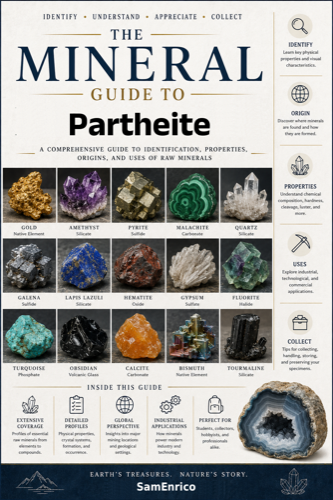 The Mineral Guide to PartheiteBogan Isela$11.99
You may also like
 Hong Kong Handover 1997Dunn Johnnie$11.99
 Zumba For Postnatal Recovery CourseNeal Christian$11.99
 Zumba for BeginnersLadner Nikia$11.99
 YouTube Comment Mining GuideHumes Pandora$12.99
 Worry Box MeditationCarlin Rudy$11.99
 Workplace Stress MeditationNguyen Lynn$11.99
 Workplace Stress and Sleep RepairHawley Ivory$11.99
 Workplace Perfectionism CureDelaney Jeffry$11.99
 Workplace Injustice Anger GuideWallen Isabelle$11.99
 Work Addiction and Burnout LinkGreenwood Ester$11.99
 Women in Yoga and WellnessBeattie Galina$11.99
 Women in Stand Up ComedyChun Evangeline$11.99