
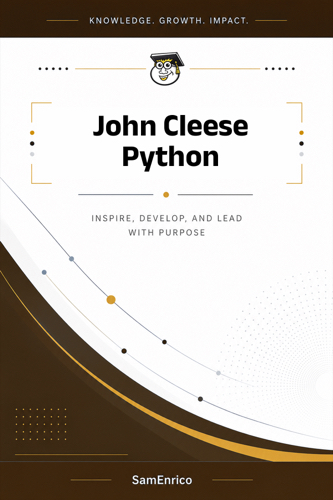
John Cleese Python eBook
Explores the Monty Python member's ministry of sil
Explores the Monty Python member's ministry of silly walks.
Formats
Free sample
Chapter 1: Six Feet of Chewed String--The first thing you need to understand about John Cleese is that he never learned to dance.This is not a metaphor, though it will become one. It is a simple biographical fact. In the early 1960s, at Cambridge University, Cleese attended a single dance lesson. He lasted twenty minutes. The instructor, a patient woman who had taught generations of undergraduates to waltz without incident, watched the six-foot-five-inch law student flail his limbs in directions that seemed to violate human anatomy.
She approached him afterward and said, quietly, "Perhaps you might consider chess."Cleese laughed at the time. He laughs about it still, though the laugh now carries an edge that wasn't there fifty years ago. Because the same body that could not waltz would, within a decade, produce one of the most famous movements in the history of comedy. The Ministry of Silly Walks is not a dance. But it is also not not a dance.
It is something else entirely: a negotiated truce between a man and his own awkwardness, a peace treaty signed in the territory of the ridiculous.This chapter is about that treaty. It is about the body that signed it, the influences that shaped it, and the paradox that lies at its heart. The same gangly frame that made Cleese a target for schoolyard mockery became, through sheer force of comedic will, his greatest instrument. But instruments wear out. The body that gave the world the Silly Walk would, decades later, refuse to perform it.
The asset and the liability, the gift and the cost, are the same thing. That is the central truth of this chapter, and perhaps of this entire book: genius does not arrive free of charge. It is always rented, never owned, and the landlord eventually comes to collect.The Awkward Physique: A Biography in Inches John Marwood Cleese was born on October 27, 1939, in Weston-super-Mare, a seaside town in Somerset that he would later describe as "the kind of place where ambition went to die quietly." His father, Reginald, was an insurance salesman. His mother, Muriel, was a former shop assistant. Neither was tall.
Neither was particularly funny. Neither had any expectation that their firstborn son would grow into a creature of such improbable dimensions.By the age of twelve, Cleese stood over five feet ten inches. By fourteen, he was six feet two. By sixteen, he had reached his full height of six feet five inches—though his coordination would take another decade to catch up. In photographs from this period, Cleese appears as a collection of joints loosely organized around a spine.
His arms seem to have been attached by someone who had never seen arms before. His legs operate on independent schedules. His neck, astonishingly long, supports a head that looks slightly bewildered by its surroundings.A teacher at St. Peter's Preparatory School, a man whose name Cleese has deliberately forgotten, pulled him aside after a particularly disastrous cricket match. The boy had managed to trip over his own shadow, collide with a teammate, and send the ball in a direction that approximated neither the batsman nor the wicket.
The teacher sighed. He looked at Cleese with something between pity and exasperation."You are," he said, "six feet of chewed string."Cleese would repeat this phrase for the rest of his life. Not bitterly, exactly. More with the careful distance of a man who has learned to frame his wounds as origin stories. The phrase stuck because it was accurate.
Chewed string is limp, unravelling, structurally unsound. It cannot hold its shape. It cannot be relied upon. It is what remains after something stronger has been destroyed.But here is where the story takes its first interesting turn. Most children who receive such a description internalize it as a limitation.
They become cautious. They hide their bodies in oversized clothing. They learn to stand still, to take up as little space as possible, to apologize for their physical existence. Cleese did the opposite. He decided, somewhere between the cricket pitch and the school dining hall, that if his body was ridiculous, he would make it deliberately ridiculous.
He would not be mocked for his awkwardness. He would deploy it.This is not the same as confidence. Confidence would have required believing that his body was not awkward. Cleese never believed that. He knew, with the unshakeable certainty of a boy who had been tripped, shoved, and laughed at, that his body was objectively peculiar.
He could not make it graceful. But he could make it useful.The Influence of Max Wall: Broken Bodies as Comedy Every comedian has a ghost. Some have several. These are the performers who came before, whose techniques and sensibilities echo through the decades, shaping the work of those who never met them. For Cleese, two ghosts loom particularly large.
The first is Max Wall. The second is Jacques Tati.Max Wall was a British music hall comedian who specialized in a character called "Professor Wallofski." The professor was a supposed intellectual—dressed in a tattered frock coat, wearing ill-fitting spectacles, and delivering highbrow monologues in a thick German accent. But the joke was not the monologue. The joke was the body.Wall walked like a man whose skeleton had been reassembled by a drunk. His legs swung forward independently, as if each knee were controlled by a different puppeteer.
His arms dangled at odd angles. His head lolled. He gave the impression that his body was a rental property from which the landlord was trying to evict him. And yet—and this is crucial—Professor Wallofski never acknowledged the chaos. He spoke with the seriousness of a university lecturer.
He gestured with the authority of a man who believed he was making a valid point. The physical comedy emerged from the gap between his intent and his execution.Cleese saw Wall perform at the Bristol Hippodrome in 1953. He was fourteen years old. He had never seen anything like it. The other comedians of the era—the smooth, tuxedoed entertainers, the quick-witted standups, the slapstick clowns in oversized shoes—seemed to be performing at the audience.
Wall was performing against himself. His enemy was not the audience's expectations. His enemy was his own body."I realized," Cleese would later write in his memoir-in-interviews, "that I was watching someone who had turned his limitations into his material. Wall wasn't funny despite his awkwardness. He was funny because of it.
And he was funnier than the smooth performers because we recognized ourselves in him. We all feel awkward. We all feel that our bodies are betraying us. Wall just showed it."This recognition—that awkwardness is universal, that the body is always slightly out of our control—would become the foundation of Cleese's physical comedy. He did not aspire to Wall's broken-body aesthetic directly.
He was too tall for that. Wall's comedy was compact, inward, a collapse of the self. Cleese's comedy would be expansive, outward, a flailing rebellion against the self. But the principle was the same: the comedian does not fight the awkward body. The comedian surrenders to it.The Influence of Jacques Tati: The Precision of the Absurd…
This is the end of the free sample. Get the eBook to keep going. Buy now
About this book
Details
- Author
- Mcgrath Zachariah
- Publisher
- SamEnrico
- Language
- English
- Genre
- Non-Fiction, Biography, British
- Released
- 2026-06-05
- Pages (approx.)
- 135
- Available as
- eBook, Audiobook

Read better in the ZLOADR app
Your eBooks on your phone or tablet. Sign in with your SamEnrico account and start reading.
More by Mcgrath Zachariah
 Drug Dependency Mindfulness Based Relapse PreventionMcgrath Zachariah$11.99
 Self Loving Kindness Practice GuideMcgrath Zachariah$11.99
 Gym Anxiety MeditationMcgrath Zachariah$11.99
 Water Dream SymbolismMcgrath Zachariah$11.99
 Anapanasati for Test AnxietyMcgrath Zachariah$11.99
 The Water Cooler ComebackMcgrath Zachariah$11.99
 Financial Stress For AdopteesMcgrath Zachariah$11.99
 Parent Financial Planning GuideMcgrath Zachariah$11.99
 The Last Voyage of the MV Ever Given: A Canal Crisis That Shook the WorldMcgrath Zachariah$11.99
 The First to the Moon: The Untold Story of the Apollo 11 Backup CrewMcgrath Zachariah$11.99
 The Iron Horse: How the Transcontinental Railroad United a NationMcgrath Zachariah$11.99
 Growing Coffea (Coffee Tree)Mcgrath Zachariah$11.99
You may also like
 Kate Winslet TitanicMuhammad Annika$11.99
 British Pub Chain OwnerBethel Trenton$11.99
 Redgrave Dynasty - Vanessa RedgraveAlmanza Erasmo$11.99
 Redgrave DynastyCave Flor$11.99
 Redgrave Dynasty - Joely RichardsonAnaya Caroyln$11.99
 Redgrave Dynasty - Lynn RedgraveMinton Mafalda$11.99
 Love Island UKChambers Silvia$11.99
 Jonathan Ross BigKey Elane$11.99
 Redgrave Dynasty - Natasha RichardsonBohannon Charita$11.99
 Graham Norton ChairBabcock Brian$11.99