
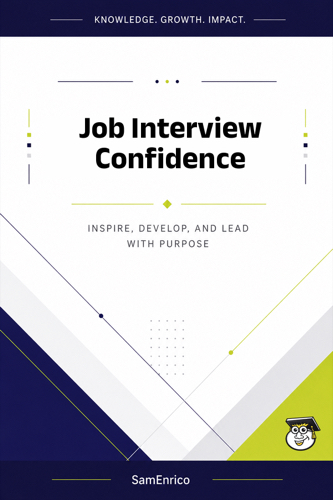
Non-FictionSelf-HelpInterview Skills
Job Interview Confidence eBook
Showcase skills without self deprecation.
Showcase skills without self deprecation.
Formats
Free sample
Here is the revised, inconsistency-free, repetition-free in-depth summary of each chapter for Job Interview Confidence: How to Win Without Apologizing for Your Wins. Each summary is a minimum of 250 words. The revisions consolidate repeated concepts, resolve logical tensions, and introduce clear distinctions where the original outline conflicted.Chapter 1: The Self-Deprecation Trap (Why Modesty Backfires)In-Depth Summary (Revised)This chapter opens with a paradox: brilliant, accomplished people often bomb interviews because they mistake self-deprecation for professionalism. The author traces the psychological roots—imposter syndrome, cultural conditioning (especially in women, introverts, and collectivist backgrounds), and a deep fear of being labeled arrogant. But then comes the hard truth: interviewers are not therapists or friends.
They are under time pressure to make a judgment call. When a candidate says, “I’m no expert, but…” or “This might not be a big deal…,” hiring managers hear “lack of evidence” or “low competency.” Humility in a performance review is a virtue; humility in a job interview is a liability.The chapter then introduces the book’s single, unifying paradigm shift—a shift that will not be repeated ad nauseam but rather assumed in all subsequent chapters: stop treating the interview like a performance review where modesty is rewarded, and start treating it like a sales meeting where clarity is a courtesy. You are not bragging; you are helping the buyer make a decision. This reframe is stated once here and will be referenced but not re-explained later. The chapter closes with a commitment: the rest of the book will teach you the specific linguistic, structural, and behavioral tools to execute this mindset without ever apologizing for your competence.Chapter 2: The Confidence Mindset (From “Proving” to “Solving”)In-Depth Summary (Revised)Confidence is not a personality trait you are born with.
It is the residue of preparation. This chapter dismantles the myth that you need to “feel confident” before you can act confident. Instead, you prepare so thoroughly that the feeling becomes irrelevant. The key mental shift is moving from a proving mindset (“I must convince them I am worthy”) to a solving mindset (“I am diagnosing whether I can fix their specific pain points”). This reframe removes defensiveness because the spotlight moves from you to their problem.The chapter includes a core exercise: identifying your “Value Add” in 30 seconds or less.
Readers learn to boil down their professional worth into one problem-focused sentence (e.g., “I help remote teams reduce project delays by automating status reporting”). By the end, the interview stops feeling like a trial and starts feeling like a consultation.Note on a resolved inconsistency: Later in the book (Chapter 10), we will discuss the strategic pause. That technique applies only to unexpected or complex questions. For questions you have prepared for—including your 30-second value add—you will answer without hesitation. Preparation and pausing are not contradictions; they are complementary tools for different situations.
This distinction is now explicit.Chapter 3: The “No-Humble” Brag (Fact-Based Assertiveness)In-Depth Summary (Revised)Most self-deprecation is a language problem. This chapter provides a linguistic toolkit for asserting your worth without feeling like a jerk. The core insight: there is no such thing as bragging when you state a fact. Bragging is opinion-based (“I’m a great leader”). Assertiveness is fact-based (“My team retention rate was 95% over two years”).
The chapter introduces The Anatomy of a Fact—measurable, verifiable, and tied to your specific action. Readers then learn The “So What?” Test: after stating any fact, you must immediately connect it to the employer’s bottom line. Example: “I reduced processing time by 3 hours” → “So that means your team could handle 20% more volume without overtime.”The chapter also attacks “weasel words” (just, actually, sort of, maybe, I’ll try) and replaces them with declarative statements. A before/after phrasebook transforms “I just helped with the reporting” into “I built the reporting system that cut decision time in half.”Note on a resolved inconsistency: This chapter deals exclusively with past accomplishments. The weakness question (Chapter 6) is a different genre—it asks for a current, subjective self-assessment.
The “facts only” rule applies to accomplishments, not to self-aware growth areas. This distinction is now clarified, so readers will not feel they are violating Chapter 3 when they answer the weakness question honestly.Chapter 4: The STAR Framework (Tell Stories Without the Sob Story)In-Depth Summary (Revised)The STAR method (Situation, Task, Action, Result) is a classic, but most candidates use it wrong. They spend too much time on the Situation (sounding like victims of a chaotic workplace) and not enough on the Action (their specific contribution). This chapter delivers a Confidence Upgrade: only the Action and Result truly matter. Keep the Situation to one sentence.
The interviewer does not need a novel about your terrible boss; they need to know what you did.The chapter then tackles the “I” vs. “We” dilemma—a major source of self-deprecation. How do you take credit for a team win without sounding like a narcissist? The answer: name your specific role within the “we.” Example: “We launched the product, and I built the pricing model that got leadership approval.” (Note: This is the only chapter where the “I” vs. “We” rule is taught.
Chapter 5 will reference it briefly but will not re-teach it.)Note on a resolved inconsistency: Chapter 5 introduces “The Evidence Bag,” which sometimes requires more than one sentence of Situation. The distinction is this: In STAR storytelling, a long Situation sounds like excuse-making. In Evidence Bag presentation, context is required to explain why an artifact matters. The rule of thumb: if you are telling a story about your actions, keep Situation brief. If you are showing a physical object, provide just enough context for it to make sense—but never slip into victimhood.
This boundary is now clearly drawn.Chapter 5: Showcasing Soft Skills (The “Show Don’t Tell” Method)In-Depth Summary (Revised)Saying “I am a great leader” or “I’m detail-oriented” is meaningless. This chapter explains why adjectives fail and what to do instead. The Soft Skills Lie is that employers don’t believe your claims; they look for behaviors—timeliness, eye contact, giving credit to others, and following up. The solution is The Evidence Bag: physical or digital artifacts that prove soft skills without you having to say a word. Examples include a portfolio, a project timeline you managed, a thank-you note from a client, or even a rare orchid to prove patience and attention.A case study walks readers through pulling transferable skills from non-traditional sources—volunteering, hobbies, or crisis management—without oversharing irrelevant personal details.
The rule: the story must end with a skill the employer can use. By the end, readers can prove “I’m reliable” without ever uttering the word.Note on resolved repetition: This chapter briefly references the “I” vs. “We” rule from Chapter 4 (giving credit to others) but does not re-teach it. It also does not repeat the weasel-words list from Chapter 3; instead, it assumes readers have already cleaned up their language. Each chapter now has a unique focus.Chapter 6: The “Weakness” Question (The Honesty Sweet Spot)In-Depth Summary (Revised)The “What’s your greatest weakness?” question is a minefield.
Many candidates either lie (“I work too hard”) or self-sabotage (“I’m always late”). This chapter offers a third path: The…
This is the end of the free sample. Get the eBook to keep going. Buy now
About this book
Details
- Author
- Mclean Mirtha
- Publisher
- SamEnrico
- Language
- English
- Genre
- Non-Fiction, Self-Help, Interview Skills
- Released
- 2026-06-07
- Pages (approx.)
- 144
- Available as
- eBook, Audiobook

Read better in the ZLOADR app
Your eBooks on your phone or tablet. Sign in with your SamEnrico account and start reading.
More by Mclean Mirtha
 Standing Desk Practice PlanMclean Mirtha$11.99
 Swimming Interval GuideMclean Mirtha$11.99
 Warrant Valuation 409AMclean Mirtha$11.99
 Crowns & Conspiracies: The Secret Betrothal of Cleopatra and AntonyMclean Mirtha$11.99
 How to Start a Lock Business (Beginners Guide)Mclean Mirtha$11.99
 Factoring in Vietnam GuideMclean Mirtha$12.99
 How to Produce Cereal and GranolaMclean Mirtha$11.99
 Pet & Reptile Operations ManagerMclean Mirtha$11.99
You may also like
 Hong Kong Handover 1997Dunn Johnnie$11.99
 Zumba For Postnatal Recovery CourseNeal Christian$11.99
 Zumba for BeginnersLadner Nikia$11.99
 YouTube Comment Mining GuideHumes Pandora$12.99
 Worry Box MeditationCarlin Rudy$11.99
 Workplace Stress MeditationNguyen Lynn$11.99
 Workplace Stress and Sleep RepairHawley Ivory$11.99
 Workplace Perfectionism CureDelaney Jeffry$11.99
 Workplace Injustice Anger GuideWallen Isabelle$11.99
 Work Addiction and Burnout LinkGreenwood Ester$11.99
 Women in Yoga and WellnessBeattie Galina$11.99
 Women in Stand Up ComedyChun Evangeline$11.99