
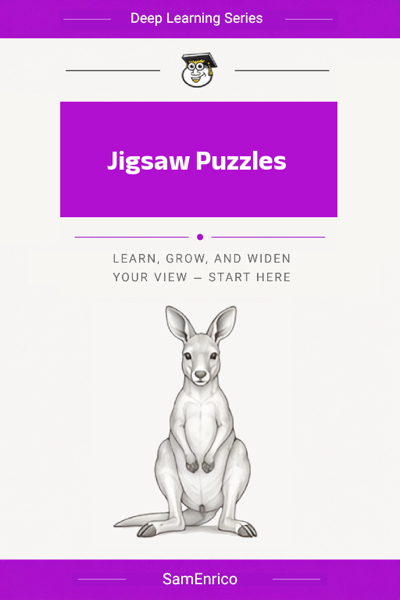
Non-FictionInformativeEducational
Jigsaw Puzzles eBook
A Coursebook on Jigsaw Puzzles
A Coursebook on Jigsaw Puzzles
Formats
Free sample
Chapter 1: The Quiet Click...--– In the winter of 2019, before the world learned to fear doorknobs and delivery boxes, a forty-two-year-old graphic designer named Sarah bought a 1,500-piece jigsaw puzzle of a Venetian canal. She had no intention of finishing it. She had no intention of starting it, really. The puzzle sat in her coat closet for three months, shrink-wrapped and guiltless, until a sleepless night in March when the news became unbearable and her phone became a torture device. She opened the box not out of curiosity but out of desperation.
She dumped the pieces onto a folding table. She sorted edges from middles. She built the frame. And then, at 2:17 in the morning, she placed a single piece—a small wedge of terracotta roof tile—into the upper left corner. It clicked.
Not audibly, but physically. A small, precise surrender of friction. Something in her chest unclenched. She placed another piece. Then another.
At 4:30 AM, she looked up and realized she had not checked her phone for two hours. She had not thought about case numbers or supply chains or the strange arithmetic of social distancing. She had only thought about which blue piece belonged to which blue shadow. That night, Sarah joined a silent, global congregation. She became a puzzler.This chapter is not about Sarah, exactly.
It is about the click. The quiet click of a piece finding its home is the smallest possible unit of satisfaction, and yet it is powerful enough to reorganize a human brain, to quiet the amygdala’s alarm bells, to replace the jittery dopamine of a Twitter notification with something slower and more sustainable. To understand why jigsaw puzzles have survived for 260 years—through depressions, wars, plagues, and the rise of entertainment systems that can simulate entire universes—you must first understand the psychology of the piece. Not the puzzle as a finished object, but the moment of fitting. That moment is a neurological event, a philosophical argument, and a form of medicine all at once.The Neurochemistry of a Single Fit Every time you place a puzzle piece correctly, your brain releases a small pulse of dopamine.
This is not unique to puzzles; dopamine is the brain’s reward chemical, and it appears whenever you complete a goal, from eating a meal to winning an argument. But the puzzle piece offers something unusual: the reward is perfectly calibrated to the effort. The piece is neither too easy (which would feel trivial) nor too hard (which would feel frustrating). It arrives at the exact edge of your competence. This is what the psychologist Mihaly Csikszentmihalyi called flow—a state of deep engagement where challenge meets skill in a narrow, golden channel.Unlike video game dopamine, which is often accelerated and amplified by flashing lights, level-up sounds, and social comparison (leaderboards, loot boxes, friend rankings), puzzle dopamine is self-contained.
No one is watching. No one is competing. The reward loop is closed entirely within your own perception. A 2017 study from the University of Pennsylvania’s Positive Psychology Center found that activities with “clear proximal goals and immediate feedback”—like fitting a puzzle piece—produced measurable reductions in cortisol (the stress hormone) within twenty minutes of engagement. The researchers noted that the effect was strongest when the activity had no external evaluation.
In other words, the moment you turn a puzzle into a competition, you lose some of its medicinal power.This is not to say competitive puzzling is invalid. The speed-puzzling champions we will meet in Chapter 7 experience a different kind of reward: the thrill of mastery, the adrenaline of the clock, the social status of a trophy. But the mindful puzzler—the person who puzzles to quiet the mind—is after something else. She is after the non-competitive reward system. Each piece is its own finish line.
Each click is a small, private celebration. Over the course of a 1,000-piece puzzle, you will experience that celebration roughly 999 more times than you will experience the final completion. The process, not the product, is the point.The Paradox of Finite Systems The digital age is defined by infinite scroll. Social media feeds have no bottom. News cycles have no resolution.
Streaming platforms offer an endless corridor of thumbnails. The human brain, which evolved to crave closure and completion, is left perpetually unfinished. Each swipe promises a reward that never quite arrives. This is not an accident; it is the business model. The longer you scroll, the more ads you see.
The platform has no incentive to give you a stopping cue.A jigsaw puzzle is the opposite of infinite scroll. It is radically finite. There are exactly 1,000 pieces. There is exactly one correct position for each. When you place the final piece, the puzzle is done.
You cannot scroll past the edge of the frame. The puzzle gives you what the internet cannot: an ending. This is not a trivial psychological feature. The philosopher Byung-Chul Han, in his book The Burnout Society, argues that the exhaustion of modern life comes not from having too much to do but from having no clear off-ramps. We are never done.
Our to-do lists regenerate overnight. Our email inboxes refill. The puzzle, by contrast, offers a perfect, miniature apocalypse: the death of the task. When the last piece clicks, you are finished. Not paused.
Not interrupted. Finished.This is why puzzling experienced a renaissance during the COVID-19 lockdowns of 2020 and 2021. Puzzle manufacturers sold out of inventory within weeks. Ravensburger, the German puzzle company, reported a 370 percent increase in sales. New puzzle companies launched.
Old puzzle companies reopened dormant production lines. But the pandemic did not invent the puzzle’s appeal; it simply revealed it. People who had never considered themselves puzzlers discovered that the finite system of the puzzle was an antidote to the infinite uncertainty of the news. When you cannot control the world, you can control the placement of a single piece. That sense of agency—tiny, trivial, and real—is a form of psychological first aid.The Puzzle as Active Meditation Meditation is often misunderstood as the absence of thought.
In fact, most meditative traditions teach focused attention rather than blank emptiness. You focus on the breath. When the mind wanders, you notice the wandering and return to the breath. This act of return—not the stillness itself—is the practice. A jigsaw puzzle works the same way.
You focus on the piece. When your mind wanders to the argument you had this morning or the email you forgot to send, you notice the wandering and return to the piece. The puzzle becomes a meditation object, as valid as a candle flame or a mantra.The difference is that puzzles also engage the brain’s problem-solving networks. Functional MRI studies of puzzle-solving (conducted by researchers at the University of Tübingen in 2019) show activation in both the default mode network (associated with mind-wandering and self-referential thought) and the central executive network (associated with focused problem-solving). The puzzle literally occupies both the part of your brain that wants to daydream and the part that wants to work.
This dual activation may explain why puzzling feels less effortful than pure meditation (which many beginners find frustrating) and more…
This is the end of the free sample. Get the eBook to keep going. Buy now
About this book
Details
- Author
- Burkholder Lonnie
- Publisher
- SamEnrico
- Language
- English
- Genre
- Non-Fiction, Informative, Educational
- Released
- 2026-05-06
- Pages (approx.)
- 130
- Available as
- eBook, Audiobook

Read better in the ZLOADR app
Your eBooks on your phone or tablet. Sign in with your SamEnrico account and start reading.
More by Burkholder Lonnie
 Elevator Breath AwarenessBurkholder Lonnie$11.99
 The Conditional Love Recovery GuideBurkholder Lonnie$11.99
 Age Gap Relationship AngerBurkholder Lonnie$11.99
 Pre Talk Gratitude to FearBurkholder Lonnie$11.99
 Ravensong and the Thunderbird’s WrathBurkholder Lonnie$11.99
 Infographic Design Quick GuideBurkholder Lonnie$12.99
 Africa Data Center Boom GuideBurkholder Lonnie$12.99
 Understanding Lysosomal Alpha-d-mannosidase DeficiencyBurkholder Lonnie$17.99
 How to Become a Coffee RoasterBurkholder Lonnie$11.99
You may also like
 Hong Kong Handover 1997Dunn Johnnie$11.99
 Zumba For Postnatal Recovery CourseNeal Christian$11.99
 Zumba for BeginnersLadner Nikia$11.99
 YouTube Comment Mining GuideHumes Pandora$12.99
 Worry Box MeditationCarlin Rudy$11.99
 Workplace Stress MeditationNguyen Lynn$11.99
 Workplace Stress and Sleep RepairHawley Ivory$11.99
 Workplace Perfectionism CureDelaney Jeffry$11.99
 Workplace Injustice Anger GuideWallen Isabelle$11.99
 Work Addiction and Burnout LinkGreenwood Ester$11.99
 Women in Yoga and WellnessBeattie Galina$11.99
 Women in Stand Up ComedyChun Evangeline$11.99