
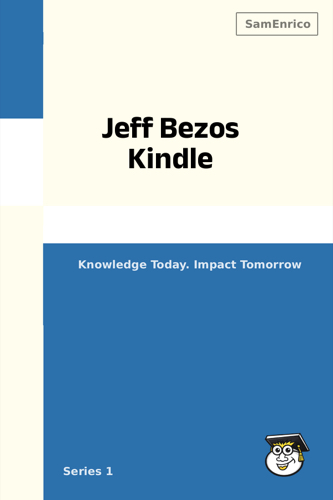
Non-FictionBiographyTech Founder
Jeff Bezos Kindle eBook
Chronicles the e reader that transformed publishin
Chronicles the e reader that transformed publishing.
Formats
Free sample
Chapter 1: The White Menace...--–- In the autumn of 2003, Jeff Bezos sat in his office on the fifth floor of Amazon’s Pacific Medical Center building in Seattle, staring at a financial model that should have brought him comfort but instead filled him with dread. The model showed Amazon’s physical book sales rising steadily, quarter over quarter, with no end in sight. The company had just reported its first full year of profitability. Wall Street was happy. The board was relieved.
And Bezos, a man who famously laughed in a way that sounded like a barking seal, was not laughing. He was terrified.The source of his terror was not a competitor like Barnes & Noble or Borders, both of which Amazon had already outmaneuvered. The source was a small, white device that had launched two years earlier, 3,000 miles away in Cupertino, California. The i Pod had sold its first million units in 2003, and while the music industry was reeling, Bezos saw something the book publishers did not: a template for the destruction of physical media. The music executives had laughed at digital downloads, then wept as Tower Records collapsed.
Bezos had no intention of becoming the Tower Records of books. But to avoid that fate, he would have to do something radical. He would have to build the very device that would make his core business obsolete.This chapter tells the story of that realization. It is not a chapter about hardware or software or supply chains. It is a chapter about fear—the specific, galvanizing fear that drives great entrepreneurs to destroy their own businesses before someone else does it for them.
The Kindle was not born in a laboratory. It was born in the wreckage of the music industry, and its godfather was not a engineer but a strategist who had learned to read the tea leaves of technological disruption.The Arrival of the White Plastic Menace The i Pod was not the first digital music player, just as the i Phone would not be the first smartphone. But it was the first device that solved every friction point that had kept consumers tethered to CDs. It was small enough to fit in a pocket. It held a thousand songs.
Its click wheel was intuitive. And most critically, it was married to the i Tunes Store, which sold individual songs for 99 cents with no subscription, no bundling, and no requirement to buy an entire album.Steve Jobs had done something revolutionary: he had convinced the record labels to unbundle the album, and in doing so, he had demonstrated that consumers would pay for digital convenience. The lesson was not lost on Bezos. He had watched the music industry’s slow-motion suicide from afar, and he had taken detailed notes. The record labels had seen digital files as a threat, so they had sued Napster, resisted licensing, and clung to physical CDs as their primary revenue stream.
By the time they agreed to work with Apple, the pirates had already trained a generation of consumers to expect free music. The labels survived, but they lost control.Bezos recognized that the book publishing industry was making the exact same mistakes. Publishers were licensing digital rights reluctantly, pricing e-books at the same level as hardcovers, and treating the entire digital category as a niche for tech enthusiasts rather than a tsunami about to hit. Bezos knew something the publishers did not: the tsunami was not coming in ten years. It was coming in three.The Numbers That Haunted Bezos To understand why Bezos moved so aggressively, it helps to look at the numbers he was tracking in 2003.
The music industry had peaked in 1999, with CD sales generating over $20 billion in revenue in the United States alone. By 2003, that number had fallen to $11 billion. The decline was not gradual; it was a cliff. Tower Records, which had been a retail icon for four decades, filed for bankruptcy in 2004. Virgin Megastores followed.
The record labels had lost two-thirds of their value in four years.Now consider the book industry in 2003. Physical book sales in the United States generated approximately $25 billion in revenue. Amazon’s share of that market was growing, but Bezos knew that the same forces that had crushed music retail were gathering around books. Digital files could be copied infinitely. Physical distribution was expensive.
And a new generation of consumers, raised on Napster and i Tunes, had no emotional attachment to paper.Bezos did not need to predict the future. He only needed to extrapolate from the present. If digital music had gone from zero to catastrophic in four years, digital books would do the same. The only question was who would control the platform.The Failed Predecessor: e Book Store 1.0Amazon had actually tried to enter the digital book market before the i Pod even existed. In 2000, Bezos launched the “e Book Store,” a section of Amazon’s website where customers could download digital books to read on their laptops or on dedicated devices like the Rocket e Book and the Soft Book.
It was a disaster.The technology was clunky. The selection was limited. And the user experience was designed by engineers who had never watched a non-technical person try to transfer a file. Bezos later called this the “Skills-Forward Trap”—the tendency to build what you can build rather than what customers want. The engineers had solved the technical problem of file delivery, but they had ignored the emotional problem of reading.Why the Skills-Forward Trap Is So Dangerous The Skills-Forward Trap is a specific form of hubris that affects technology companies more than any other industry.
It happens when engineers or product managers start with a list of capabilities—we can compress files, we can sync across devices, we can add bookmarks—and then build a product around those capabilities, assuming that customers will appreciate the sophistication. But customers do not appreciate sophistication. They appreciate simplicity. They do not want to know how the sausage is made. They want the sausage to taste good.The e Book store 1.0 was a classic Skills-Forward product.
It offered advanced features like text search, digital highlighting, and the ability to import personal documents. But it required users to download a proprietary reading application, connect their laptop to a slow internet connection, and then transfer files manually to a separate device. The process took twenty minutes for a single book. Reading on a laptop in 2000 meant hunching over a backlit screen, scrolling with a trackpad, and trying to ignore the email notifications that buzzed in the background. It was not a pleasure.
It was a chore.The e Book store 1.0 sold almost nothing. By 2002, Amazon had quietly deprioritized the entire effort. Most of the industry assumed that Amazon had given up on digital books. They were wrong. Bezos had not given up; he had simply realized that the technology was not ready.
The screen was wrong. The connectivity was wrong. The business model was wrong. And until all three were fixed, digital reading would remain a curiosity for early adopters rather than a mainstream habit.The 2004 Epiphany The turning point came in early 2004, during a series of meetings that…
This is the end of the free sample. Get the eBook to keep going. Buy now
About this book
Details
- Author
- Wingate Ashton
- Publisher
- SamEnrico
- Language
- English
- Genre
- Non-Fiction, Biography, Tech Founder
- Released
- 2026-06-05
- Pages (approx.)
- 123
- Available as
- eBook, Audiobook

Read better in the ZLOADR app
Your eBooks on your phone or tablet. Sign in with your SamEnrico account and start reading.
More by Wingate Ashton
 Cocaine Psychosis Recovery GuideWingate Ashton$11.99
 Forgiveness After Assault GuideWingate Ashton$11.99
 1031 Exchange Forced Sale ExceptionsWingate Ashton$11.99
 Number Chunking TechniquesWingate Ashton$11.99
 Resume Photo Inclusion GuideWingate Ashton$11.99
 Autumn Leaf PileWingate Ashton$11.99
 Commercial Real Estate Broker GuideWingate Ashton$11.99
 USS Missouri SailorWingate Ashton$11.99
 The Silk and the Scepter: A Queen’s Secret WarWingate Ashton$11.99
 The Last Library of Alexandria: A Digital Dark AgeWingate Ashton$11.99
 Bones, Badges, and the Beast of Bray RoadWingate Ashton$11.99
 The Complete Guide to the Honeycutt DietWingate Ashton$11.99
You may also like
 Hong Kong Handover 1997Dunn Johnnie$11.99
 Zumba For Postnatal Recovery CourseNeal Christian$11.99
 Zumba for BeginnersLadner Nikia$11.99
 YouTube Comment Mining GuideHumes Pandora$12.99
 Worry Box MeditationCarlin Rudy$11.99
 Workplace Stress MeditationNguyen Lynn$11.99
 Workplace Stress and Sleep RepairHawley Ivory$11.99
 Workplace Perfectionism CureDelaney Jeffry$11.99
 Workplace Injustice Anger GuideWallen Isabelle$11.99
 Work Addiction and Burnout LinkGreenwood Ester$11.99
 Women in Yoga and WellnessBeattie Galina$11.99
 Women in Stand Up ComedyChun Evangeline$11.99