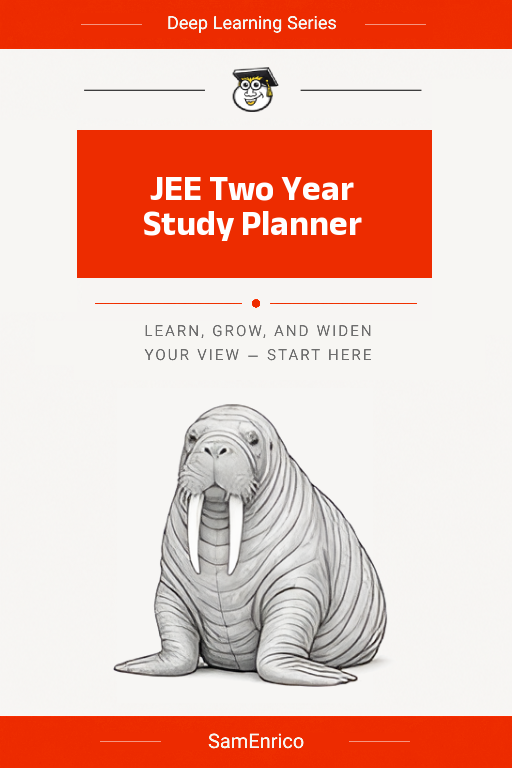
JEE Two Year Study Planner eBook
Map class 11 and 12 syllabus coverage, revision cy
by Sowell Reena
Map class 11 and 12 syllabus coverage, revision cycles, and mock test schedules for systematic JEE preparation.
Formats
Free sample
Chapter 1: The 24-Month Lie--Most JEE aspirants will fail. Not because they are less intelligent, not because they lack resources, and not because they didn't study hard enough. They will fail because they start with the wrong map.Picture this: Two students, Ankit and Priya, walk into the same coaching institute on the same April morning. Both have identical Class 10 percentages. Both have parents who believe in them.
Both have the same JEE Advanced dream. Twenty-four months later, Ankit is at IIT Bombay, and Priya is filling out forms for a private engineering college. What happened? Did Priya suddenly become less capable? Did she stop working hard?
No. Priya worked just as hard as Ankit—sometimes harder. But she worked on the wrong things at the wrong times.This book exists because that gap—between effort and outcome—is almost entirely preventable. It exists because the difference between an IIT seat and a disappointment is not raw intelligence. It is a system.
A calendar. A set of decisions made on ordinary Tuesday afternoons when no one is watching.The 24-Month Lie Here is the first and most dangerous lie you have been told: that JEE preparation is a two-year journey that begins in Class 11 and ends with JEE Advanced. That is technically true but practically useless. It is like saying a marathon is a 42-kilometer journey that begins at the start line. Yes, but how do you run it?
Where do you conserve energy? Where do you sprint? Where do you drink water? Where do you risk falling?The lie is that "two years" means you have time. Two years feels like a vast, forgiving ocean of days.
You are in Class 11. JEE Advanced is a distant, hazy dot on the horizon. There is no urgency. You attend classes, you do some homework, you scroll through your phone, and you tell yourself, "I will start seriously in a few months."But here is the truth that separates those who succeed from those who merely participate: Two years is not a long time. It is exactly 730 days.
Of those, approximately 200 days will be lost to school exams, board practicals, festivals, family obligations, sickness, and the simple exhaustion of being a teenager. Another 100 days will be eaten by coaching classes and travel. You are left with roughly 430 days of actual, productive self-study. And within those 430 days, the difference between an IIT rank and a three-digit rank comes down to fewer than 50 specific days where key decisions are made.This book is not a motivational speech. It is a calendar.
A weapon. A system that turns 730 confusing, overwhelming days into a precise, repeatable, almost mechanical process.The Reverse Engineering Principle Every successful JEE aspirant—every single one—does something that the rest do not. They start with the end and work backward. They do not ask, "What should I study today?" They ask, "What must be true 24 months from now for me to walk out of JEE Advanced with a smile on my face? And what does that force me to do today?"This is reverse engineering.
It is how architects build bridges, how software engineers write code, and how toppers crack the JEE.Let us perform this exercise together right now. Take a mental snapshot of the day before your JEE Advanced exam. You have 24 hours left. What do you wish to have accomplished in the preceding 730 days? Write it down.
Not vague wishes like "I want to be prepared." Specific, measurable outcomes: "I want to have solved 150 full-length mock tests." "I want my Error Notebook to contain no more than 20 unresolved conceptual mistakes." "I want to be able to derive every formula in Physics from first principles within 90 seconds."Now, work backward from that day. If you need 150 mocks under your belt, and you cannot realistically take more than one mock per day in the final two months (because analysis takes 3–4 hours), then you must start daily mocks no later than 60 days before the exam. That is Month 22 of your 24-month journey. If you start daily mocks at Month 22, then you must have completed the entire syllabus—every chapter, every topic, every formula—by Month 20. If the syllabus must be done by Month 20, then Class 12 material cannot spill into the gap after Board exams.
It must be finished while you are still in school. And if Class 12 material must be finished by Month 18, then Class 11 material—every single chapter—must be rock solid by the end of Class 11, because Class 12 builds on it relentlessly.Do you see what just happened? In five paragraphs, we have reverse-engineered your entire two-year journey into a series of non-negotiable deadlines. This is not a suggestion. This is the physics of time.
You cannot argue with a calendar.The Three Phases of the JEE Journey Now let us put those deadlines into a structure. The 24 months are divided into three distinct phases. Each phase has a different goal, a different rhythm, and a different measure of success. Mixing them up—studying for depth when you should be practicing speed, or taking full mocks when you have not finished the syllabus—is like using a hammer to screw in a nail. It wastes time and breaks things.Phase 1: The Learning Phase (Months 1–12, Class 11)Goal: Build unshakable conceptual foundations.
Not speed. Not JEE cutoffs. Not rankings. Understanding.In Phase 1, you are an architect drawing blueprints. You are not yet a construction worker carrying bricks.
The worst mistake you can make in Class 11 is to obsess over how many questions you can solve per hour or what your rank is in coaching tests. Those metrics matter later. Right now, the only metric that matters is: Do I understand why this formula works? Can I derive it? Can I explain it to someone who knows nothing about Physics or Chemistry or Math?Phase 1 focuses on depth over speed.
You will spend 6–8 hours per day on self-study, but those hours are not for racing through problems. They are for reading NCERT line by line (especially Inorganic Chemistry), for deriving every equation in Mechanics from Newton's Laws, for understanding why a quadratic equation has two roots and what that means for a real-world projectile.By the end of Phase 1, you should be able to solve any Class 11 problem given unlimited time. Speed comes later. Accuracy and understanding come first.Phase 2: The Integration Phase (Months 13–20, Class 12)Goal: Connect Class 11 and Class 12 topics while building problem-solving stamina.In Phase 2, you are no longer learning things for the first time. You are connecting dots.
You will discover that Electrostatics is just Gravitation with different constants. That Magnetism is Mechanics with a twist. That Organic Chemistry reactions follow patterns you first saw in GOC. That Calculus is the language of Physics.This is also when you begin timed problem-solving. You have the understanding from Phase 1.
Now you need the speed. Weekly chapter-wise tests begin in Phase 2 (though some institutes may start them earlier). Fortnightly part-syllabus tests begin midway through Phase 2.Phase 2 is the most demanding phase because you are juggling three things simultaneously: learning new Class 12 material, revising high-yield Class 11 topics, and practicing integration problems that combine both years. Most students collapse here…
This is the end of the free sample. Get the eBook to keep going. Buy now
About this book
Details
- Author
- Sowell Reena
- Publisher
- SamEnrico
- Language
- English
- Genre
- Non-Fiction, Student's Shortcut, Study Planning
- Released
- 2026-06-01
- Pages (approx.)
- 143
- Available as
- eBook, Audiobook

Read better in the ZLOADR app
Your eBooks on your phone or tablet. Sign in with your SamEnrico account and start reading.
More by Sowell Reena
 Perceptual Mapping Excel WorkbookSowell Reena$11.99
 PQ4R Study Method GuideSowell Reena$11.99
 Remote Retreats Technology SetupSowell Reena$11.99
 French Resistance Courier GuideSowell Reena$11.99
 Deep Work for Legal ProfessionalsSowell Reena$11.99
 The Billionaire's Secret: How Warren Buffett's $100 Million Bet Changed PhilanthropySowell Reena$11.99
 Runes of the Forgotten: Loki's Lost GambitSowell Reena$11.99
 How to Become a Mock-up BuilderSowell Reena$11.99
 Understanding Choreoacanthocytosis AmyotrophicSowell Reena$17.99
 Operations Department BudgetSowell Reena$12.99
 Pasta MakerSowell Reena$11.99