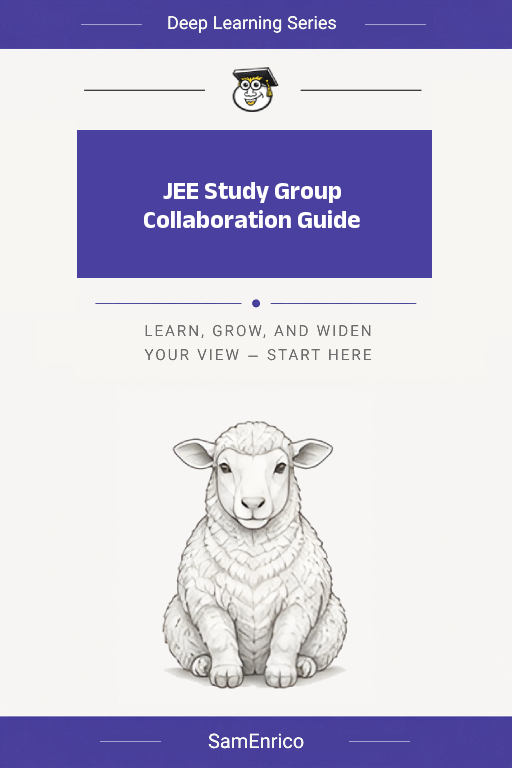
JEE Study Group Collaboration Guide Audiobook
Form effective peer learning groups, teach each ot
Form effective peer learning groups, teach each other, and share resources without distraction.
Formats
Free sample
Chapter 1: The Lonely Myth...--–- Arjun had a routine. Wake up at 5:00 AM, drink black coffee, and sit at his desk until 11:00 PM. His parents whispered outside his door. His friends stopped inviting him to outings. He had uninstalled Instagram, Snapchat, and even Whats App.
For eighteen months, he did everything "right." He finished two coaching modules. He watched every You Tube lecture from every popular teacher. He solved thirty years of previous JEE papers. When the JEE Advanced results came out, Arjun scored an All India Rank of 48,000. Not bad.
Not good enough for IIT. Meanwhile, his classmate Priya studied six hours a day, took weekends off, and worked regularly with a group of three friends. Her rank? 2,400. She got into IIT Kharagpur.
The difference wasn't intelligence. It wasn't hours logged. It was something far simpler and far more uncomfortable to admit: Arjun believed the myth, and Priya understood the science.The Myth of the Lone Wolf Every JEE aspirant has heard the story. The hero sits alone in a small room, surrounded by towering stacks of books, and grinds for sixteen hours a day. He emerges only for exams.
He has no social life, no distractions, no fun. And then he tops. This story is repeated in coaching center brochures, in motivational You Tube videos, and in the whispered legends parents pass around at PTMs. It is almost entirely wrong.Let us be clear about what the research actually says. Educational psychologists have studied thousands of high-performing students across engineering entrance exams worldwide.
The pattern is unmistakable. Students who study exclusively alone for more than eight hours a day experience what researchers call "diminishing returns after the fourth hour." That means hour five through hour twelve produce less learning per hour than hour one through hour four. The brain becomes saturated. Attention fragments. Mistakes increase.
And most dangerously, the solitary student develops blind spots that no one ever points out.Consider what happens when Arjun solves a physics problem incorrectly. He checks the solution. He sees his mistake. He tells himself, "Oh, I get it now." But does he? Research on the "explanation effect" shows that reading a correct solution produces only superficial learning.
The brain registers the answer and moves on. It does not rewire itself to prevent the same mistake tomorrow. When Priya solves the same problem in her group, she must explain her reasoning…
This is the end of the free sample. Get the Audiobook to keep going. Buy now
About this book
Details
- Author
- Henderson Seth
- Publisher
- SamEnrico
- Language
- English
- Genre
- Non-Fiction, Student's Shortcut, Group Study
- Released
- 2026-05-30
- Pages (approx.)
- 148
- Available as
- eBook, Audiobook

Listen in the VoxFlicks app
Audiobooks and audio dramas wherever you go. Sign in with your SamEnrico account and press play.
More by Henderson Seth
 Lactobacillus GuideHenderson Seth$11.99
 Self Esteem After CheatingHenderson Seth$11.99
 Blind Non24 Clock ResetHenderson Seth$11.99
 Trauma Response HierarchyHenderson Seth$11.99
 Personal Brand for HealthcareHenderson Seth$11.99
 PhD Imposter Syndrome GuideHenderson Seth$11.99
 Claims Process WalkthroughHenderson Seth$11.99
 The Cossack Thunder: How the Zaporozhian Host Defied the TsarHenderson Seth$11.99
 The Phantom Phone Phreak: The Hunt for the First Digital OutlawHenderson Seth$11.99
 How to Produce a Safety CoatingHenderson Seth$11.99
 How to Trade WoolHenderson Seth$11.99
 A Collector's Handbook to the Aston Martin Mk Ii LongHenderson Seth$11.99