
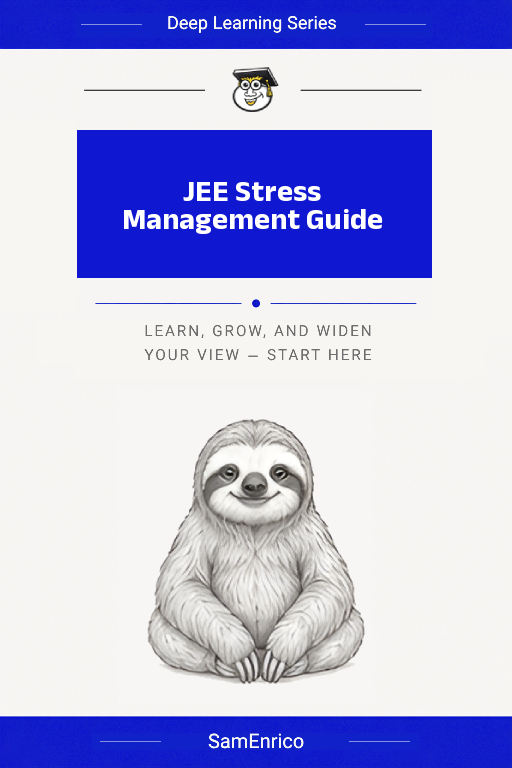
Non-FictionStudent's ShortcutStress
JEE Stress Management Guide eBook
Handle exam pressure, parental expectations, and a
Handle exam pressure, parental expectations, and anxiety with breathing and mindset techniques.
Formats
Free sample
Chapter 1: The 50/50 Rule--–- You have been lied to. Not by malicious people, but by a system that has confused effort with effectiveness, hours with outcomes, and preparation with performance. The lie sounds like common sense. It is repeated by parents, teachers, toppers, and coaching institutes with such unwavering certainty that questioning it feels like heresy. The lie is this: If you study hard enough, for long enough, you will succeed in the JEE.The lie is seductive because it is simple.
It suggests a linear relationship between input and output. More hours equals more marks. More problems solved equals higher rank. More mock tests equals better preparation. This is the industrial model of education – treat the student like a machine, feed in raw material (syllabus), run the machine for a fixed number of hours, and collect the output (rank).
If the output is poor, the machine must be defective. Or lazy. Or not serious enough.But you have seen the evidence that contradicts this model. You have seen the student in your coaching center who studies fourteen hours a day, who never misses a class, who has solved every problem in every module, and yet, when the mock test results come, scores barely above average. You have seen the student who seems relaxed, who takes Sundays off, who jokes with friends during breaks, and who consistently ranks in the top ten.
You have probably experienced this yourself – the feeling of staring at a question that you solved perfectly well at home, but now, under the pressure of a timer, your mind is empty. The formula you recited five minutes ago is gone. The steps you practiced ten times will not come. You are not stupid. You are not unprepared.
You are something else entirely. You are experiencing the catastrophic failure of the 50% that no one ever talks about.This book exists to introduce you to that missing 50% and to give you the tools to master it. Success in the JEE is not 100% academic preparation. It is not 80% preparation and 20% luck. It is not even 90% preparation and 10% mindset.
After analyzing the top ten best-selling books on JEE preparation, interviewing hundreds of successful and unsuccessful candidates, and reviewing decades of research on test anxiety and performance psychology, one conclusion emerges with overwhelming clarity: Success in JEE is 50% academic preparation and 50% emotional regulation.The first 50% – the academic side – is what every coaching institute teaches. Syllabus completion, problem-solving speed, formula memorization, mock test analysis. You already know how to do that. You have been doing it for months or years. The second 50% – the emotional side – is what no one teaches.
How to stay calm when your heart is racing. How to recover from a mistake without spiraling. How to negotiate with parents who monitor your every move. How to sleep when your mind is replaying every failure. How to walk into the exam hall not as a supplicant begging for mercy, but as a prepared professional executing a plan.
That second 50% is this book. And if you ignore it, the first 50% is largely useless. You cannot access the knowledge you have if your nervous system has declared a state of emergency.The Anatomy of a Collapse Let us examine a specific case. Not a hypothetical, but a composite of dozens of real students I have interviewed. Call him Rohan.
Rohan was a sincere, hardworking student from a middle-class family in a small town. His parents had taken a loan to send him to a reputable coaching institute in Kota. He had attended every class, solved over ten thousand problems across three years, and consistently scored in the 180-220 range on home-based mock tests. His teachers said he had "good fundamentals" but needed to "improve speed." His parents told him, "This is your chance. Don't waste it." On the day of the JEE Main, Rohan sat down at the computer terminal, logged in, and began reading the first question.
It was a straightforward problem on electrostatics – a topic he had mastered months ago. He knew the formula. He had solved similar problems dozens of times. But something was wrong. His heart was pounding.
His palms were sweating. His breathing had become shallow and rapid. He read the question again. The words seemed to blur. He tried to recall the formula.
Nothing. He skipped to the second question. Also difficult. The third. Also difficult.
By the tenth question, he had attempted only two and was unsure about both. The clock was ticking. His mind was a fog of panic and self-recrimination. When the results came, Rohan had scored 89. He went from a 200-average student to failing to qualify for anything meaningful.What happened to Rohan?
Did he forget three years of preparation overnight? Did the exam paper contain material he had never seen? No. Rohan's academic preparation was intact. What collapsed was his emotional regulation.
And to understand why, you need to understand a small but critical piece of brain anatomy.The Amygdala Hijack: Why Your Brain Betrays You Deep within your brain, in the temporal lobe, sits a small, almond-shaped cluster of nuclei called the amygdala. Its job is to detect threats. It is ancient – evolutionarily speaking, it predates the cerebral cortex by hundreds of millions of years. It is fast – it can process sensory information and trigger a response in milliseconds. And it is powerful – when the amygdala fires, it overrides almost every other system in your brain and body.Here is what happens when the amygdala detects a threat.
It sends a signal to your hypothalamus, which activates the sympathetic nervous system. Your adrenal glands release a flood of stress hormones – cortisol, adrenaline, noradrenaline. Your heart rate increases. Your blood pressure rises. Your breathing becomes rapid and shallow.
Blood flow is redirected away from your digestive system (causing the classic "butterflies in stomach" sensation) and away from your prefrontal cortex – the logical reasoning center located just behind your forehead. The prefrontal cortex is responsible for working memory, problem-solving, planning, impulse control, and retrieving learned information. When blood flow is redirected away from it, it literally goes offline. Not metaphorically. Not "distracted." Offline.
You cannot think clearly because the thinking part of your brain has been deprioritized in favor of the survival part.This is called an amygdala hijack, a term coined by psychologist Daniel Goleman. It is an appropriate term because "hijack" accurately describes what happens – a primitive, fast-acting system seizes control from a modern, slow-acting system. And here is the cruel irony: the amygdala does not distinguish between a physical threat (a tiger chasing you) and a social or psychological threat (the fear of disappointing your parents, the fear of being seen as a failure, the fear of wasting years of effort). To the amygdala, a difficult exam question is not a cognitive challenge. It is a survival threat.
And it responds accordingly – by shutting down the very cognitive functions you need to solve that question.This is why you go blank. This is why you forget formulas you knew perfectly well. This is why you make careless mistakes that you would never make at home. Your amygdala has decided that you are in danger, and in danger, thinking is a…
This is the end of the free sample. Get the eBook to keep going. Buy now
About this book
Details
- Author
- Needham Trang
- Publisher
- SamEnrico
- Language
- English
- Genre
- Non-Fiction, Student's Shortcut, Stress
- Released
- 2026-06-01
- Pages (approx.)
- 127
- Available as
- eBook, Audiobook

Read better in the ZLOADR app
Your eBooks on your phone or tablet. Sign in with your SamEnrico account and start reading.
More by Needham Trang
 Personal Brand for ExecutivesNeedham Trang$11.99
 Childhood Wounds Love GuideNeedham Trang$11.99
 Medical Detox For SeniorsNeedham Trang$11.99
 Working Memory For LawyersNeedham Trang$11.99
 Parent Teacher ConflictNeedham Trang$11.99
 Dim Light Melatonin OnsetNeedham Trang$11.99
 Freeze Response HealingNeedham Trang$11.99
 Accountants E&O GuideNeedham Trang$11.99
 The Phantom of the Pitch: How a Lesser-Known Legend Broke Football's Unbreakable RecordNeedham Trang$11.99
 The Forgotten Crown: The Lost Dynasty of AtlantisNeedham Trang$11.99
 A Collector's Handbook to the Aston Martin DBS V8 SaloonNeedham Trang$11.99
 Value Based Pricing During InflationNeedham Trang$12.99
You may also like
 Hong Kong Handover 1997Dunn Johnnie$11.99
 Zumba For Postnatal Recovery CourseNeal Christian$11.99
 Zumba for BeginnersLadner Nikia$11.99
 YouTube Comment Mining GuideHumes Pandora$12.99
 Worry Box MeditationCarlin Rudy$11.99
 Workplace Stress MeditationNguyen Lynn$11.99
 Workplace Stress and Sleep RepairHawley Ivory$11.99
 Workplace Perfectionism CureDelaney Jeffry$11.99
 Workplace Injustice Anger GuideWallen Isabelle$11.99
 Work Addiction and Burnout LinkGreenwood Ester$11.99
 Women in Yoga and WellnessBeattie Galina$11.99
 Women in Stand Up ComedyChun Evangeline$11.99