
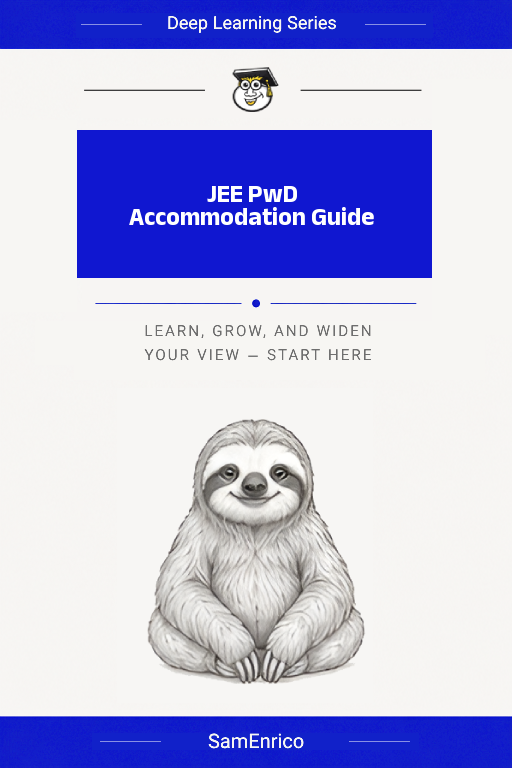
JEE PwD Accommodation Guide eBook
Apply for extra time and scribe facilities for eli
by Andre Matha
Apply for extra time and scribe facilities for eligible disabilities.
Formats
Free sample
Chapter 1: The Invisible 40%--–- When seventeen-year-old Arjun sat down for his first JEE mock test with a scribe, he solved thirty-two problems correctly in the first two hours. By the end of the fourth hour, he had solved fifty-seven. His parents cried. His coaching center called it a miracle. But six weeks later, when the real JEE Main application portal opened, Arjun couldn't even submit his form.
His medical certificate had the wrong stamp. His disability percentage was listed as "approximately 40%" instead of exactly "40%." And the phrase "limitation to write" was nowhere to be found. Arjun had done everything right except one thing: he had trusted what he heard on You Tube instead of what was written in the Rights of Persons with Disabilities Act 2016.This chapter is designed to ensure you never become Arjun. By the time you finish reading these pages, you will understand exactly what the RPw D Act 2016 means for your JEE journey, which disabilities qualify you for accommodations versus reservation, and why 40% is the single most important number in your preparation. You will also learn the critical distinction that most guides get wrong: the difference between getting a scribe (available to many) and getting a reserved seat (available only to some).
Let us begin with the law that changed everything for disabled students in India.The Law That Changed Everything On April 19, 2017, the Rights of Persons with Disabilities Act 2016 came into force, replacing the older Persons with Disabilities Act of 1995. This was not a minor update. It was a complete overhaul. The 1995 Act recognized only seven disabilities. The 2016 Act recognizes twenty-one.
The 1995 Act focused on charity and welfare. The 2016 Act focuses on rights, inclusion, and reasonable accommodation. For JEE aspirants, this shift from welfare to rights is everything. It means you are not asking for a favor when you request a scribe or extra time. You are demanding a legal right.The RPw D Act 2016 defines a "person with disability" as someone with a long-term physical, mental, intellectual, or sensory impairment that, interacting with barriers, hinders their full participation in society.
For the JEE, however, the National Testing Agency and the IITs do not use this broad definition. They use a narrower one: "benchmark disability."Benchmark Disability: The 40% Rule Here is the most important sentence in this entire chapter: A benchmark disability is a disability where the extent of impairment is certified to be 40% or more.That 40% is not arbitrary. It comes directly from Section 2(r) of the RPw D Act 2016. It is the threshold that separates two very different outcomes for JEE candidates. If your certified disability is 40% or above, you qualify for both accommodations (scribe, extra time, rest breaks) and the Pw D reservation quota in seat allocation.
If your certified disability is below 40%, you may still qualify for accommodations, but you will not receive any reservation benefit. This distinction is so important that we will return to it repeatedly throughout this book.The benchmark disabilities recognized under the RPw D Act 2016 that are most relevant to JEE aspirants fall into several categories. Locomotor disability includes conditions affecting bones, joints, or muscles that limit movement, including cerebral palsy, muscular dystrophy, and polio-induced weakness. Visual impairment includes blindness and low vision that cannot be fully corrected with glasses or contact lenses. Specific learning disabilities include dyslexia (difficulty reading), dysgraphia (difficulty writing), and dyscalculia (difficulty with mathematics) – but only when certified by a government healthcare institution, not a school psychologist.The Often-Overlooked Category: Difficulty in Writing Here is where the law becomes both powerful and confusing.
The RPw D Act 2016 includes a provision for "difficulty in writing" that is not always classified as a benchmark disability. A student with chronic wrist pain, repetitive strain injury, or a neurological condition that impairs fine motor control may receive scribe accommodations without meeting the 40% threshold. However – and this is critical – that student will not receive Pw D reservation benefits.Let me state this clearly because it is the single most misunderstood aspect of JEE Pw D accommodations: There are two separate benefits. Benefit One is accommodations – a scribe, extra time, rest breaks, a separate room. Benefit Two is reservation – a lower cutoff rank for admission into IITs, NITs, and IIITs.
You can receive Benefit One without Benefit Two. But you cannot receive Benefit Two without Benefit One. If your certificate says 38% and you have documented difficulty writing, you will get a scribe and extra time. You will not get a reserved seat. This is not a bug in the system.
It is the law.Throughout this book, when we refer to "eligible disabilities" for JEE, we are referring to disabilities that qualify for accommodations. When we refer to "benchmark disabilities," we are referring to disabilities that qualify for both accommodations and reservation. Keep these two categories separate in your mind, and you will avoid the confusion that derails hundreds of students every year.The Four Most Common JEE-Eligible Disabilities Let us walk through the disabilities most frequently encountered in JEE Pw D applications, explaining what each means for your exam strategy.Locomotor Disability refers to impairment of bones, joints, or muscles that limits movement of the limbs. This includes cerebral palsy (which may affect both motor control and speech), muscular dystrophy (progressive muscle weakness), polio-induced weakness, and spinal cord injuries. For JEE purposes, the key question is not whether you can walk.
It is whether you can write at normal speed for three to four hours without pain or fatigue. Many students with locomotor disability write slowly or with poor legibility, making a scribe essential. Others write normally but fatigue quickly, making extra time the primary accommodation. Your medical certificate must specify which limitation applies.Visual Impairment includes blindness and low vision. For JEE, low vision is defined as visual acuity less than 6/18 but equal to or better than 3/60, or a visual field of less than 20 degrees, even with the best possible correction.
If you wear glasses and your vision is correctable to 6/6, you do not qualify. The glasses must fail to correct your vision to normal levels. Students with visual impairment may need a reader (someone to read questions aloud), a scribe (someone to write answers), or both. They may also need enlarged question papers, screen reading software, or magnifying devices. Each of these accommodations requires specific certification.Specific Learning Disabilities – dyslexia, dysgraphia, dyscalculia – are neurological conditions that affect how the brain processes written information.
Dyslexia affects reading fluency and comprehension. Dysgraphia affects writing ability, including spelling, handwriting, and organizing thoughts on paper. Dyscalculia affects mathematical reasoning and number sense. These conditions are often invisible. A student with dysgraphia may be highly intelligent and verbally articulate but unable to write a coherent paragraph.
A student with dyslexia may solve complex calculus problems in their head but struggle to read the problem statement. The JEE recognizes these as legitimate disabilities, but the certification process is more stringent than for physical disabilities. You need a diagnosis from a government hospital's psychiatry or clinical psychology department, not a private educational psychologist. The certificate must specify the specific learning disability and its impact on exam-taking.Difficulty in Writing – as mentioned earlier – is the catch-all category for students who do…
This is the end of the free sample. Get the eBook to keep going. Buy now
About this book
Details
- Author
- Andre Matha
- Publisher
- SamEnrico
- Language
- English
- Genre
- Non-Fiction, Student's Shortcut
- Released
- 2026-05-30
- Pages (approx.)
- 139
- Available as
- eBook, Audiobook

Read better in the ZLOADR app
Your eBooks on your phone or tablet. Sign in with your SamEnrico account and start reading.
More by Andre Matha
 The MBSR for Migraine ReliefAndre Matha$11.99
 Speech Impediment Self EsteemAndre Matha$11.99
 Sales Active Listening GuideAndre Matha$11.99
 Douglas Dynasty - Michael DouglasAndre Matha$11.99
 Environment Creativity BoostAndre Matha$11.99
 Plyometric Injury PreventionAndre Matha$11.99
 Wholesaling PPC Ads GuideAndre Matha$11.99
 Left Lane Aggression GuideAndre Matha$11.99
 Forgiveness Without ChangeAndre Matha$11.99
 The Edge of the Sky: Wiley Post's Perilous Quest for the StratosphereAndre Matha$11.99
 Rhythm in the Shadows: The Untold Story of Pina Bausch's Wuppertal RevolutionAndre Matha$11.99
 Phaëthon’s Fall: The Sun Chariot DisasterAndre Matha$11.99
You may also like
 LSE Online Program LengthAgee Letisha$11.99
 Harvard Extension School for Working AdultsRoush Yer$11.99
 LSE Online Reading ListAshford Ludivina$11.99
 LSE Online Language RequirementsWhitten Daphine$11.99
 LSE Online Class SizeHughey Garret$11.99
 LSE Online Alumni MentorshipWild Lyla$11.99
 London School of Economics Alumni NetworkDutton Chantal$11.99
 Harvard Extension School Student SupportCantrell Christene$11.99
 Harvard Extension School Library AccessSantana Adah$11.99
 Harvard Extension School Degree CompletionBray Wyatt$11.99
 Harvard Extension School Course AuditingAbbott Craig$11.99
 Harvard Extension School Extension DiplomaNew Joane$11.99