
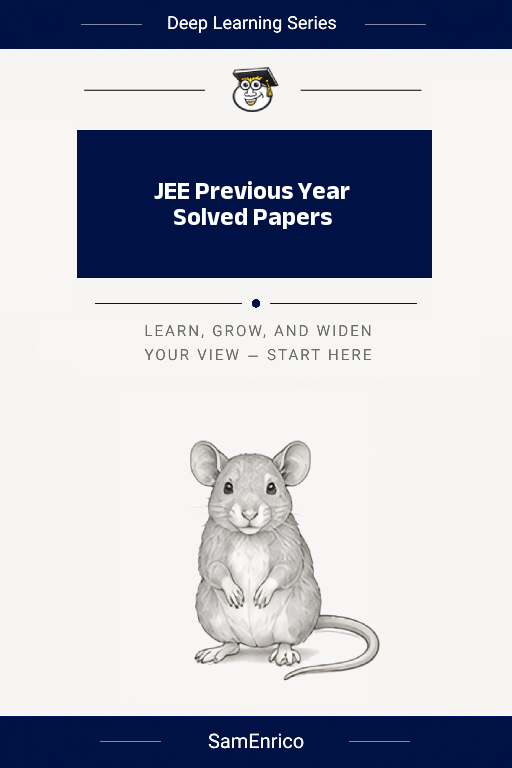
Non-FictionStudent's ShortcutExam Papers
JEE Previous Year Solved Papers Audiobook
Analyzes last 10 years of JEE Main and Advanced pa
by Ogle Chau
Analyzes last 10 years of JEE Main and Advanced papers with answer keys, detailed solutions, and topic-wise difficulty analysis.
Formats
Free sample
Chapter 1: The Decade Decoded--–- Every year, nearly 1.5 million students sit for the JEE Main examination. Of them, roughly 2.5 percent will qualify for JEE Advanced, and fewer than 0.5 percent will eventually secure a seat in an IIT. The difference between the top 0.5 percent and the rest is rarely a matter of raw intelligence. More often, it is a matter of strategy—specifically, the strategy of understanding the examination itself before attempting to master the syllabus. This chapter is not about physics, chemistry, or mathematics.
It is about the battlefield on which those subjects are tested. Welcome to the decryption of JEE Main and Advanced, based on the actual patterns of the past decade: 2017 through 2026.Most students open a solved-papers book and immediately start solving problems. That is like entering a battlefield without knowing where the mines are buried. Before you solve a single question, you must understand the rules of engagement. The JEE Main and Advanced are not random collections of problems.
They are meticulously designed instruments with predictable structures, recurring patterns, and exploitable asymmetries. This chapter will give you the strategic framework that transforms a mountain of previous year questions into a manageable, conquerable terrain.Section 1.1: The Anatomy of JEE Main (2017–2026)The National Testing Agency (NTA) has conducted JEE Main since 2019, taking over from the CBSE. But the pattern has evolved significantly over the decade we cover in this book. Understanding this evolution is crucial because a question from 2017 looks different from a question from 2026—not just in content but in format and intent.From 2017 to 2019, JEE Main consisted of 90 questions total: 30 each in Physics, Chemistry, and Mathematics. All questions were multiple-choice questions (MCQs) with four options and a single correct answer.
The marking scheme was straightforward: +4 marks for a correct answer, -1 mark for an incorrect answer, and 0 marks for an unattempted question. This pattern rewarded precision and punished guessing, but it also created a psychological barrier: students often left questions blank rather than risk the penalty.The year 2020 brought a fundamental shift. The NTA introduced Numerical Value Questions (NVQs)—questions that required a numeric answer entered via an on-screen keypad, with no options to choose from. Initially, each subject had 5 NVQs out of 30 questions. By 2022, that number increased to 10 NVQs per subject.
By 2026, the pattern stabilized at 20 MCQs and 10 NVQs per subject, giving a total of 30 MCQs and 30 NVQs across the three…
This is the end of the free sample. Get the Audiobook to keep going. Buy now
About this book
Details
- Author
- Ogle Chau
- Publisher
- SamEnrico
- Language
- English
- Genre
- Non-Fiction, Student's Shortcut, Exam Papers
- Released
- 2026-06-01
- Pages (approx.)
- 132
- Available as
- eBook, Audiobook

Listen in the VoxFlicks app
Audiobooks and audio dramas wherever you go. Sign in with your SamEnrico account and press play.
More by Ogle Chau
 Worry Time Boundary PracticeOgle Chau$11.99
 Road Rage And Road Rage VictimsOgle Chau$11.99
 Lawyer Anger ManagementOgle Chau$11.99
 Assertiveness for Coaches and ScoutsOgle Chau$11.99
 The Index of Forbidden BooksOgle Chau$11.99
 Fractured Crowns: The Unfinished War of BiafraOgle Chau$11.99
 Air Conditioning EngineerOgle Chau$11.99
 Understanding PicaOgle Chau$17.99
 VA Legal Contractor AgreementsOgle Chau$12.99
 How to Start a Button and Button Moulds Made of Plastic Business (Beginners Guide)Ogle Chau$11.99
You may also like
 Hong Kong Handover 1997Dunn Johnnie$11.99
 Zumba For Postnatal Recovery CourseNeal Christian$11.99
 Zumba for BeginnersLadner Nikia$11.99
 YouTube Comment Mining GuideHumes Pandora$12.99
 Worry Box MeditationCarlin Rudy$11.99
 Workplace Stress MeditationNguyen Lynn$11.99
 Workplace Stress and Sleep RepairHawley Ivory$11.99
 Workplace Perfectionism CureDelaney Jeffry$11.99
 Workplace Injustice Anger GuideWallen Isabelle$11.99
 Work Addiction and Burnout LinkGreenwood Ester$11.99
 Women in Yoga and WellnessBeattie Galina$11.99
 Women in Stand Up ComedyChun Evangeline$11.99