
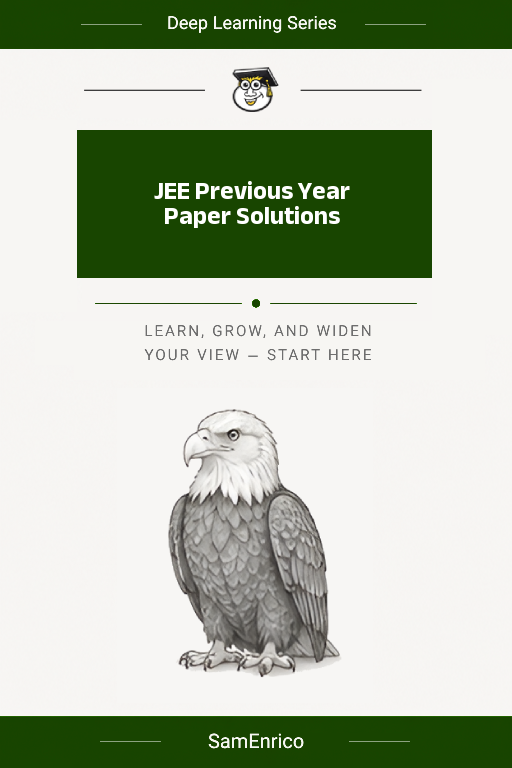
Non-FictionStudent's ShortcutPast Papers
JEE Previous Year Paper Solutions eBook
Solve and understand 10 years of JEE Main and Adva
Solve and understand 10 years of JEE Main and Advanced papers with detailed explanations.
Formats
Free sample
Chapter 1: The Map Before the Mountain--–- Every year, nearly 1.2 million students sit for the JEE Main. Of these, roughly 2.5 lakh qualify for JEE Advanced. And from that elite group, only about 16,000 finally make it to the IITs. The difference between the 1.2 million who start and the 16,000 who finish is not merely a matter of intelligence or hours spent studying. If raw intelligence were the deciding factor, the list of successful candidates would look very different every year—more random, less predictable.
But it is not random. Year after year, the same coaching institutes, the same cities, and often the same types of students dominate the ranks. Why? Because they have something that the other 1.18 million do not: a map.Consider this. Two students, Amit and Priya, both solve the same ten years of previous year papers (PYQs).
Amit solves them chronologically, year by year, from 2017 to 2026. He checks his answers, marks his score, and moves on. Priya, on the other hand, first spends three days analyzing what the papers are actually testing. She discovers that in Mathematics, Calculus alone accounts for 35-40% of the marks, while Trigonometry has been declining steadily since 2019. She learns that in Physics, Modern Physics overtook Optics in JEE Main by 2023, and that Rotational Mechanics in JEE Advanced has a peculiar pattern of appearing every other year in its most difficult form.
She finds that in Chemistry, Physical Chemistry numericals dominated from 2018 to 2021, but Organic reaction mechanisms made a strong comeback from 2022 onward. Armed with this map, Priya does not solve the papers in chronological order. She solves them by topic, by difficulty, and by strategic importance. By the time Amit has finished his tenth paper, Priya has solved only six—but her understanding is deeper, her weak spots are identified, and her time is used with surgical precision.This chapter is that map. It is not a collection of answers or a motivational speech.
It is a data-driven, decade-long autopsy of the JEE Main and Advanced examinations from 2017 to 2026. By the time you finish this chapter, you will know exactly which topics to prioritize based on your target rank, which subjects have shifted in importance over the years, and most critically, how to design your own personalized study plan that does not waste a single hour.1. The 60/20 Rule: Where Marks Actually Come From In any competitive examination, not all topics are created equal. The Pareto principle—often called the 80/20 rule—suggests that roughly 80% of effects come from 20% of causes. In the context of JEE, our analysis of ten years of papers (2017–2026) reveals a slightly different but equally powerful distribution: approximately 60% of the marks in any given year come from just 20% of the syllabus.
We call this the 60/20 Rule.Let us be precise. Over the ten-year period, we have categorized every single question from every shift of JEE Main and every paper of JEE Advanced into 42 distinct subtopics across Physics, Chemistry, and Mathematics. We then calculated two things for each subtopic: (a) its frequency of appearance (how many questions per year, on average) and (b) its yield (the average marks obtained by students who attempted those questions, normalized across years). The result is a shortlist of what we call High-Return Topics—the 20% that deliver 60% of the marks.High-Return Topics in Mathematics:Calculus (especially Definite Integrals, Area Under Curves, and Differential Equations) – appears in 4-5 questions per JEE Main paper and 6-7 questions per JEE Advanced paper. Yield: consistently high (65-70% of students who attempt these get them correct).Coordinate Geometry (Straight Lines, Circles, Conic Sections) – 3-4 questions per Main, 4-5 per Advanced.
Yield: moderate (55-60%).Vectors and 3D Geometry – 2-3 questions per Main, 3-4 per Advanced. Yield: surprisingly high (70-75%) because questions are often formula-based.High-Return Topics in Physics:Electrodynamics (Gauss’s Law, Capacitance, Current Electricity, Magnetic Effects) – 5-6 questions per Main, 7-8 per Advanced. Yield: moderate to high (60-70%).Newton’s Laws and Mechanics (Work-Power-Energy, Rotational Motion, Center of Mass) – 4-5 questions per Main, 6-7 per Advanced. Yield: moderate (55-65%).Modern Physics (Photoelectric Effect, Bohr Model, Nuclear Physics, Semiconductors) – 3-4 questions per Main, 2-3 per Advanced. Yield: very high (75-80%)—this is the single most profitable topic for JEE Main.High-Return Topics in Chemistry:Physical Chemistry (Thermodynamics, Chemical Equilibrium, Kinetics, Solutions) – 4-5 questions per Main, 5-6 per Advanced.
Yield: moderate (60-70%).Coordination Compounds – 2-3 questions per Main, 3-4 per Advanced. Yield: high (70-75%).Organic Chemistry Reaction Mechanisms (Aldol, Cannizzaro, Hoffmann, etc.) – 3-4 questions per Main, 5-6 per Advanced (in recent years). Yield: variable but increasing.If you are a student with limited time—and every JEE aspirant has limited time—your first and most important task is to master the High-Return Topics before you touch anything else. Do not spend two weeks perfecting the intricacies of Elasticity in Physics when you have not yet mastered Semiconductors. Do not memorize the entire Inorganic Chemistry periodic table before you can solve a Chemical Equilibrium numerical.
The 60/20 Rule is not a suggestion; it is a mathematical reality of the examination.2. Subject-Wise Weightage Shifts Over the Decade (2017–2026)A common mistake that students make is assuming that last year’s paper is a reliable predictor of next year’s paper. This is false. The JEE paper setters deliberately rotate emphasis across topics to prevent exactly this kind of mechanical preparation. However, over a ten-year period, clear patterns emerge—not year-to-year, but in cycles of 3 to 5 years.Physics: The Rise of Modern Physics and the Fall of Optics In 2017 and 2018, Optics was a significant player in JEE Main, accounting for 3-4 questions per paper.
Ray Optics and Wave Optics together formed a substantial block. By 2021, that number had dropped to 1-2 questions. By 2023, Modern Physics (Semiconductors, Dual Nature, Atoms, Nuclei) had overtaken Optics entirely, appearing in 4-5 questions per Main paper. Why? Because Modern Physics questions are often more numerical and less conceptual, making them easier to test in a multiple-choice format with a calculator.
Optics, by contrast, requires lengthy ray diagrams and sign conventions that are harder to assess quickly.In JEE Advanced, the story is different. Rotational Mechanics has fluctuated wildly. In 2018, it appeared in 4 questions (out of 18). In 2019, only 1 question. In 2021, 3 questions.
In 2024, 5 questions. There is a pattern: Rotational Mechanics appears in clusters of high-difficulty problems every 2-3 years. If you are targeting a rank below 5000, you cannot afford to ignore it even in a low-frequency year.Chemistry: The Physical-to-Organic Pendulum From 2018 to 2021, JEE Main saw a marked increase in Physical Chemistry numericals. Thermodynamics, Chemical Equilibrium, and Kinetics dominated, sometimes accounting for 7-8 questions out of 25. These were calculation-heavy problems that favored students comfortable with logarithms, quadratic equations, and unit conversions.Starting in 2022, however, the pendulum swung back toward Organic Chemistry.
Reaction mechanisms—Aldol condensation, Cannizzaro reaction, Hoffmann bromamide degradation—returned with force. By 2025, Organic Chemistry matched Physical Chemistry in question count, and in 2026, it slightly exceeded it. Inorganic Chemistry has remained relatively stable, with 4-5 questions per paper, but the nature of Inorganic has changed: more application-based questions (e.g., "Which of the following compounds is used in water softening?") and fewer direct fact-recall questions.Mathematics: The Slow Death of Pure Trigonometry and the Rise of Probability Trigonometry as a standalone topic has been declining steadily. In 2017…
This is the end of the free sample. Get the eBook to keep going. Buy now
About this book
Details
- Author
- Ashford Ashley
- Publisher
- SamEnrico
- Language
- English
- Genre
- Non-Fiction, Student's Shortcut, Past Papers
- Released
- 2026-06-01
- Pages (approx.)
- 139
- Available as
- eBook, Audiobook

Read better in the ZLOADR app
Your eBooks on your phone or tablet. Sign in with your SamEnrico account and start reading.
More by Ashford Ashley
 Musk Brand CreationAshford Ashley$11.99
 Meal Prep for Gut HealthAshford Ashley$11.99
 Salary Negotiation TalkAshford Ashley$11.99
 Personal Brand Networking GuideAshford Ashley$11.99
 The Virtual Commute MethodAshford Ashley$11.99
 Memory Training For Language LearningAshford Ashley$11.99
 Alcan Highway Builder AlaskaAshford Ashley$11.99
 Umbrella Liability GuideAshford Ashley$11.99
 The Robben Island Revolution: How Prisoners Shaped a NationAshford Ashley$11.99
 The Poisoner of Montpellier: France's First Serial KillerAshford Ashley$11.99
 A Collector's Handbook to the Aston Martin 15Ashford Ashley$11.99
 How to Produce RugsAshford Ashley$11.99
You may also like
 Hong Kong Handover 1997Dunn Johnnie$11.99
 Zumba For Postnatal Recovery CourseNeal Christian$11.99
 Zumba for BeginnersLadner Nikia$11.99
 YouTube Comment Mining GuideHumes Pandora$12.99
 Worry Box MeditationCarlin Rudy$11.99
 Workplace Stress MeditationNguyen Lynn$11.99
 Workplace Stress and Sleep RepairHawley Ivory$11.99
 Workplace Perfectionism CureDelaney Jeffry$11.99
 Workplace Injustice Anger GuideWallen Isabelle$11.99
 Work Addiction and Burnout LinkGreenwood Ester$11.99
 Women in Yoga and WellnessBeattie Galina$11.99
 Women in Stand Up ComedyChun Evangeline$11.99