
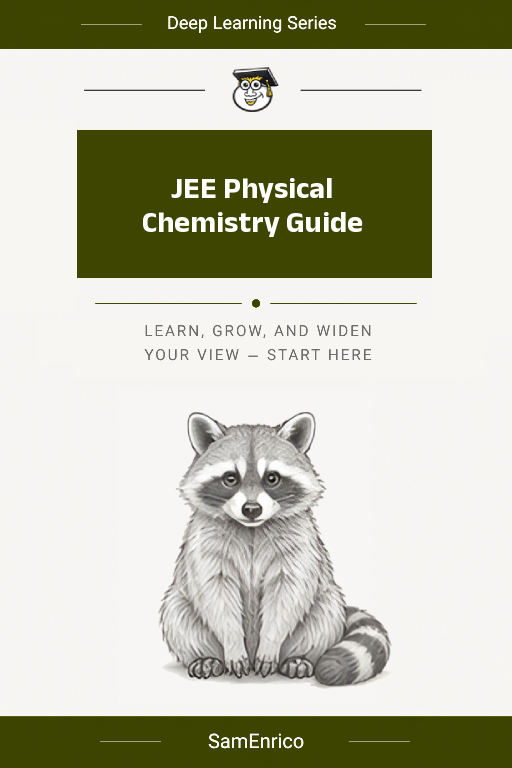
JEE Physical Chemistry Guide
Solve mole concept thermodynamics and kinetics pro
Solve mole concept thermodynamics and kinetics problems using systematic steps.
Formats
About this book
Free sample
Chapter 1: The Mole Compass...--–- Every year, over a million students attempt the JEE Advanced, and nearly every single one of them will lose marks on problems involving the mole concept. Not because the problems are inherently difficult, but because they lack a reliable navigation system. They memorize formulas—n=m Mn = \frac{m}{M}n=Mm, n=V22.4n = \frac{V}{22.4}n=22.4V, n=NNAn = \frac{N}{N_A}n=NAN—and then freeze when a problem combines grams, liters, and molecules in a single question. They treat each conversion as an isolated trick rather than a connected roadmap.This chapter will give you something better than formulas. It will give you The Mole Compass—a visual, step-by-step decision tree that works for every mole conversion problem, regardless of how messy the numbers or how many steps are involved.
By the end of this chapter, you will never look at a mole problem and wonder where to start. You will simply follow the compass.Before we dive into the compass itself, let us understand why the mole concept sits at the foundation of all JEE Physical Chemistry. Every single topic that follows—stoichiometry, thermodynamics, kinetics, equilibrium—requires you to count particles. The mole is how chemists count. If you cannot accurately convert between grams, liters, particles, and moles, you cannot solve any of the problems in the remaining eleven chapters.
This is not hyperbole. This is the cold reality of JEE preparation.Why Most Students Fail at Mole Conversions (And You Won't)Let me describe a scene that plays out in coaching centers across India every day. A student sees this problem: "Calculate the number of oxygen atoms in 50 g of Ca CO3Ca CO_3Ca CO3." The student writes n=50100=0.5n = \frac{50}{100} = 0.5n=10050=0.5 moles of Ca CO3Ca CO_3Ca CO3. Then they freeze. They know there are oxygen atoms inside, but how many?
They write 0.5×3=1.50.5 \times 3 = 1.50.5×3=1.5 moles of oxygen atoms. Then they multiply by NAN_ANA and get an answer. That is correct. But if the problem changes slightly—"Calculate the number of…
This is the end of the free sample. Get the eBook to keep going. Buy now
Contents
- Chapter 1
- Chapter 2
- Chapter 3
- Chapter 4
- Chapter 5
- Chapter 6
- Chapter 7
- Chapter 8
- Chapter 9
- Chapter 10
- Chapter 11
- Chapter 12
Details
- Author
- Mcallister Jarrett
- Publisher
- SamEnrico
- Language
- English
- Genre
- Non-Fiction, Student's Shortcut
- Released
- 2026-06-01
- Pages (approx.)
- 156
- Available as
- eBook, Audiobook

Read better in the ZLOADR app
Your eBooks on your phone or tablet. Sign in with your SamEnrico account and start reading.
More by Mcallister Jarrett
 Assertiveness For Social WorkersMcallister Jarrett$11.99
 Meniscus Tear Recovery GuideMcallister Jarrett$11.99
 Metta For AbusersMcallister Jarrett$11.99
 China Antitrust Merger BlocksMcallister Jarrett$11.99
 The Last SpankingMcallister Jarrett$11.99
 Immigrant Jewelry Designer SuccessMcallister Jarrett$11.99
 Wholesaling After Repair ValueMcallister Jarrett$11.99
 Glass Fracture Pattern AnalysisMcallister Jarrett$11.99
 Nudge Ethics GuidelinesMcallister Jarrett$11.99
 The Silent Roar: The Untold Story of the Olympic Scandal That Shook the WorldMcallister Jarrett$11.99
 Black Gold & Blood: The Untold Story of Coffee’s Darkest EmpireMcallister Jarrett$11.99
 The Boy Who Stole the Sun: The Untold Story of the 1968 Prague Spring ProtestsMcallister Jarrett$11.99
You may also like
 LSE Online Program LengthAgee Letisha$11.99
 Harvard Extension School for Working AdultsRoush Yer$11.99
 LSE Online Reading ListAshford Ludivina$11.99
 LSE Online Language RequirementsWhitten Daphine$11.99
 LSE Online Class SizeHughey Garret$11.99
 LSE Online Alumni MentorshipWild Lyla$11.99
 London School of Economics Alumni NetworkDutton Chantal$11.99
 Harvard Extension School Student SupportCantrell Christene$11.99
 Harvard Extension School Library AccessSantana Adah$11.99
 Harvard Extension School Degree CompletionBray Wyatt$11.99
 Harvard Extension School Course AuditingAbbott Craig$11.99
 Harvard Extension School Extension DiplomaNew Joane$11.99