
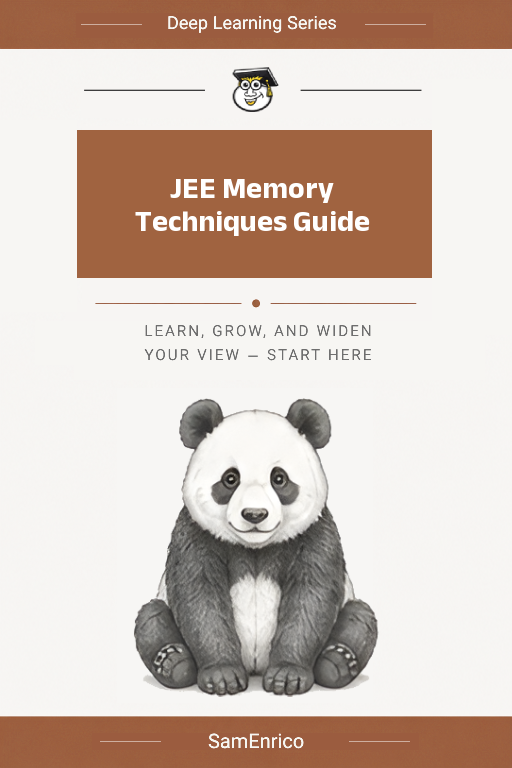
JEE Memory Techniques Guide eBook
Apply spaced repetition, memory palaces, and activ
Apply spaced repetition, memory palaces, and active recall to retain formulas, reactions, and constants long-term.
Formats
Free sample
Chapter 1: The 80% Graveyard--–- Rajesh, a second-year JEE aspirant from Kota, stared at his physics textbook on a Tuesday night in November. He had just spent six hours studying Thermodynamics – the first law, the second law, Carnot engines, entropy, the whole chapter. He understood everything. He solved fifteen numerical problems without looking at the solutions. He felt, for the first time in months, a flicker of confidence.
"I finally got it," he whispered to himself, closed the book, and went to sleep.The next morning, his tutor called him to the board. "Rajesh," he said, "write down the expression for the efficiency of a Carnot engine."Rajesh picked up the chalk. His hand hovered over the green slate. He remembered something about hot and cold reservoirs. He remembered a formula with T1 and T2.
But which one was numerator? Which one was denominator? Was it 1 minus T2/T1 or T1 minus T2 over T1? His mind raced through the six hours from the previous night, but all he found was a fog. He wrote something incorrect.
His classmates snickered. His tutor sighed. Rajesh sat down, his confidence shattered, and thought: "What is wrong with me?"Nothing was wrong with Rajesh. He was not lazy. He was not stupid.
He was not lacking in effort. Rajesh was a victim of a predictable, well-documented, and entirely preventable biological phenomenon – the same phenomenon that has frustrated students for over a century and that the entire multi-billion dollar coaching industry largely ignores. Rajesh was a victim of the Forgetting Curve.The Discovery That Changed Everything In 1885, a German psychologist named Hermann Ebbinghaus did something no one had done before. He decided to study memory scientifically, not anecdotally. He created a list of 2,300 nonsense syllables – meaningless three-letter combinations like "ZOF," "WUX," and "GIB" – so that prior knowledge would not interfere with his measurements.
Then he memorized these lists and tested himself at regular intervals, recording precisely how much he forgot and when.His findings were brutal. Ebbinghaus discovered that within one hour of learning something new, the human brain forgets approximately 50% of it. Within 24 hours, that number climbs to 70-80%. Within one week, without intervention, nearly 90% of newly learned information vanishes as if it had never been there.Ebbinghaus drew a graph of his results. It looked like a steep ski slope – a rapid, terrifying drop followed by a gradual leveling off.
He called this the Forgetting Curve. And here is the most important fact in this entire book: The Forgetting Curve is not a suggestion. It is not a tendency. It is a law of human neurobiology. Every student who has ever lived, from the ancient Greeks to the present day, has been subject to it.
No amount of motivation, intelligence, or willpower can override it. You cannot "try harder" and beat the Forgetting Curve any more than you can flap your arms and fly.But Ebbinghaus also discovered something else – something that most students and even many teachers do not know. He discovered that the Forgetting Curve can be flattened. It can be reshaped. And the tool for reshaping it is not more hours of study, not brighter highlighters, not louder motivational speeches.
The tool is timing.When Ebbinghaus reviewed material at strategically spaced intervals – just before he was about to forget it – the curve flattened dramatically. After one spaced review, he remembered more for longer. After two spaced reviews, even longer. After three, the information began to approach what we call "long-term memory" – not perfect, but durable enough to survive weeks or months without review.This discovery – the Spacing Effect – is the single most replicated finding in the history of cognitive psychology. It has been confirmed in thousands of studies across species (rats, pigeons, humans), across materials (nonsense syllables, vocabulary, math formulas, medical diagnoses), and across time intervals (minutes, days, years).
It works for everyone. It always works. And yet, almost no JEE aspirant uses it intentionally.The JEE Syllabus: A Numerical Nightmare Let us understand exactly what Rajesh was up against. The JEE syllabus is not large. It is enormous.
It is, by any reasonable standard, a memory task of superhuman proportions – not because the concepts are impossibly difficult, but because the sheer volume of discrete facts exceeds what the human brain can hold without a strategic system.Consider the numbers. Based on an analysis of the last ten years of JEE Main and Advanced papers, here is what a student must retain:Physics: Approximately 400 distinct formulas, spanning mechanics, electromagnetism, optics, thermodynamics, and modern physics. Each formula contains an average of four variables. Many formulas have special cases, sign conventions, and unit considerations. The formula for the magnetic field at the center of a current-carrying arc is different from the formula at the center of a solenoid.
The sign convention in thermodynamics (whether work done by the system is positive or negative) flips depending on which textbook you use. Each of these is a separate memory item.Chemistry: Approximately 300 named reactions in organic chemistry alone – Aldol, Cannizzaro, Wurtz, Fittig, Friedel-Crafts alkylation, Friedel-Crafts acylation, Sandmeyer, Gattermann, Reimer-Tiemann, Kolbe, Hell-Volhard-Zelinsky, and hundreds more. Each reaction has specific conditions: temperature (reflux? room temperature? ice bath?), solvent (dry ether?
aqueous? alcoholic?), catalyst (Al Cl₃? Fe Br₃? H₂SO₄?), and time (30 minutes? 6 hours?
overnight?). Inorganic chemistry adds color of ions (why is permanganate purple and chromate yellow?), qualitative analysis schemes (which group precipitates in which reagent?), and extraction processes (which ore requires froth flotation versus gravity separation?). Physical chemistry contributes its own formulas, constants, and exceptions.Mathematics: Approximately 200 standard integrals, 50+ differentiation rules, trigonometry identities (some of which have multiple equivalent forms), probability formulas (permutations with repetition, permutations without repetition, combinations, conditional probability, Bayes' theorem), 3D geometry formulas (distance between skew lines, angle between planes, equation of a sphere), and complex number transformations.Constants: Approximately 200 physical and chemical constants – some fundamental (speed of light, Planck's constant, gravitational constant), some derived (Rydberg constant, Bohr radius, Faraday constant), some measured (Avogadro's number, elementary charge, electron mass). Each constant has a numerical value that must be recalled with sufficient precision to avoid calculation errors.Add to this the countless exceptions, the edge cases, the "but remember that this formula breaks down when..." caveats that appear in every JEE problem. The total number of discrete memory items exceeds 5,000 by any reasonable estimate.And here is the kicker: The human working memory – the part of your brain that holds information you are actively thinking about – can hold approximately four items at once.
Four. Not forty. Not four hundred. Four. This limit has been established by decades of cognitive psychology research (Miller's Law, Cowan's research, the entire field of working memory studies).
You cannot expand your working memory through effort any more than you can expand your height through positive thinking.So here is the JEE Memory Crisis in a nutshell: You are required to remember over 5,000 discrete facts, but your brain can only actively work with four of them at a time. This is not a fairness problem. This is not a motivation problem. This is a design problem. Your brain was not designed to memorize 5,000 arbitrary facts and recall them on demand.
Your brain was designed to remember where the fruit trees are, which animals are dangerous, and how to get back…
This is the end of the free sample. Get the eBook to keep going. Buy now
About this book
Details
- Author
- Griggs Bernetta
- Publisher
- SamEnrico
- Language
- English
- Genre
- Non-Fiction, Student's Shortcut, Memory Skills
- Released
- 2026-05-29
- Pages (approx.)
- 137
- Available as
- eBook, Audiobook

Read better in the ZLOADR app
Your eBooks on your phone or tablet. Sign in with your SamEnrico account and start reading.
More by Griggs Bernetta
 The Chronic Lateness TalkGriggs Bernetta$11.99
 Remote Retreats for NonprofitsGriggs Bernetta$11.99
 Long Term Care Insurance Housing GuideGriggs Bernetta$11.99
 Deep Work for ConsultantsGriggs Bernetta$11.99
 Norwegian Resistance Sabotage CellGriggs Bernetta$11.99
 The Stargazer of Babylon: How a Forgotten Scholar Defied the CosmosGriggs Bernetta$11.99
 How to Start a Pouch Made of Leather or Leather Substitute Business (Beginners Guide)Griggs Bernetta$11.99
 End Of Year Budget SurplusGriggs Bernetta$12.99
 Public Health LawGriggs Bernetta$11.99
 Understanding Christmas DiseaseGriggs Bernetta$17.99