
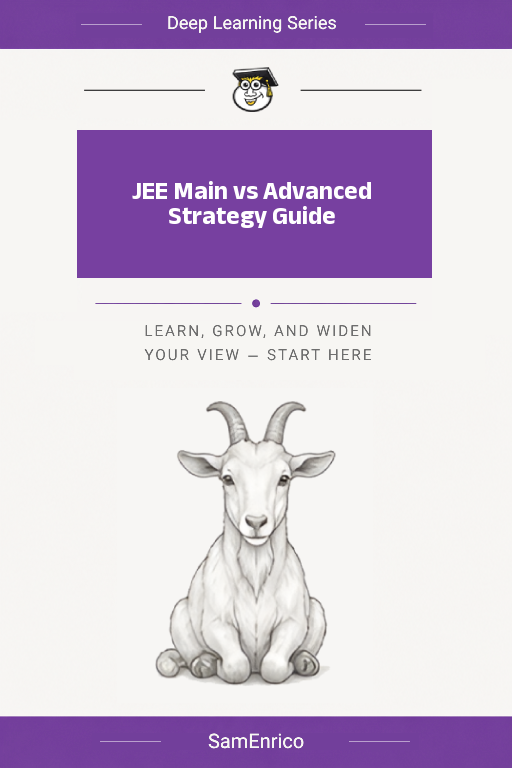
Non-FictionStudent's ShortcutTest Strategy
JEE Main vs Advanced Strategy Guide eBook
Understand the difference in difficulty, question
by Acuna Janeth
Understand the difference in difficulty, question types, and scoring patterns between both exams.
Formats
Free sample
Chapter 1: The Twin Illusion--Every year, nearly fifteen lakh students sit for the JEE Main examination. Of these, approximately two and a half lakh qualify for JEE Advanced. And of those, barely fifty thousand secure a seat in an Indian Institute of Technology. The remaining fourteen and a half lakh students – ninety-seven percent of all aspirants – either settle for National Institutes of Technology, IIITs, or other engineering colleges, or disappear into the cycle of drop years and regret.Here is the question that almost no one asks, but this book will answer on every single page: How many of those fourteen and a half lakh students actually prepared for the wrong exam?Not the easier exam. Not the harder exam.
The wrong exam.The distinction is not about difficulty. The distinction is about the fundamental nature of what is being tested. JEE Main and JEE Advanced are not two versions of the same test, one slightly more difficult than the other. That would be like saying a bicycle and a truck are both vehicles, just one is harder to drive. The truth is far more consequential.
JEE Main is a screening test designed to eliminate candidates quickly and efficiently. JEE Advanced is a ranking test designed to separate the top few thousand from the next few thousand with surgical precision.A screening test rewards speed, consistency, and mastery of a predictable syllabus. A ranking test rewards deep intuition, novel problem-solving, and the ability to handle unfamiliar question formats under sustained mental pressure. Preparing for both exams with the same strategy is like training for a hundred-meter sprint and a marathon using the same daily routine. You will not win either.This chapter dismantles the single most destructive myth in JEE preparation: that JEE Main is simply an easier version of JEE Advanced.
It then provides a framework for understanding what each exam actually rewards, a target score matrix based on real cutoff data, and a self-diagnostic quiz that forces you to answer the question that will determine your entire preparation strategy: Are you chasing the brand or the branch?The Myth of the Easier Version Walk into any coaching institute in Kota, Delhi, or Hyderabad, and you will hear some variation of this phrase: "Main ke liye utna nahi karna, Advanced ke liye karna hai." You do not need to do as much for Main; you need to do it for Advanced.On the surface, this sounds reasonable. Advanced is harder, so you should prepare harder for it. But this advice contains a hidden assumption that ruins more JEE attempts than any difficult question ever could. The assumption is that harder is simply more of the same. More practice.
More problems. More hours. That if you prepare for Advanced, you will automatically be prepared for Main.This assumption is false. Worse, it is dangerously false.Consider two students. Student A spends two years solving Irodov, Black Book, and J.D.
Lee – the holy trinity of Advanced preparation. Student B spends the same two years balancing speed drills for Main with conceptual depth for Advanced, using the 60-40 rule introduced in Chapter 8 of this book. Who scores higher on JEE Main?If you answered Student A, you are wrong. The student who solves only Advanced-level problems will be slow on Main. They will spend four minutes deriving an equation that a Main question expects them to plug into a formula in forty-five seconds.
They will run out of time. They will make silly calculation errors because they are not used to the pressure of a three-hour sprint. They will score lower on Main than Student B – sometimes substantially lower.And here is the cruel irony. That same Student A, who prepared only for Advanced, might also score lower on Advanced than Student B. Because Advanced requires speed too – not the same kind of speed as Main, but the ability to move through derivation steps efficiently.
A student who has never practiced timed problem-solving at all will choke under the six-hour marathon of Advanced as well.The myth of the easier version creates a false binary. Either you prepare for Main or you prepare for Advanced. Either you focus on NCERT or you focus on advanced problem books. Either you chase speed or you chase depth. This book exists to destroy that binary.
The correct answer is both – but with a strategic allocation of time that changes across the three phases of preparation detailed in Chapter 8.What JEE Main Actually Tests JEE Main is designed by the National Testing Agency with a specific mandate: to screen approximately fifteen lakh candidates down to two and a half lakh in a single three-hour examination. The word "screen" is critical here. When you are screening, you are not trying to distinguish between rank one hundred and rank one thousand. You are trying to eliminate the bottom eighty to ninety percent efficiently and accurately.A screening test has predictable characteristics. First, it heavily favors questions that can be graded by a machine without ambiguity.
This means multiple-choice questions and numerical value questions. Second, it favors questions that have a single correct answer derived from a standard formula or NCERT statement. Third, it favors speed over depth because the test makers know that time pressure is the most efficient way to separate candidates.What does this mean for you as a test-taker? It means that JEE Main rewards the following skills in order of importance:Speed. The ability to recognize a problem type within ten seconds, recall the relevant formula within another five seconds, and execute the calculation within the next thirty seconds.
In Main, a problem that requires four minutes of derivation is a failed problem – not because you cannot solve it, but because the opportunity cost of those four minutes is two or three easier problems that you will now leave unsolved.Accuracy. Not the kind of accuracy that comes from understanding deep principles, but the kind that comes from careful reading, proper sign conventions, and avoiding simple arithmetic mistakes. In Main, a silly mistake on a numerical value question costs you four marks with no negative marking in Section B, which is devastating when you consider that the difference between a rank of ten thousand and twenty thousand is often just ten to fifteen marks.NCERT mastery. Approximately sixty percent of JEE Main questions are directly solvable using NCERT content without any additional reference books. This is especially true for Chemistry, where Inorganic and Organic questions are frequently lifted almost verbatim from NCERT tables and reaction schemes.
Chapter 4 of this book provides a detailed five-year statistical breakdown of exactly which topics from NCERT appear most frequently.Familiarity with question patterns. JEE Main reuses question archetypes. If you have solved the previous ten years of Main papers, you will encounter very few genuinely novel problems on exam day. This predictability is a feature of screening tests. It allows the NTA to reliably compare performance across years.Now notice what is not on this list.
Deep conceptual understanding is not a primary driver of Main scores. Novel problem-solving is not required. Partial marks strategies are irrelevant because Main does not have partial marking except for the numerical…
This is the end of the free sample. Get the eBook to keep going. Buy now
About this book
Details
- Author
- Acuna Janeth
- Publisher
- SamEnrico
- Language
- English
- Genre
- Non-Fiction, Student's Shortcut, Test Strategy
- Released
- 2026-06-01
- Pages (approx.)
- 153
- Available as
- eBook, Audiobook

Read better in the ZLOADR app
Your eBooks on your phone or tablet. Sign in with your SamEnrico account and start reading.
More by Acuna Janeth
 Musk Engineering FirstAcuna Janeth$11.99
 Non 24 Hour Sleep WakeAcuna Janeth$11.99
 Meal Prep for Theme NightsAcuna Janeth$11.99
 YouTube Personal Brand GuideAcuna Janeth$11.99
 Request Conversation GuideAcuna Janeth$11.99
 Quartermaster Supply Chain WarAcuna Janeth$11.99
 Cyber Insurance OverviewAcuna Janeth$11.99
 Auditory Memory Training MethodAcuna Janeth$11.99
 The Case of the Phantom Killer: The Trial That Defined Forensic ScienceAcuna Janeth$11.99
 The Clown Killer of Phoenix: A Carnival of Terror (2005-2007)Acuna Janeth$11.99
 How to Trade MilkAcuna Janeth$11.99
 How to Produce Fingerboards and Fingerboard SetsAcuna Janeth$11.99
You may also like
 Hong Kong Handover 1997Dunn Johnnie$11.99
 Zumba For Postnatal Recovery CourseNeal Christian$11.99
 Zumba for BeginnersLadner Nikia$11.99
 YouTube Comment Mining GuideHumes Pandora$12.99
 Worry Box MeditationCarlin Rudy$11.99
 Workplace Stress MeditationNguyen Lynn$11.99
 Workplace Stress and Sleep RepairHawley Ivory$11.99
 Workplace Perfectionism CureDelaney Jeffry$11.99
 Workplace Injustice Anger GuideWallen Isabelle$11.99
 Work Addiction and Burnout LinkGreenwood Ester$11.99
 Women in Yoga and WellnessBeattie Galina$11.99
 Women in Stand Up ComedyChun Evangeline$11.99