
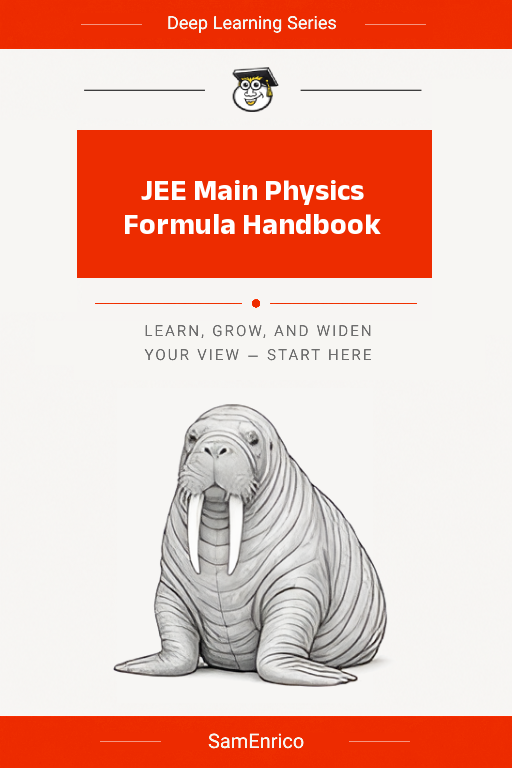
JEE Main Physics Formula Handbook eBook
Master all essential physics formulas with memory
Master all essential physics formulas with memory tricks and quick revision strategies for JEE Main success.
Formats
Free sample
Chapter 1: The 6,400 Formula Lie--–- Most JEE aspirants believe they have a memory problem. They don't. They have a strategy problem. Let me prove this to you with a simple experiment. Right now, try to recall the formula for the kinetic energy of a rolling solid sphere on an inclined plane.
If you hesitated for more than three seconds, you probably thought, "I know this… wait, is it ½mv² plus something with omega?" That hesitation is not a failure of memory. It is a failure of how you organized that memory in the first place.Here is the uncomfortable truth that no coaching institute will tell you. The average JEE Main syllabus contains approximately 400 to 500 core physics formulas. Yet most students spend hundreds of hours memorizing derivations, solving thousands of problems, and still freeze during the exam when they need to recall a simple equation like s = ut + ½at². Why?
Because they are using the wrong memory system. They are trying to store physics formulas like isolated facts rather than building a connected, retrieval-ready network in their brain.This entire book exists to solve one specific problem. Not the problem of understanding physics. Standard textbooks like HC Verma and NCERT already do that well. Not the problem of practicing problems.
PYQ banks like Disha and Arihant cover that exhaustively. The problem this book solves is the gap between knowing a formula and recalling it instantly under the pressure of a three-hour exam with ninety questions. That gap is where most students lose thirty to forty marks.I call this the 6,400 Formula Lie. Here is what I mean. Most students believe they need to memorize every formula that appears in their textbooks.
That number, across all topics, can feel like 6,400 tiny pieces of information. But that is a lie. You do not need to memorize six thousand formulas. You need to master approximately 400 core formulas and learn how to reconstruct the rest from first principles in under three minutes. The difference between memorizing six thousand disconnected facts and mastering four hundred connected patterns is the difference between a rank in the thousands and a rank under five hundred.Let me give you a concrete example.
In rotational motion, there are at least twenty different moments of inertia formulas for different shapes. Most students try to memorize each one separately. A smarter student notices that all moments of inertia follow the pattern I = k MR², where k varies from 1 (ring) down to 0.4 (solid sphere). That single observation compresses twenty formulas into one pattern plus a short list of k values. This is not cheating.
This is efficient memory architecture.This chapter will teach you three foundational systems. First, the 3-30-3 Rule, which transforms how you practice formula recall. Second, the Priority Formula Deck, which uses active recall and spaced repetition to move formulas from short-term to long-term memory. Third, the Question Triage Strategy, which helps you scan the JEE Main paper in the first few minutes and identify which formulas you will need. By the end of this chapter, you will never again stare at a blank rough sheet wondering where to start.But before we dive into the systems, we need to understand why traditional memorization fails.
This is not about laziness or low intelligence. This is about cognitive science.The Forgetting Curve and Why Your Brain Betrays You In the late 1800s, a German psychologist named Hermann Ebbinghaus discovered something disturbing. He memorized lists of nonsense syllables and tested himself at various intervals. He found that within one hour of learning, his memory dropped by nearly fifty percent. Within twenty-four hours, he had forgotten almost two-thirds of what he learned.
This became known as the forgetting curve. And it is still true for every student reading this book.When you learn a formula in class on Monday, by Wednesday you have already forgotten forty percent of it unless you review it actively. By Friday, you remember barely half. This is not a personal failing. This is how human memory works.
The brain is designed to discard information that appears unimportant or infrequently used. Your study habits have to explicitly fight this natural tendency.Most students fight the forgetting curve using passive review. They read their notes again. They highlight formulas in bright colors. They rewatch lecture recordings.
This feels productive, but research consistently shows that passive review is one of the least effective study methods. It creates familiarity—you recognize the formula when you see it—but it does not create recall. And the exam does not ask you to recognize formulas. It asks you to recall them from nothing.The difference between recognition and recall is enormous. Recognition is seeing the formula for kinetic energy KE = ½mv² written on a page and thinking, "Yes, I have seen that before." Recall is sitting in the exam hall, reading a problem about a block sliding down an incline, and writing KE = ½mv² from memory without any prompt.
Recognition is easy. Recall is hard. And recall is the only skill that matters on exam day.This entire book uses methods that target recall specifically. Every memory trick, every mnemonic, every visual code is designed to force your brain to retrieve information, not just recognize it. The 3-30-3 rule that follows is a training protocol for recall.
The Formula Deck uses active recall, which is the most research-backed method for moving information into long-term memory. And the Question Triage Strategy helps you map problems to the correct recall pathways during the exam.The 3-30-3 Rule: A Training Protocol for Recall Let me introduce you to the 3-30-3 rule. This is not an exam strategy. Let me repeat that because it is critically important. The 3-30-3 rule is for offline practice only.
During the actual JEE Main exam, you will never spend three minutes deriving a formula. But during your preparation, this rule builds neural redundancy that protects you when you are stressed.Here is what the 3-30-3 rule means in practice.First, three seconds. You should be able to write any core formula from a given chapter in three seconds flat. Not ten seconds. Not "I can derive it in a minute." Three seconds.
This trains pure automatic recall. When you see a problem about a projectile, your hand should write v = u + at before your conscious mind even finishes reading the question. That is the level of automaticity we are building.Second, thirty seconds. You should be able to apply that formula to a basic JEE Main level problem using direct substitution. For example, given u = 10 m/s, a = 2 m/s², t = 5 s, you should find v in thirty seconds or less.
This connects the formula to its application context. Many students can recite a formula but freeze when they have to plug in numbers because they have not practiced the substitution step under time pressure.Third, three minutes. You should be able to derive the formula from first principles if your memory fails. This is your safety net. During the exam, you will never spend three minutes deriving a formula.
But in your practice sessions, you should practice derivation so that even if you forget the formula, you can rebuild…
This is the end of the free sample. Get the eBook to keep going. Buy now
About this book
Details
- Author
- Lambert Joseph
- Publisher
- SamEnrico
- Language
- English
- Genre
- Non-Fiction, Student's Shortcut
- Released
- 2026-06-01
- Pages (approx.)
- 150
- Available as
- eBook, Audiobook

Read better in the ZLOADR app
Your eBooks on your phone or tablet. Sign in with your SamEnrico account and start reading.
More by Lambert Joseph
 Immigrant Child Care Entrepreneur SuccessLambert Joseph$11.99
 ABCDE For One On One MeetingsLambert Joseph$11.99
 Metta For Grieving ParentsLambert Joseph$11.99
 Port Wine Stain Self-EsteemLambert Joseph$11.99
 Virtual Mentorship Best PracticesLambert Joseph$11.99
 The Cold ShoulderLambert Joseph$11.99
 Runner Knee Injury PreventionLambert Joseph$11.99
 Lotus Symbol RebellionLambert Joseph$11.99
 The Last Dance of the Red Baron: Aerial Duel That Shook the WorldLambert Joseph$11.99
 Assertiveness For TeensLambert Joseph$11.99
 The Last Great Ascent: Reinhold Messner and the Conquest of K2Lambert Joseph$11.99
 Nefertiti’s Lost Voice: The Pharaoh Who Vanished from HistoryLambert Joseph$11.99
You may also like
 Hong Kong Handover 1997Dunn Johnnie$11.99
 Zumba For Postnatal Recovery CourseNeal Christian$11.99
 Zumba for BeginnersLadner Nikia$11.99
 YouTube Comment Mining GuideHumes Pandora$12.99
 Worry Box MeditationCarlin Rudy$11.99
 Workplace Stress MeditationNguyen Lynn$11.99
 Workplace Stress and Sleep RepairHawley Ivory$11.99
 Workplace Perfectionism CureDelaney Jeffry$11.99
 Workplace Injustice Anger GuideWallen Isabelle$11.99
 Work Addiction and Burnout LinkGreenwood Ester$11.99
 Women in Yoga and WellnessBeattie Galina$11.99
 Women in Stand Up ComedyChun Evangeline$11.99