
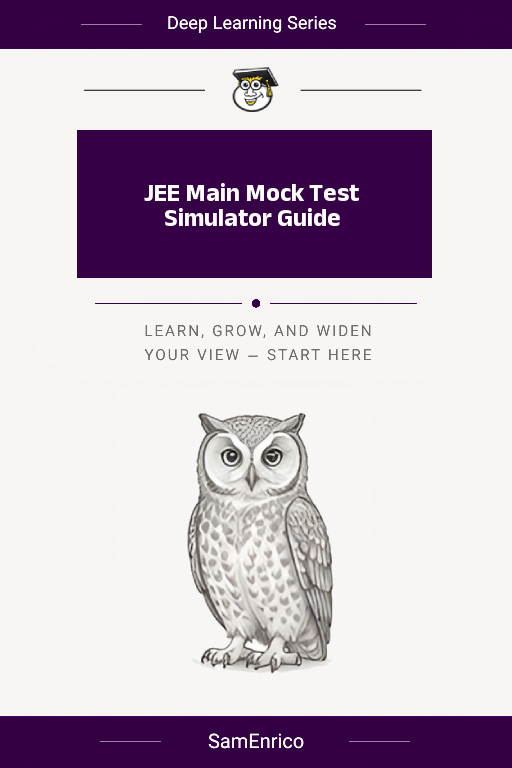
JEE Main Mock Test Simulator Guide eBook
Take 50 full length timed tests with performance a
Take 50 full length timed tests with performance analytics to identify weak chapters before exam.
Formats
Free sample
Chapter 1: The Testing Trap--–- Rohan was not a bad student. By all conventional measures, he was a good one. He attended every coaching class, finished all his homework, and spent his weekends rewatching video lectures on Electrodynamics because, as his teachers said, “revision is the mother of learning.” Three months before his JEE Main attempt, he had covered 85% of the syllabus. He had filled three notebooks with neatly highlighted formulas. He could explain Faraday’s Law to anyone who asked, and he had memorized the entire periodic table’s s-block and p-block trends.Yet, when he sat for his first full-length mock test, something terrifying happened.
His mind went blank. Not the kind of blank where you forget one formula – the kind where you stare at a simple question on Ohm’s Law and suddenly cannot remember whether V = IR or I = VR. The timer ticked. His palms sweated. By the end of three hours, he had attempted only 54 of the 90 questions.
His score was 97 out of 300. He looked at the result and felt a quiet, crushing certainty: I am not good enough.Rohan’s story is not unusual. It is, in fact, the most common story in JEE preparation. Thousands of students every year study for 12, 14, even 16 hours a day. They attend coaching, solve thousands of problems, and yet, when the mock test arrives – or worse, when the real exam arrives – they underperform dramatically.
The gap between effort and outcome is so wide and so consistent that it cannot be explained by “lack of intelligence” or “laziness.” Something else is happening.This chapter is about that something else.It is about a cognitive principle that most students have never heard of, even though it is one of the most replicated findings in the science of learning. It is about why Rohan’s three notebooks and hundreds of hours of revision did not save him. And it is about a single shift in mindset – from practice to simulation – that can double your mock test scores in weeks, not months.Welcome to the Testing Effect.The Myth That Is Destroying Your Scores Let us begin with a simple question. If you want to get better at swimming, do you spend most of your time reading books about swimming? Do you watch videos of Olympic swimmers and take notes on their technique?
Do you memorize the physics of buoyancy and drag?No. You get into the water. You swim. You fail. You swim again.And yet, when it comes to JEE preparation, most students do the exact opposite.
They spend 80% of their time studying – reading, watching, highlighting, re-reading – and only 20% of their time testing. This is backwards. Decades of cognitive psychology research have shown that retrieval practice (pulling information out of your memory) is dramatically more effective than repeated exposure (putting information into your memory).The most famous study on this was conducted by psychologists Roediger and Karpicke in 2006. They gave students a prose passage to learn. One group studied the passage four times (repeated reading).
Another group studied it once and then took three practice tests (retrieval practice). One week later, the repeated-reading group remembered only 40% of the material. The retrieval-practice group remembered 65% – a 62% improvement. No new information was given to either group. The only difference was how they interacted with what they already knew.This is the Testing Effect.
It is not about “testing” as in grading or evaluation. It is about testing as a learning mechanism. Every time you successfully retrieve an answer from your memory, you strengthen the neural pathway to that information. Every time you struggle to retrieve and then succeed, you strengthen it even more. The act of retrieval literally changes the structure of your brain.Most JEE aspirants do not know this.
They treat mock tests as measurements – as report cards that tell them how much they have learned. They think: “I will study first, then I will test.” This is a catastrophic error. Testing is not the end of learning. Testing is learning.The Difference Between Practice and Simulation Here is where we must introduce a distinction that will run through this entire book. Most students who take mock tests are not actually simulating anything.
They are practicing.What is the difference?Practice Mindset: You take a mock test but you pause when you get stuck. You check the answer key halfway through to see if you are on the right track. You allow yourself to stretch, get water, or check your phone between sections. You treat the test as a learning exercise – comfortable, flexible, forgiving.Simulator Mindset: You take the mock test exactly as if it were the real JEE Main. You sit at a clean desk with no distractions.
You set a timer for 180 minutes and do not stop it for any reason. You do not pause. You do not check answers until the timer ends. You do not eat, drink, or look at your phone. You replicate the pressure, the silence, and the stakes.The Practice Mindset feels good.
It reduces anxiety. It allows you to learn during the test. But it also robs you of the single most valuable benefit of mock exams: stress inoculation.Stress inoculation is a concept from military and sports psychology. The idea is simple: you cannot eliminate stress, but you can train your nervous system to respond to stress effectively rather than catastrophically. Fighter pilots train in simulators that replicate the sensory overload of actual combat.
Olympic athletes practice with crowd noise piped into their training facilities. Surgeons practice emergency procedures on lifelike mannequins that bleed and beep.In every case, the goal is the same: to make the real event feel familiar, so that when stress hormones flood the body, the brain does not panic. It executes trained routines.When you take a mock test with a Practice Mindset, you are training your brain to expect a comfortable, low-pressure environment. Then, when the real exam arrives – with its strict proctors, its unfamiliar room, its irreversible timer – your brain experiences a mismatch. The stress feels new.
It feels dangerous. And you freeze.When you take a mock test with a Simulator Mindset, you are training your brain to expect pressure. The real exam becomes just another simulation – your 51st, if you follow this book’s 50-test plan. Your heart may still race, but your hands will know what to do. Your breathing may quicken, but your eyes will move across the page in familiar patterns.This is not theory.
A 2019 study of medical students taking their licensing exams found that those who completed at least 12 full-length simulated exams had heart-rate variability patterns during the real exam that were indistinguishable from their baseline – meaning their bodies did not register the exam as a threat. The students who took fewer than 4 simulations showed sharp increases in heart rate, cortisol, and self-reported panic.The Practice Mindset feels safer. The Simulator Mindset is safer.Why Your Brain Lies to You About Studying There is another reason students fall into the Practice Mindset. It is not just comfort – it is illusion. Your brain actively deceives you into believing that studying is more effective than testing.Here is…
This is the end of the free sample. Get the eBook to keep going. Buy now
About this book
Details
- Author
- Basham Loraine
- Publisher
- SamEnrico
- Language
- English
- Genre
- Non-Fiction, Student's Shortcut
- Released
- 2026-06-01
- Pages (approx.)
- 147
- Available as
- eBook, Audiobook

Read better in the ZLOADR app
Your eBooks on your phone or tablet. Sign in with your SamEnrico account and start reading.
More by Basham Loraine
 Drug Dependency and Overdose AftercareBasham Loraine$11.99
 Shenandoah Missing PersonsBasham Loraine$11.99
 Nobel Laureates In Particle PhysicsBasham Loraine$11.99
 Rewire Betrayal Self TalkBasham Loraine$11.99
 Sighing as Emotional ReleaseBasham Loraine$11.99
 Adam Neumann WeWorkBasham Loraine$11.99
 The Nobel Laureate Refugee StoriesBasham Loraine$11.99
 Beginner Meditation MistakesBasham Loraine$11.99
 The Rendlesham Forest Incident: Britain’s RoswellBasham Loraine$11.99
 The Green Banner of the Qing: How the Manchus Conquered the Forests of ChinaBasham Loraine$11.99
 The Velvet Revolution: How Mozart Redefined Royal CourtsBasham Loraine$11.99
 How to Produce a Breast FormBasham Loraine$11.99
You may also like
 LSE Online Program LengthAgee Letisha$11.99
 Harvard Extension School for Working AdultsRoush Yer$11.99
 LSE Online Reading ListAshford Ludivina$11.99
 LSE Online Language RequirementsWhitten Daphine$11.99
 LSE Online Class SizeHughey Garret$11.99
 LSE Online Alumni MentorshipWild Lyla$11.99
 London School of Economics Alumni NetworkDutton Chantal$11.99
 Harvard Extension School Student SupportCantrell Christene$11.99
 Harvard Extension School Library AccessSantana Adah$11.99
 Harvard Extension School Degree CompletionBray Wyatt$11.99
 Harvard Extension School Course AuditingAbbott Craig$11.99
 Harvard Extension School Extension DiplomaNew Joane$11.99