
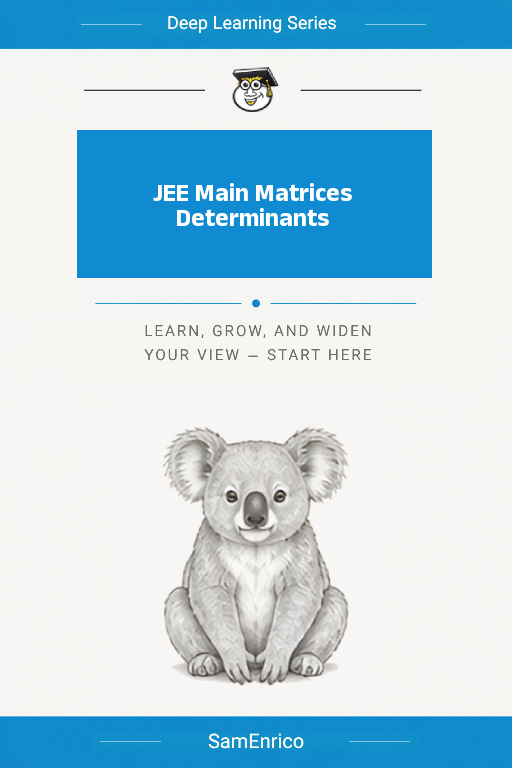
JEE Main Matrices Determinants eBook
Solve matrix equations find inverse and evaluate d
Solve matrix equations find inverse and evaluate determinants using row column operations.
Formats
Free sample
Chapter 1: The Matrix Mindset--–- Mathematics, at its core, is a language. And like any language, it has nouns (numbers), verbs (operations), and grammar (rules). But matrices? Matrices are the sentences — structured arrays of numbers that pack meaning far beyond isolated digits. If you have picked up this book, you already know that JEE Main treats matrices and determinants not as two separate topics but as a unified weapon system.
Get this right, and you unlock vector algebra, 3D geometry, calculus, and even differential equations. Get it wrong, and you will bleed marks across half the paper.This chapter is not a dry vocabulary list. It is the foundation stone. By the time you finish these pages, you will see any matrix — whether 2×2 or 4×4 — not as a grid of random numbers but as a story waiting to be read. You will understand why a square matrix is special, why a non-square matrix cannot have a determinant, and why the trace of a matrix tells you more than you expect.
Most importantly, you will start thinking like a problem-solver, not a memorizer.Let us begin.1.1 What Exactly Is a Matrix?A matrix is a rectangular arrangement of numbers, symbols, or expressions organized into rows (horizontal lines) and columns (vertical lines). We denote the order (or dimension) of a matrix by m × n, where m is the number of rows and n is the number of columns.Example: A = [ 2 -1 0 ][ 3 4 -5 ] is a 2 × 3 matrix (2 rows, 3 columns).The individual entries are denoted by aᵢⱼ, where i is the row index and j is the column index. In matrix A above, a₁₂ = –1, a₂₃ = –5.Notation conventions:– Capital letters (A, B, C) represent matrices.– Square brackets [ ] are standard; some texts use parentheses ( ).– A zero matrix (denoted O) has all entries zero.– An identity matrix (denoted Iₙ or simply I) is a square matrix with 1s on the main diagonal and 0s elsewhere.Example: I₃ = [ 1 0 0 ][ 0 1 0 ][ 0 0 1 ]The identity matrix is the multiplicative neutral element: A·I = I·A = A for any square matrix A that matches the order.1.2 Why the Order Matters: Square vs. Rectangular A square matrix has m = n. Examples: 2×2, 3×3, 4×4.
A rectangular matrix has m ≠ n.This distinction is not academic. In JEE Main, nearly all determinant-related problems involve square matrices. Why? Because determinants are defined only for square matrices. The determinant of a matrix is a scalar that measures how the matrix scales area (in 2D) or volume (in 3D) when it transforms space.
A rectangular matrix maps space to a space of different dimension — volume comparison becomes meaningless.Think of it this way: You can find the area of a square or a triangle (both closed shapes), but you cannot find the "area" of a line segment or a point. Similarly, a non-square matrix is like an incomplete shape — useful for many operations (addition, multiplication, even solving certain equations) but outside the realm of determinants.JEE Insight: When a problem asks "Find the determinant of matrix A", the first thing you must check is whether A is square. If not, the answer is simply "not defined" — and that can appear as a trick option.1.3 Types of Matrices You Must Recognize Instantly JEE Main loves to hide properties inside matrix types. Recognizing the type in 5 seconds can save you 2 minutes of unnecessary calculation.Diagonal Matrix: A square matrix where all non-diagonal entries are zero.Example: [ 3 0 0 ][ 0 -2 0 ][ 0 0 1 ]Scalar Matrix: A diagonal matrix where all diagonal entries are equal. Example: 5·I₃.Triangular Matrices:– Upper triangular: All entries below the main diagonal are zero.– Lower triangular: All entries above the main diagonal are zero.Property: The determinant of a triangular matrix is the product of its diagonal entries.
This is a massive shortcut.Symmetric Matrix: A square matrix where A = Aᵀ (equal to its own transpose). The entries are symmetric across the main diagonal: aᵢⱼ = aⱼᵢ for all i, j.Example: [ 1 4 5 ][ 4 2 6 ][ 5 6 3 ]Skew-Symmetric Matrix: A square matrix where Aᵀ = –A. This forces the diagonal entries to be zero, because aᵢᵢ = –aᵢᵢ implies 2aᵢᵢ = 0 ⇒ aᵢᵢ = 0.Example: [ 0 2 -3 ][-2 0 4 ][ 3 -4 0 ]Orthogonal Matrix: A square matrix satisfying Aᵀ = A⁻¹. Equivalently, A·Aᵀ = I. Orthogonal matrices represent rotations and reflections — they preserve lengths and angles.
We will explore their geometry in Chapter 3.JEE Pattern: "If A is skew-symmetric of order 3, find |A|." The answer? 0 always for odd-order skew-symmetric matrices.1.4 The Trace: A Small Tool with Big Applications The trace of a square matrix, denoted tr(A), is the sum of its diagonal entries.tr(A) = a₁₁ + a₂₂ + … + aₙₙProperties (learn these; they appear in JEE Advanced occasionally):tr(A + B) = tr(A) + tr(B)tr(c A) = c·tr(A) for scalar ctr(AB) = tr(BA) — This is subtle: the trace of a product is independent of order, even though the product itself is not commutative.tr(Aᵀ) = tr(A)tr(Iₙ) = n Why does trace matter? In JEE problems, trace often appears in:– Proving certain matrices are nilpotent or idempotent– Checking eigenvalues without calculating them (though eigenvalues are not officially in JEE Main, their traces appear disguised)– Solving matrix equations where summing diagonal entries yields a simple equation Example: If A = [ a b; c d ], then tr(A) = a + d. If A² = I (involutory), then tr(A) can be –2, 0, or 2. This is a known shortcut.1.5 The Great Question: Why Only Square Matrices Have Determinants?Let us go deeper than the standard textbook answer.A determinant measures the signed scaling factor of a linear transformation.
When you apply a square matrix to a region in n-dimensional space, the volume of the image equals |det(A)| times the original volume. This only makes sense if the input and output spaces have the same dimension (n → n).If A is m × n with m ≠ n:– If m > n (tall matrix), the image lies in a higher-dimensional space but the domain is lower-dimensional — the "volume" is always zero.– If m < n (wide matrix), the transformation cannot be one-to-one — multiple inputs map to the same output, so volume scaling is ambiguous.Thus, the determinant is simply not defined for non-square matrices. JEE Main has asked conceptual questions like "Which of the following matrices cannot have a determinant?" — the answer includes any rectangular matrix.1.6 Equality and Zero Matrices: The Simple but Tricky Start Two matrices A and B are equal if:They have the same order (m × n identical).Every corresponding entry is equal: aᵢⱼ = bᵢⱼ for all i, j.This sounds trivial, but JEE problems exploit this in matrix equations. For example, if A = [ x+y 2; 3 x-y ] and B = [ 5 2; 3 1 ], equating entries gives x+y=5 and x-y=1 → solve to x=3, y=2.The zero matrix O has every entry 0. It behaves like the number 0 in addition: A + O = A.
But unlike real numbers, a non-zero matrix multiplied by another non-zero matrix can give zero — these are called zero divisors, covered in Chapter 2.1.7 Visualizing Matrices: The Data Structure Perspective Think of a matrix as a spreadsheet. Rows can represent different entities (students, vectors, equations), and columns represent different attributes (scores, coordinates, coefficients). This perspective helps in:– Systems of linear equations: each row is one equation, each column is a variable.– Coordinate geometry: each row is a point, columns are x, y, z coordinates.– Transformations: each column is where…
This is the end of the free sample. Get the eBook to keep going. Buy now
About this book
Details
- Author
- Hamblin Daniell
- Publisher
- SamEnrico
- Language
- English
- Genre
- Non-Fiction, Student's Shortcut
- Released
- 2026-05-30
- Pages (approx.)
- 99
- Available as
- eBook, Audiobook

Read better in the ZLOADR app
Your eBooks on your phone or tablet. Sign in with your SamEnrico account and start reading.
More by Hamblin Daniell
 Delegation for Control FreaksHamblin Daniell$11.99
 Guardianship Planning GuideHamblin Daniell$11.99
 Nobel Prize Circadian Rhythm DiscoveryHamblin Daniell$11.99
 Pictured Rocks MysteriesHamblin Daniell$11.99
 Compulsive Spending Self Help GroupHamblin Daniell$11.99
 The Physics Nobel Quantum EntanglementHamblin Daniell$11.99
 Beginner Mindful StretchingHamblin Daniell$11.99
 Heel Bouncing RestlessnessHamblin Daniell$11.99
 The Last Voyage of the Ghost FleetHamblin Daniell$11.99
 Baba Yaga's Firebird: A Slavic Witch's CurseHamblin Daniell$11.99
 The Twitter Files: Musk’s Billion-Dollar BetHamblin Daniell$11.99
 How to Become a Advertising-space ClerkHamblin Daniell$11.99
You may also like
 LSE Online Program LengthAgee Letisha$11.99
 Harvard Extension School for Working AdultsRoush Yer$11.99
 LSE Online Reading ListAshford Ludivina$11.99
 LSE Online Language RequirementsWhitten Daphine$11.99
 LSE Online Class SizeHughey Garret$11.99
 LSE Online Alumni MentorshipWild Lyla$11.99
 London School of Economics Alumni NetworkDutton Chantal$11.99
 Harvard Extension School Student SupportCantrell Christene$11.99
 Harvard Extension School Library AccessSantana Adah$11.99
 Harvard Extension School Degree CompletionBray Wyatt$11.99
 Harvard Extension School Course AuditingAbbott Craig$11.99
 Harvard Extension School Extension DiplomaNew Joane$11.99