
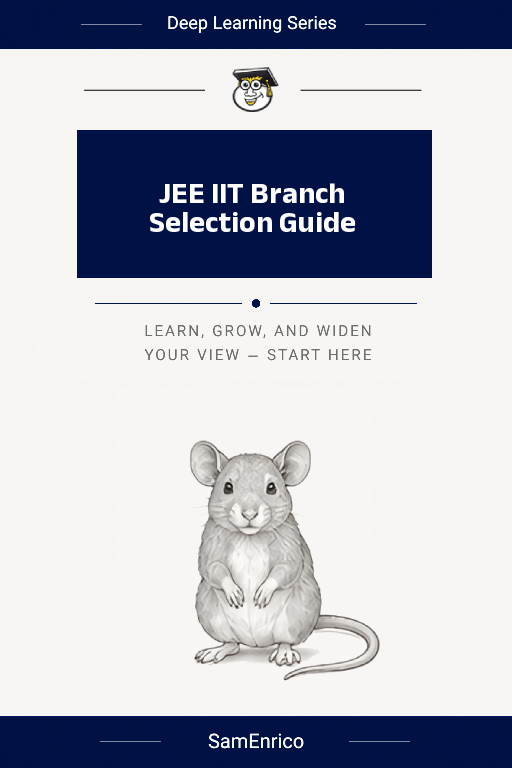
JEE IIT Branch Selection Guide eBook
Choose between lower IIT with good branch vs older
Choose between lower IIT with good branch vs older IIT with lower branch.
Formats
Free sample
Chapter 1: The 55 Lakh Lie--–- The boy who said no to Computer Science at IIT Bhilai and yes to Metallurgy at IIT Madras was called insane by his coaching teachers, foolish by his friends, and reckless by his relatives. His mother cried for three days. His father didn't speak to him for two weeks. Two years later, that same boy sat in a corner office in Gurugram, signing an offer letter for ₹55 lakhs per annum—more than double what his CS classmates from "better" branches at newer IITs were making. His name is not important.
His decision framework is everything.This is not a book about Metallurgy. This is not a book about Computer Science. This book is about a question that haunts every JEE aspirant who has ever stared at their rank and felt the ground shift beneath their feet: Should I take a lower branch at an old IIT or a good branch at a lower IIT?And here is the lie you have been told: that this is a question with a right answer.The Myth of the Universal Hierarchy Every coaching institute in India sells the same dream. They publish glossy rank lists showing which IIT you can get at which rank. They create elaborate cutoff charts that descend like a food chain—IIT Bombay CS at the top, IIT Bhilai Civil at the bottom, and everything else in between.
The implication is clear: higher up the chain is better. Lower down is worse.This is a lie.Not a small lie. Not a well-intentioned simplification. A fundamental, career-destroying, financially devastating lie.The lie survives because it is convenient. Coaching institutes need simple metrics to sell their courses.
Parents need simple comparisons to justify their pride. Students need simple hierarchies to reduce their anxiety. But the real world does not operate on cutoffs. The real world operates on ecosystems—complex, dynamic systems of people, opportunities, constraints, and luck.Consider two students who took the JEE Advanced in the same year. Student A scored AIR 2,500 and took Civil Engineering at IIT Kharagpur.
Student B scored AIR 9,500 and took Computer Science at IIT Bhilai. By every conventional metric, Student A "won." Better college. Older brand. Higher rank. The kind of result that makes relatives nod approvingly at weddings.Four years later, Student B was offered ₹38 lakhs by a fintech startup.
Student A was offered ₹8 lakhs by a construction company. Student A spent the next two years learning to code on the side, grinding through online courses while working 10-hour days at a job he hated. Student B spent those two years getting promoted.The hierarchy lied.What This Chapter Actually Does This chapter has one job: to destroy the binary thinking that keeps brilliant students trapped in terrible decisions. By the time you finish reading, you will never again ask "Which IIT is better?" without also asking "Better for what? Better for whom?
Better under what conditions?"We will introduce the Ecosystem Value Theory—the central framework of this book. We will define the two metrics that actually matter: Financial Risk and Career Optionality. We will show you why the "Brand vs. Branch" debate is a trap designed by people who never had to live with the consequences of their advice. And we will give you the first version of a decision matrix that will become more sophisticated as you move through the remaining eleven chapters.But first, we need to talk about the student who broke the matrix.The Metallurgy Millionaire Let me tell you the full story of that boy from the opening paragraph—the one who chose Metallurgy at IIT Madras.His name is Arjun.
He scored AIR 1,847 in JEE Advanced 2020. His rank was good enough for Computer Science at IIT Bhilai, Electronics at IIT Patna, Mechanical at IIT Roorkee, or Metallurgy at IIT Madras. His father, a government school teacher in a small town in Rajasthan, had one demand: "IIT Madras. I don't care about the branch. The brand will carry you."Arjun's coaching institute had a different demand.
"Take Computer Science," his teacher said. "Branch is everything now. The market pays for skills, not tags."Arjun did something neither expected. He sat down with a notebook and asked himself three questions that would become the foundation of this book:First: What is my actual risk of failing?He looked at placement reports. IIT Madras Metallurgy had a placement rate of 92%—but only 40% of graduates worked in core metallurgy.
The rest went into consulting, finance, tech, or startups. The median salary was ₹16 lakhs. The top 10% earned over ₹40 lakhs. The bottom 10% earned under ₹8 lakhs.IIT Bhilai CS had a placement rate of 96%, almost entirely in tech. The median salary was ₹23 lakhs.
The top 10% earned over ₹50 lakhs. The bottom 10% earned under ₹12 lakhs.On paper, IIT Bhilai CS looked safer. Higher median. Lower downside. But Arjun noticed something the raw numbers didn't show.Second: What is the ecosystem I'm entering?IIT Madras is one of the oldest IITs.
Its alumni network includes CEOs, founders, partners at Mc Kinsey, and managing directors at Goldman Sachs. Its startup cell is among the most active in India. Its culture is aggressively cross-disciplinary—metallurgy students regularly won hackathons, consulting competitions, and business plan contests.IIT Bhilai is a new IIT. Its alumni network is small. Its startup culture is emerging.
Its brand recognition outside tech is limited. What it offers is a clean, predictable path into software engineering.Arjun realized he wasn't choosing between a "good branch" and a "good college." He was choosing between two different life trajectories.Third: What kind of person am I?Arjun was honest with himself. He was not a coding prodigy. He had never built an app. He didn't spend weekends on Git Hub.
But he was relentlessly social, good at public speaking, and willing to grind through subjects he didn't love if it opened doors later. He also knew something crucial: he wanted an MBA in seven to ten years.That last point changed everything.For an MBA applicant, the IIT brand matters enormously. IIM Ahmedabad, Bangalore, and Calcutta admit more students from old IITs than from all new IITs combined—not because old IIT students are smarter, but because the brand signal is stronger. An IIT Madras metallurgy graduate with a good GMAT score and two years of consulting experience is a stronger MBA candidate than an IIT Bhilai CS graduate with the same profile.Arjun chose Metallurgy at IIT Madras.Two years after graduation, he joined a boutique consulting firm at ₹28 lakhs. One year later, he was poached by a strategy role at a large conglomerate at ₹55 lakhs.
He is now preparing his MBA applications.The Ecosystem Value Theory Arjun's story is not an argument for choosing metallurgy over computer science. It is an argument for choosing ecosystems over labels.The Ecosystem Value Theory is simple: every IIT offers a unique combination of four factors. Your job is not to rank these factors globally. Your job is to weigh them according to your own goals and personality.Factor One: Peer Quality The single most underestimated variable in the IIT decision. Your peers will teach you more than your professors.
They will challenge you, inspire you, and drag you into opportunities you never knew existed.Old IITs have exceptionally high peer…
This is the end of the free sample. Get the eBook to keep going. Buy now
About this book
Details
- Author
- Mccall Saundra
- Publisher
- SamEnrico
- Language
- English
- Genre
- Non-Fiction, Student's Shortcut
- Released
- 2026-06-01
- Pages (approx.)
- 114
- Available as
- eBook, Audiobook

Read better in the ZLOADR app
Your eBooks on your phone or tablet. Sign in with your SamEnrico account and start reading.
More by Mccall Saundra
 Immigrant Education Tutoring Business GuideMccall Saundra$11.99
 Teaching Active Listening GuideMccall Saundra$11.99
 Creative Constraint GuideMccall Saundra$11.99
 The Broken GuitarMccall Saundra$11.99
 Sensitive Information PenaltiesMccall Saundra$11.99
 Huston Dynasty - Anjelica HustonMccall Saundra$11.99
 Soccer Injury Prevention GuideMccall Saundra$11.99
 Peer Mentorship CirclesMccall Saundra$11.99
 Assertiveness For Family ConversationsMccall Saundra$11.99
 Ticking Toward Tomorrow: The Timekeepers Who Built the Modern WorldMccall Saundra$11.99
 Midnight in the Mediterranean: The Vanishing of the Emerald EmpressMccall Saundra$11.99
 Blood Moon Conspiracy: The Jaguar Priest’s GambitMccall Saundra$11.99
You may also like
 LSE Online Program LengthAgee Letisha$11.99
 Harvard Extension School for Working AdultsRoush Yer$11.99
 LSE Online Reading ListAshford Ludivina$11.99
 LSE Online Language RequirementsWhitten Daphine$11.99
 LSE Online Class SizeHughey Garret$11.99
 LSE Online Alumni MentorshipWild Lyla$11.99
 London School of Economics Alumni NetworkDutton Chantal$11.99
 Harvard Extension School Student SupportCantrell Christene$11.99
 Harvard Extension School Library AccessSantana Adah$11.99
 Harvard Extension School Degree CompletionBray Wyatt$11.99
 Harvard Extension School Course AuditingAbbott Craig$11.99
 Harvard Extension School Extension DiplomaNew Joane$11.99