
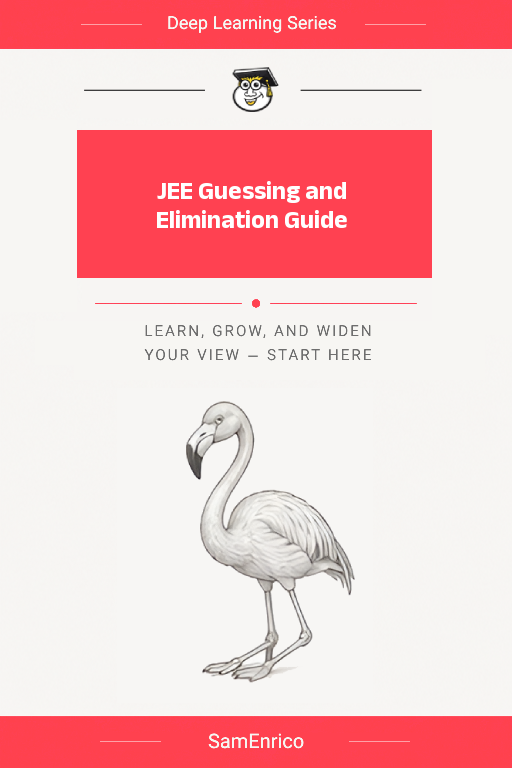
Non-FictionStudent's ShortcutTest Tactics
JEE Guessing and Elimination Guide eBook
Applies logical elimination, unit analysis, and in
by Lim Tanner
Applies logical elimination, unit analysis, and intelligent guessing techniques for multiple-choice questions when unsure.
Formats
Free sample
Chapter 1: The Gambler’s Edge--–- Akash stared at the JEE screen, his cursor hovering over option C. He had no idea whether the answer was correct. Three minutes remained on the clock. Seven questions were unanswered. His heart pounded.
In the seat next to him, a girl methodically solved her paper. On his other side, a boy had already given up, staring blankly. Akash had studied for eighteen months. He had solved over five thousand problems. Yet here he was, paralyzed by a single multiple-choice question.
Should he guess? Should he leave it blank? His coaching institute had warned him: “Negative marking will destroy your rank.” His parents had said: “Only attempt what you know perfectly.” But the clock kept ticking. And Akash had a secret he hadn’t shared with anyone. During his last mock test, he had guessed on twelve questions and gotten nine correct.
He had eliminated options without solving fully, using tricks he’d picked up from online forums and random You Tube videos. He never told his teachers. They would have called it luck. But Akash suspected otherwise. He suspected that guessing, when done intelligently, was not gambling.
It was a skill. And this chapter is the proof that he was right.Every year, over 1.2 million students appear for the JEE Main. Less than 2,500 make it into the IITs. Most of those successful candidates will tell you they solved every question perfectly. That is a lie.
They guessed. They eliminated. They used every tool available, including the very techniques this book will teach you. The difference between a wild guess and an educated guess is the difference between a roulette wheel and a poker table. One is luck.
The other is strategy. This chapter dismantles the single greatest fear that holds JEE aspirants back: the fear of negative marking. You will learn why skipping a question is often the worst possible decision. You will learn the mathematics of expected value, a concept that turns guessing from a gamble into a calculated move. You will meet the three pillars of this book—logical elimination, unit analysis, and intelligent guessing.
And by the end, you will never look at an unanswered JEE question the same way again.The Psychology of Skipping: Why Your Brain Lies to You Your brain is wired to avoid loss more than it seeks gain. This is called loss aversion, and it was discovered by psychologists Daniel Kahneman and Amos Tversky in their prospect theory. In simple terms, losing 100 rupees feels twice as painful as gaining 100 rupees feels pleasurable. Applied to JEE, the fear of losing 1 mark (negative marking) feels far more devastating than the pleasure of gaining 4 marks (correct answer). This psychological bias causes students to skip questions even when guessing is mathematically superior.Let us run an experiment.
Consider two students, Rohan and Priya. Rohan attempts 60 questions in a JEE paper, solving all of them perfectly. His score is 60×4 = 240 marks, assuming +4/-1 scheme. Priya also solves 60 questions perfectly, but she attempts 20 additional questions where she is uncertain. On those 20, she uses no elimination—she guesses blindly.
Statistics tell us she will get roughly 5 correct (25% of 20) and 15 incorrect. Her additional score: (5×4) + (15×–1) = 20 – 15 = +5 marks. Priya’s total becomes 245 marks. She beats Rohan by 5 marks. That margin could mean thousands of ranks.
Now imagine if Priya eliminated just one option before guessing. Her probability of correctness rises to 1/3 ≈ 33.3%. On 20 questions, she gets roughly 6.7 correct and 13.3 incorrect. Expected value: (6.7×4) + (13.3×–1) = 26.8 – 13.3 = +13.5 marks. Her total becomes 253.5.
The gap widens.But your brain will still scream: “What if I get them all wrong?” That is loss aversion talking. The mathematics does not lie. Over many questions, the student who guesses intelligently will always outperform the student who skips. The problem is that JEE does not give you “many questions” in the sense of infinite repetitions. You have one paper, 90 questions, 180 minutes.
But the law of large numbers still applies at smaller scales. If you guess on 10 questions with 1/3 probability each, your chance of getting zero correct is (2/3)^10 ≈ 1.7%. That is a 98.3% chance that you get at least one correct. And the expected value remains positive.The Expected Value Equation: When Guessing Beats Skipping Let us formalize the mathematics so you can apply it under pressure. Expected value (EV) is the average outcome if you repeated an action many times.
For a single JEE question with +4 for correct, –1 for incorrect, and 0 for skip:Skip: EV = 0 (certain)Blind guess (4 options, no elimination): Probability correct = 0.25, probability wrong = 0.75. EV = (0.25 × 4) + (0.75 × –1) = 1 – 0.75 = +0.25.Guess after eliminating 1 option (3 options remain): Probability correct = 0.333, wrong = 0.667. EV = (0.333 × 4) + (0.667 × –1) = 1.332 – 0.667 = +0.665.Guess after eliminating 2 options (2 options remain): Probability correct = 0.5, wrong = 0.5. EV = (0.5 × 4) + (0.5 × –1) = 2 – 0.5 = +1.5.Guess after eliminating 3 options (only 1 option remains): Probability correct = 1.0. EV = +4.Even a blind guess has positive expectation in +4/-1 marking.
In +3/-1 marking (used in some JEE sessions), blind guess EV = (0.25×3)+(0.75×–1)=0.75 – 0.75 = 0. Neutral. But eliminate one option: (0.333×3)+(0.667×–1)=1 – 0.667 = +0.333. Still positive. The only scenario where skipping beats guessing is if the marking scheme penalizes more than it rewards, such as +4/-2 or +3/-2.
JEE does not use those. Therefore, the mathematically correct strategy is: never skip a question if you can eliminate at least one option. Only skip if you have literally zero information and the marking scheme is +3/-1 or worse. But even then, in the final minutes, blind guess.Here is a memory device: The 50% Rule. If your confidence is 50% or higher (meaning you have eliminated at least one option and possibly two), guess.
If your confidence is below 50%, skip unless you are in the final 2 minutes of the exam. We will revisit this rule throughout the book. For now, simply accept that skipping is not a safe harbor. It is a missed opportunity.The Three Pillars: Logical Elimination, Unit Analysis, Intelligent Guessing This book rests on three pillars. Think of them as three tools in your JEE survival kit.
Each chapter will add new techniques, but these three categories organize everything.Pillar One: Logical Elimination – This uses pure reasoning without subject knowledge. You look at the options themselves. Are two options mathematically identical? Then both are wrong. Is one option far outside a reasonable range?
Eliminate it. Do two options contradict each other such that only one can be true? Use that to narrow. Logical elimination works in physics, chemistry, and mathematics equally. It requires zero formulas.
It is the fastest tool in your arsenal.Pillar Two: Unit Analysis – This uses the fact that physical quantities have dimensions. An option with the wrong units cannot be correct. If a question asks for velocity, an option in meters (distance) is eliminated. If a question asks for a dimensionless ratio, an option in grams or newtons is eliminated. Unit analysis takes five seconds.
It will save you more times than you can count.Pillar Three: Intelligent Guessing – This combines partial solving with option pattern recognition. You solve the first 30% of a problem—enough to set up the equation or eliminate impossible forms—then match your partial result to the options. You also look for answer seeding (numbers that appear in multiple options) and value repetition. Intelligent guessing is the most advanced skill, and it is covered in depth in Chapter 9.These three pillars are not sequential; you can apply them in any order. A typical flow might be…
This is the end of the free sample. Get the eBook to keep going. Buy now
About this book
Details
- Author
- Lim Tanner
- Publisher
- SamEnrico
- Language
- English
- Genre
- Non-Fiction, Student's Shortcut, Test Tactics
- Released
- 2026-06-01
- Pages (approx.)
- 136
- Available as
- eBook, Audiobook

Read better in the ZLOADR app
Your eBooks on your phone or tablet. Sign in with your SamEnrico account and start reading.
More by Lim Tanner
 Labyrinth Walking VirtuallyLim Tanner$11.99
 Divorce and Child Therapy GuideLim Tanner$11.99
 Chari Ecommerce ExitLim Tanner$11.99
 Constraint as CollaboratorLim Tanner$11.99
 The Confessionalization Thesis GuideLim Tanner$11.99
 The Alchemists of the Iron Age: Celtic Metallurgy and the Birth of Western CraftsmanshipLim Tanner$11.99
 Arcubisite MiningLim Tanner$11.99
 How to Start a Optical Mirrors Business (Beginners Guide)Lim Tanner$11.99
 VA Technical Skills ChecklistLim Tanner$12.99
 Understanding Pili MultigeminiLim Tanner$17.99
You may also like
 Hong Kong Handover 1997Dunn Johnnie$11.99
 Zumba For Postnatal Recovery CourseNeal Christian$11.99
 Zumba for BeginnersLadner Nikia$11.99
 YouTube Comment Mining GuideHumes Pandora$12.99
 Worry Box MeditationCarlin Rudy$11.99
 Workplace Stress MeditationNguyen Lynn$11.99
 Workplace Stress and Sleep RepairHawley Ivory$11.99
 Workplace Perfectionism CureDelaney Jeffry$11.99
 Workplace Injustice Anger GuideWallen Isabelle$11.99
 Work Addiction and Burnout LinkGreenwood Ester$11.99
 Women in Yoga and WellnessBeattie Galina$11.99
 Women in Stand Up ComedyChun Evangeline$11.99