
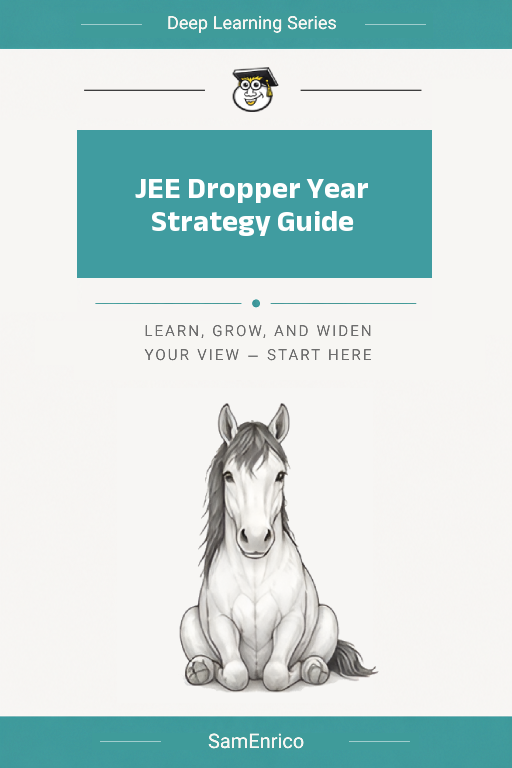
Non-FictionStudent's ShortcutDropper
JEE Dropper Year Strategy Guide eBook
Optimize your gap year with a structured plan for
by Rowan Astrid
Optimize your gap year with a structured plan for complete syllabus revision and testing.
Formats
Free sample
Chapter 1: The Second Attempt--–- The decision to take a drop year for JEE is one of the most misunderstood choices in the Indian education system. Your relatives may ask why you could not clear it the first time. Your friends may have moved on to their engineering colleges. Your own mind may whisper that you are somehow behind, somehow less capable, somehow falling short. Every single one of these voices is wrong.
The drop year is not a mark of failure. It is not evidence of inadequacy. It is a strategic decision—a recognition that you deserve more than a compromise college and that you are willing to invest an additional year to secure the future you truly want. This chapter exists to rebuild your mindset from the ground up. Before we discuss syllabus, before we discuss schedules, before we discuss a single formula or problem, we must establish the psychological foundation that separates successful droppers from those who waste their gap year.
By the end of this chapter, you will understand why your first attempt was incomplete, the mathematics of the 4,000+ hours you now have, the critical difference between a repeat and a rebuild, and exactly what successful droppers do differently. Your second attempt is not a second chance. It is a better chance. Let us understand why.Why Your First Attempt Was Incomplete Before we discuss how to prepare, we must conduct an honest audit of why your first attempt did not produce the result you wanted. This is not an exercise in self-criticism.
It is not an opportunity to blame yourself or your circumstances. It is a clear-eyed analysis that will inform your entire drop year strategy. Without understanding what went wrong, you are doomed to repeat it.When you appeared for JEE Main after Class 12, several factors worked against you simultaneously. These factors were not your fault. They were structural, environmental, and experiential.
But they are also factors that no longer apply.First, board exams ran parallel to JEE preparation for months. From January to March, your attention was divided between two demanding examinations with different formats, different syllabi, and different timelines. Board exams reward memorization, presentation, and lengthy descriptive answers. JEE rewards conceptual clarity, speed, and accuracy under pressure. Preparing for both simultaneously is like practicing for a marathon while training for a sprint.
Your brain had to switch modes constantly, and that switching cost you time, focus, and mental energy. In your drop year, there are no board exams. Your attention is undivided. Every hour can go to JEE preparation.Second, the 75 percent attendance requirement in many schools created pressure and distraction. You were physically present in school when you could have been practicing problems at home.
You sat through classes that covered material you already understood, while your weak areas remained unaddressed. You attended school not because it helped your JEE preparation but because the rules required it. In your drop year, there are no attendance requirements. You control your schedule completely. Every hour is yours to allocate where it will have the greatest impact.Third, many students lack proper mentorship or structured guidance in Class 11 and 12.
You were learning concepts for the first time while simultaneously trying to apply them to JEE-level problems. Your teachers had to cover a vast syllabus in a limited time, often racing through chapters without ensuring deep understanding. You may have had doubts that went unresolved because the class moved on. You may have used resources that were not aligned with the JEE pattern. In your drop year, you have already learned the syllabus at least once.
You are not learning from scratch. You are rebuilding, refining, and reinforcing. And you have the opportunity to choose structured programs, targeted resources, and mentorship that was not available to you in your first attempt.Fourth, and perhaps most importantly, you were a first-time test-taker. This is a factor that students almost never consider, yet it is one of the most significant. You had never experienced the pressure of the JEE exam hall.
You had never managed the timing of 75 questions across three hours. You had never navigated the psychological challenge of a wrong answer deducting points from your score. You had never sat in a crowded hall with hundreds of other students, the clock ticking, your heart pounding, your mind racing. All of these experiences are real, and they affect performance. Research consistently shows that first-time test-takers underperform relative to their ability because of anxiety, unfamiliarity, and lack of practice under authentic conditions.
In your drop year, you have already faced that pressure. You know what the paper looks like. You know how the timing feels. You have survived the experience. That experience is now an asset, not a liability.
Use it.None of the factors that worked against you in your first attempt apply in your drop year. No board exams. No attendance requirements. Prior exposure to the syllabus. Exam experience.
These are not small advantages. They are transformative. The student entering a drop year is not the same student who walked into the JEE exam hall for the first time. That student was fighting with one hand tied behind their back. You are not.
Recognize this. Internalize it. Your second attempt starts from a position of strength, not weakness.The Mathematics of 4,000 Plus Hours Let us be precise about what a drop year actually gives you in terms of preparation time. This is not motivation. This is arithmetic.
The numbers do not lie.From May or June, when you begin your drop year, to the first JEE Main session in January, you have approximately 240 days. To that, add the period between JEE Main sessions and JEE Advanced, which extends your total to roughly 370 days. These 370 days are yours. No school. No board exams.
No attendance requirements. Just you and the syllabus.At 11 to 12 productive study hours per day, a dropper has over 4,000 hours of preparation time. Divide that by three subjects—Physics, Chemistry, Mathematics—and you have approximately 1,350 hours per subject. Now consider this: In JEE Main, you have roughly one hour to attempt each subject's questions. That means, across your drop year, you could theoretically practice the equivalent of 1,350 full subject papers per subject.
Not ten papers. Not fifty papers. One thousand three hundred and fifty papers.No topic in the JEE syllabus—not Organic Chemistry with its hundreds of reactions, not Calculus with its infinite applications, not Modern Physics with its counterintuitive concepts—cannot be mastered with 1,350 hours of focused work. This is not hyperbole. This is the fundamental mathematics of learning.
The human brain, when given sufficient time and appropriate practice, can achieve mastery of any subject within the JEE syllabus. The limiting factor is not intelligence. It is not aptitude. It is not your background or your board marks. The limiting factor is how effectively you use these 4,000 hours.Think about what this means.
A chapter that gave you trouble in Class 11—say, Coordination Compounds or Thermodynamics—can now receive 50, 60, or 100 hours of dedicated attention. A problem type that you never understood—say, integer-type questions or paragraph-based reasoning—can be practiced until it becomes automatic. A skill that you never developed—say, time…
This is the end of the free sample. Get the eBook to keep going. Buy now
About this book
Details
- Author
- Rowan Astrid
- Publisher
- SamEnrico
- Language
- English
- Genre
- Non-Fiction, Student's Shortcut, Dropper
- Released
- 2026-06-01
- Pages (approx.)
- 146
- Available as
- eBook, Audiobook

Read better in the ZLOADR app
Your eBooks on your phone or tablet. Sign in with your SamEnrico account and start reading.
More by Rowan Astrid
 Detox For Pregnant WomenRowan Astrid$11.99
 Stress Resilience EQRowan Astrid$11.99
 Self Esteem Communication GuideRowan Astrid$11.99
 Fawn Response BoundariesRowan Astrid$11.99
 The Remote Notification PurgeRowan Astrid$11.99
 Personal Brand for EntrepreneursRowan Astrid$11.99
 Nonprofit Directors CoverageRowan Astrid$11.99
 Attention Working Memory LinkRowan Astrid$11.99
 The Silk Road’s Forgotten Astronomers: How Ancient Traders Mapped the StarsRowan Astrid$11.99
 The Swords and Scrolls of Sparta: Philosophy in the Age of WarRowan Astrid$11.99
 How to Become a Pay-station AttendantRowan Astrid$11.99
 How to Produce Fire ExtinguishersRowan Astrid$11.99
You may also like
 Hong Kong Handover 1997Dunn Johnnie$11.99
 Zumba For Postnatal Recovery CourseNeal Christian$11.99
 Zumba for BeginnersLadner Nikia$11.99
 YouTube Comment Mining GuideHumes Pandora$12.99
 Worry Box MeditationCarlin Rudy$11.99
 Workplace Stress MeditationNguyen Lynn$11.99
 Workplace Stress and Sleep RepairHawley Ivory$11.99
 Workplace Perfectionism CureDelaney Jeffry$11.99
 Workplace Injustice Anger GuideWallen Isabelle$11.99
 Work Addiction and Burnout LinkGreenwood Ester$11.99
 Women in Yoga and WellnessBeattie Galina$11.99
 Women in Stand Up ComedyChun Evangeline$11.99