
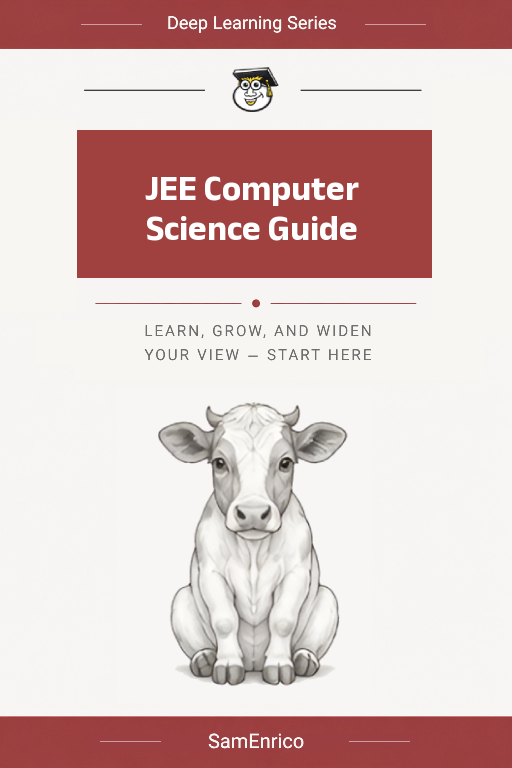
Non-FictionStudent's ShortcutCS Thinking
JEE Computer Science Guide eBook
Prepare for JEE with CSE branch target including p
Prepare for JEE with CSE branch target including programming basics, logic, and algorithm thinking.
Formats
Free sample
Chapter 1: The Silicon Mirror--–- Look at the problem in front of you. A quadratic equation: 2x2−5x+1=02x^2 - 5x + 1 = 02x2−5x+1=0. Your JEE-trained mind instantly recognizes the pattern. You recall the quadratic formula, substitute the coefficients, simplify the square root, and produce two roots in perhaps forty-five seconds. This is speed. This is efficiency. This is exactly what the examination rewards.Now look at the same problem again, but this time, imagine you cannot do any of that. Imagine you are a silicon chip – a collection of switches, logic gates, and memory cells that knows nothing about "quadratics" or "roots" or "discriminants." All you understand are three things: fetch an instruction from memory, decode what it means, execute it exactly as written. No intuition. No pattern recognition. No shortcuts.How would you solve 2x2−5x+1=02x^2 - 5x + 1 = 02x2−5x+1=0?This question is the entire point of this book. The JEE examination and computer science engineering demand two different kinds of intelligence. One is human: fluid, intuitive, pattern-driven. The other is mechanical: literal, exhaustive, step-by-step. The first wins you marks. The second builds systems. And the JEE Computer Science aspirant – the student who intends to study CSE at an IIT, NIT, or IIIT – must master both. Not separately. Together.This chapter is about that mirror. When you look into it, you see not a calculator but a different way of thinking. You see the difference between getting an answer quickly and defining a process that never fails. You see why computers, for all their speed, are profoundly stupid – and why that stupidity, when harnessed correctly, becomes the most powerful tool humanity has ever built.By the end of this chapter, you will understand the basic anatomy of a computer, the fundamental limitation of all computation (the Halting Problem), the critical distinction between JEE thinking and coding thinking, and how to set up your own programming environment. More importantly, you will write your first program – a quadratic equation solver – and discover that the computer's "dumb" step-by-step approach, when combined with your mathematical knowledge, becomes something remarkable.The Machine That Cannot Guess Every computer ever built – from the room-sized ENIAC of 1945 to the smartphone in your pocket – operates on a simple, almost insultingly simple principle. It follows instructions. One after another. No skipping, no inferring, no "understanding" in the human sense.This is the Fetch-Decode-Execute cycle, and it is the heartbeat of computation.Fetch: The CPU (Central Processing Unit) reads the next instruction from RAM (Random Access Memory). RAM holds both the program code and the data. Each instruction is just a number – for example, 0x A3 might mean "add two numbers."Decode: The CPU's control unit interprets what the instruction means. Does it want to add? Compare? Jump to a different location in memory? Store a result?Execute: The CPU performs the operation. If the instruction was "add," the Arithmetic Logic Unit (ALU) performs addition. If it was "compare," the ALU sets flags that will affect future decisions.Then it repeats. Billions of times per second.Here is what this means for you, the JEE aspirant. When you look at a complex physics problem – say, a block sliding down an inclined plane with friction – your brain can skip steps. You recognize the type: "Ah, this is a standard inclined plane problem. I'll use mgsinθ−μmgcosθ=mamg\sin\theta - \mu mg\cos\theta = mamgsinθ−μmgcosθ=ma." You jump directly to the governing equation.A computer cannot do this. Not because it is stupid (though it is), but because it has no memory of "inclined plane problems." It has no concept of "standard." All it knows is the instructions you give it. You must tell it: read the mass, read the angle, read the coefficient of friction, compute the gravitational component, compute the frictional component, subtract, divide by mass, print the result. Every. Single. Step.This is maddening at first. Why would anyone want to work this way? But consider the payoff. Once you have written those instructions correctly, the computer will solve every inclined plane problem you throw at it – millions of variations – without tiring, without making arithmetic mistakes, without forgetting the formula. Your forty-five-second quadratic solution becomes, in code, a permanent tool that runs in microseconds.The tradeoff is absolute. Humans are fast, flexible, and error-prone. Computers are slow (in terms of steps per decision), literal, and perfectly consistent. The art of computer science is learning to translate human flexibility into machine literalism.The Dark Boundary: What Computers Cannot Do Before we celebrate the machine too much, we must visit its fundamental limitation. In 1936, long before the first electronic computer, the mathematician Alan Turing proved something unsettling. He proved that there are problems that no computer – no matter how fast, no matter how much memory – can ever solve.This is the Halting Problem.Here is the question: Given any computer program and its inputs, can you write a second program that will determine, with absolute certainty, whether the first program will eventually stop (halt) or run forever?Turing proved the answer is no. There is no general algorithm that can predict halting for all possible programs.This sounds abstract, but it has real consequences. Consider the Collatz conjecture (which we will explore in Chapter 6). Start with any positive integer nnn. If nnn is even, divide by 2. If nnn is odd, multiply by 3 and add 1. Repeat. Does this always eventually reach 1? Mathematicians have tested billions of numbers and never found a counterexample, but nobody has proved it for all numbers. No one knows if there exists some starting number that goes to infinity.If you wrote a program to test the Collatz conjecture for a given starting number, and that number never reached 1, the program would run forever. But can you write a program that looks at that starting number and decides, in advance, whether it will halt? Turing says no. Not for the general case.For JEE students, this connects directly to infinite series. Consider the series ∑n=1∞1n2\sum_{n=1}^{\infty} \frac{1}{n^2}∑n=1∞n21. It converges to π2/6\pi^2/6π2/6. But consider ∑n=1∞1n\sum_{n=1}^{\infty} \frac{1}{n}∑n=1∞n1. It diverges. A naive program that sums terms until the term becomes very small might stop for the first series (because terms shrink rapidly) but run "forever" for the harmonic series (because terms shrink slowly, and the sum grows without bound). Can a program look at a series and decide, in finite time, whether it converges? Not in general. This is not just a technical limitation – it is a fundamental truth about computation.Why does this matter for you, the JEE Computer Science aspirant? Because you will learn that computer science is not just about what we can compute. It is also about understanding the boundaries of computation. Some problems are undecidable. Some problems are decidable but require so much time that they are practically impossible (we call these "intractable" – Chapter 11). Knowing these boundaries saves you from chasing impossible solutions.Two Minds: JEE Thinking vs. Coding Thinking Let us make the distinction concrete. Open your JEE preparation notebook. Look at the problems you have solved. What did you do?JEE Thinking looks like this:Recognize the pattern (quadratic, kinematics, electrostatics, coordination compound).Recall the relevant formula or shortcut.Substitute the given numbers.Simplify using algebraic manipulation.Arrive at the answer, usually within…
This is the end of the free sample. Get the eBook to keep going. Buy now
About this book
Details
- Author
- Fredrickson Briana
- Publisher
- SamEnrico
- Language
- English
- Genre
- Non-Fiction, Student's Shortcut, CS Thinking
- Released
- 2026-06-01
- Pages (approx.)
- 111
- Available as
- eBook, Audiobook

Read better in the ZLOADR app
Your eBooks on your phone or tablet. Sign in with your SamEnrico account and start reading.
More by Fredrickson Briana
 The Career Change AnnouncementFredrickson Briana$11.99
 Remote Retreats Pets PolicyFredrickson Briana$11.99Remote Retreats Pets PolicyFredrickson Briana$11.99
 Downsizing Moving Insurance ManualFredrickson Briana$11.99
 Polish Resistance Lvov CemeteryFredrickson Briana$11.99
 Deep Work for Social WorkersFredrickson Briana$11.99
 The Silk and Steel Pact: How a Queen and a Warlord United a ContinentFredrickson Briana$11.99
 Understanding Chromosome 1, Monosomy 1pFredrickson Briana$17.99
 Department Budget Communication GuideFredrickson Briana$12.99
 Red Poll Cattle BreedingFredrickson Briana$11.99
You may also like
 Hong Kong Handover 1997Dunn Johnnie$11.99
 Zumba For Postnatal Recovery CourseNeal Christian$11.99
 Zumba for BeginnersLadner Nikia$11.99
 YouTube Comment Mining GuideHumes Pandora$12.99
 Worry Box MeditationCarlin Rudy$11.99
 Workplace Stress MeditationNguyen Lynn$11.99
 Workplace Stress and Sleep RepairHawley Ivory$11.99
 Workplace Perfectionism CureDelaney Jeffry$11.99
 Workplace Injustice Anger GuideWallen Isabelle$11.99
 Work Addiction and Burnout LinkGreenwood Ester$11.99
 Women in Yoga and WellnessBeattie Galina$11.99
 Women in Stand Up ComedyChun Evangeline$11.99