
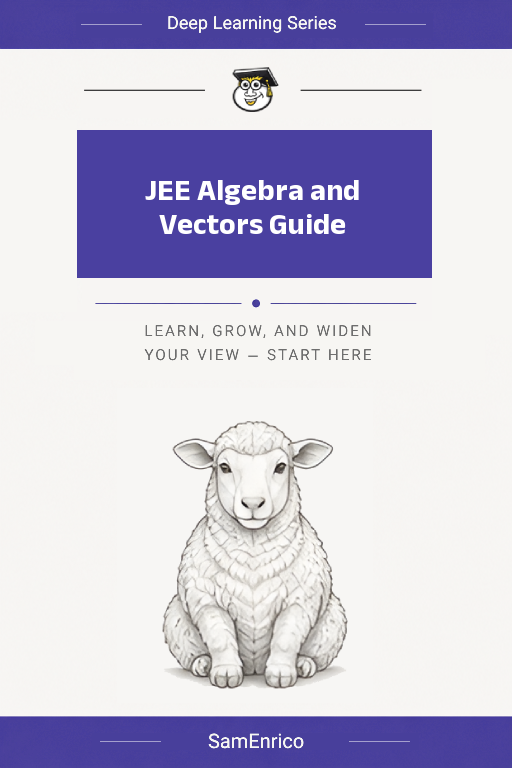
Non-FictionStudent's ShortcutAlgebra
JEE Algebra and Vectors Guide eBook
Covers matrices, determinants, complex numbers, pr
by Irish Aletha
Covers matrices, determinants, complex numbers, probability, vectors, and 3D geometry with problem-solving frameworks.
Formats
Free sample
Chapter 1: The Grid That Thinks--–- Matrices are not just arrays of numbers. They are the algebra’s way of seeing the world in parallel. A single matrix can encode a system of equations, a geometric transformation, or a network of relationships. Most JEE aspirants learn matrices as a collection of operations and types, but they fail to see the hidden architecture: every matrix tells a story about how inputs become outputs. This chapter rewires your intuition.
You will not merely classify matrices as symmetric or orthogonal—you will learn why those properties exist, how to recognize them in under ten seconds, and how to use frameworks that turn complex matrix problems into predictable steps. By the end, matrix equations that once looked like a maze will feel like a straight line.1.1 Why Matrices Matter for JEEThe Joint Entrance Examination tests matrices in three distinct ways: theoretical classification, algebraic manipulation, and as a tool for solving systems. In the last five years of JEE Main, at least two questions have appeared directly from matrix properties, while JEE Advanced integrates matrices into coordinate geometry and complex number problems. The reason is simple: matrices compress information. A 3×3 matrix holds nine numbers, but its trace, determinant, and special properties can answer complex questions without ever expanding the full multiplication.Consider this: when you see a problem asking whether A2=AA^2 = AA2=A or A2=IA^2 = IA2=I, the examiner is not testing your multiplication speed.
They are testing whether you recognize idempotent or involutory matrices and the shortcuts they unlock. This chapter builds those recognition skills systematically.1.2 The DNA of a Matrix: Order, Notation, and Basic Types A matrix of order m×nm \times nm×n has mmm rows and nnn columns. We denote it as A=[aij]A = [a_{ij}]A=[aij], where iii is the row index and jjj the column index. Square matrices (m=nm = nm=n) dominate JEE problems, but rectangular matrices appear in consistency questions (Chapter 3).Critical classification for JEE:Symmetric matrix: AT=AA^T = AAT=A (the transpose equals itself). The matrix mirrors across the diagonal.
Example: [255−3]\begin{bmatrix} 2 & 5 \\ 5 & -3 \end{bmatrix}[255−3].Skew-symmetric matrix: AT=−AA^T = -AAT=−A. Diagonal elements are always zero. Example: [04−40]\begin{bmatrix} 0 & 4 \\ -4 & 0 \end{bmatrix}[0−440].Orthogonal matrix: ATA=IA^T A = IATA=I. The rows (and columns) form an orthonormal set. Determinant is either +1+1+1 or −1-1−1.Idempotent matrix: A2=AA^2 = AA2=A.
Projection matrices fall here.Nilpotent matrix: Ak=0A^k = 0Ak=0 for some positive integer kkk. The smallest such kkk is the index of nilpotency.Involutory matrix: A2=IA^2 = IA2=I. Orthogonal matrices with determinant −1-1−1 are a subset.JEE shortcut: If a problem states A2=AA^2 = AA2=A, you immediately know AAA is idempotent. That implies An=AA^n = AAn=A for all n≥1n \ge 1n≥1, and (I−A)(I - A)(I−A) is also idempotent. Similarly, A2=IA^2 = IA2=I implies A−1=AA^{-1} = AA−1=A, which saves an entire inverse calculation.1.3 Matrix Operations: The Non-Commutative World Addition and subtraction are entry-wise and commutative.
Multiplication is where matrices become interesting—and dangerous.Matrix multiplication: For Am×n A_{m \times n}Am×n and Bn×p B_{n \times p}Bn×p, the product C=ABC = ABC=AB is m×pm \times pm×p with cij=∑k=1naikbkjc_{ij} = \sum_{k=1}^{n} a_{ik} b_{kj}cij=∑k=1naikbkj.Three non-intuitive facts:AB≠BAAB \neq BAAB=BA in general. Order matters.AB=0AB = 0AB=0 does not imply A=0A = 0A=0 or B=0B = 0B=0. Example: [1000][0010]=0\begin{bmatrix} 1 & 0 \\ 0 & 0 \end{bmatrix} \begin{bmatrix} 0 & 0 \\ 1 & 0 \end{bmatrix} = 0[1000][0100]=0.AB=ACAB = ACAB=AC does not imply B=CB = CB=C (unless AAA is invertible).Transpose properties to memorize:(AT)T=A(A^T)^T = A(AT)T=A(A+B)T=AT+BT(A+B)^T = A^T + B^T(A+B)T=AT+BT(AB)T=BTAT(AB)^T = B^T A^T(AB)T=BTAT (note the reversal)Trace (sum of diagonal entries) has a beautiful property: tr(AB)=tr(BA)\text{tr}(AB) = \text{tr}(BA)tr(AB)=tr(BA), even when AB≠BAAB \neq BAAB=BA. This fact alone solves many JEE matrix equations without expanding.1.4 The Power of Elementary Row Operations Elementary row operations are the engine of matrix algebra. There are three types:Row interchange: Swap two rows.Row scaling: Multiply a row by a non-zero scalar.Row addition: Add a multiple of one row to another.These operations do not change the solution set of a linear system.
More importantly, they allow us to find the inverse of a matrix through the Gauss-Jordan method:Step 1: Write the augmented matrix [A∣I][A | I][A∣I].Step 2: Apply row operations to transform the left side into III.Step 3: The right side becomes A−1A^{-1}A−1.Example: For A=[2111]A = \begin{bmatrix} 2 & 1 \\ 1 & 1 \end{bmatrix}A=[2111], start with [21∣1011∣01]\begin{bmatrix} 2 & 1 & | & 1 & 0 \\ 1 & 1 & | & 0 & 1 \end{bmatrix}[2111∣∣1001]. After operations, A−1=[1−1−12]A^{-1} = \begin{bmatrix} 1 & -1 \\ -1 & 2 \end{bmatrix}A−1=[1−1−12].Why this matters for JEE: The rank of a matrix—the number of non-zero rows in its row echelon form—determines consistency of systems (Chapter 3). Mastering row operations now saves hours later.1.5 Framework 1.1: Nilpotent and Idempotent Proofs The problem pattern: "If A2=AA^2 = AA2=A, prove that (I−A)2=I−A(I - A)^2 = I - A(I−A)2=I−A" or "If A3=0A^3 = 0A3=0, find (I+A+A2)−1(I + A + A^2)^{-1}(I+A+A2)−1."Framework 1.1 steps:Write down the given condition (idempotent: A2=AA^2 = AA2=A; nilpotent: Ak=0A^k = 0Ak=0).Expand the desired expression using matrix algebra (respecting non-commutativity).Substitute the condition repeatedly.Simplify.Example (idempotent): Given A2=AA^2 = AA2=A, show (I−A)2=I−A(I - A)^2 = I - A(I−A)2=I−A.(I−A)2=I2−IA−AI+A2=I−A−A+A2=I−2A+A=I−A(I - A)^2 = I^2 - IA - AI + A^2 = I - A - A + A^2 = I - 2A + A = I - A(I−A)2=I2−IA−AI+A2=I−A−A+A2=I−2A+A=I−A. Done.Example (nilpotent): Given A3=0A^3 = 0A3=0, find (I+A+A2)−1(I + A + A^2)^{-1}(I+A+A2)−1.Guess inverse as I−AI - AI−A (pattern from geometric series). Multiply: (I+A+A2)(I−A)=I−A+A−A2+A2−A3=I−0=I(I + A + A^2)(I - A) = I - A + A - A^2 + A^2 - A^3 = I - 0 = I(I+A+A2)(I−A)=I−A+A−A2+A2−A3=I−0=I.
So inverse is I−AI - AI−A.JEE shortcut: For nilpotent index kkk, (I+A+A2+⋯+Ak−1)(I−A)=I−Ak=I(I + A + A^2 + \dots + A^{k-1})(I - A) = I - A^k = I(I+A+A2+⋯+Ak−1)(I−A)=I−Ak=I.1.6 Framework 1.2: Solving Matrix Equations Without Expanding Many JEE problems give a matrix equation like 2A+3B=[4105]2A + 3B = \begin{bmatrix} 4 & 1 \\ 0 & 5 \end{bmatrix}2A+3B=[4015] and A−B=[1023]A - B = \begin{bmatrix} 1 & 0 \\ 2 & 3 \end{bmatrix}A−B=[1203], asking for AAA or BBB. The naive approach solves entry by entry. The framework approach uses linearity.Framework 1.2 steps:Treat matrix equations as linear in the unknown matrices.Solve by elimination exactly as you would for scalar equations, but keeping matrix order.If trace or determinant conditions are…
This is the end of the free sample. Get the eBook to keep going. Buy now
About this book
Details
- Author
- Irish Aletha
- Publisher
- SamEnrico
- Language
- English
- Genre
- Non-Fiction, Student's Shortcut, Algebra
- Released
- 2026-05-30
- Pages (approx.)
- 149
- Available as
- eBook, Audiobook

Read better in the ZLOADR app
Your eBooks on your phone or tablet. Sign in with your SamEnrico account and start reading.
More by Irish Aletha
 Divorce and Identity LossIrish Aletha$11.99
 So What TechniqueIrish Aletha$11.99
 Road Rage And Eye ContactIrish Aletha$11.99
 The Puritan Reformation GuideIrish Aletha$11.99
 The Assertiveness for Funeral Directors GuideIrish Aletha$11.99
 Lost in the Labyrinth: The Forgotten Odyssey of Hanno the NavigatorIrish Aletha$11.99
 Aluminium TradingIrish Aletha$11.99
 Bookkeeping VA Hiring GuideIrish Aletha$12.99
 Understanding Piepkorn–karp–hickoc SyndromeIrish Aletha$17.99
 How to Start a Butter Milk Business (Beginners Guide)Irish Aletha$11.99
You may also like
 Hong Kong Handover 1997Dunn Johnnie$11.99
 Zumba For Postnatal Recovery CourseNeal Christian$11.99
 Zumba for BeginnersLadner Nikia$11.99
 YouTube Comment Mining GuideHumes Pandora$12.99
 Worry Box MeditationCarlin Rudy$11.99
 Workplace Stress MeditationNguyen Lynn$11.99
 Workplace Stress and Sleep RepairHawley Ivory$11.99
 Workplace Perfectionism CureDelaney Jeffry$11.99
 Workplace Injustice Anger GuideWallen Isabelle$11.99
 Work Addiction and Burnout LinkGreenwood Ester$11.99
 Women in Yoga and WellnessBeattie Galina$11.99
 Women in Stand Up ComedyChun Evangeline$11.99