
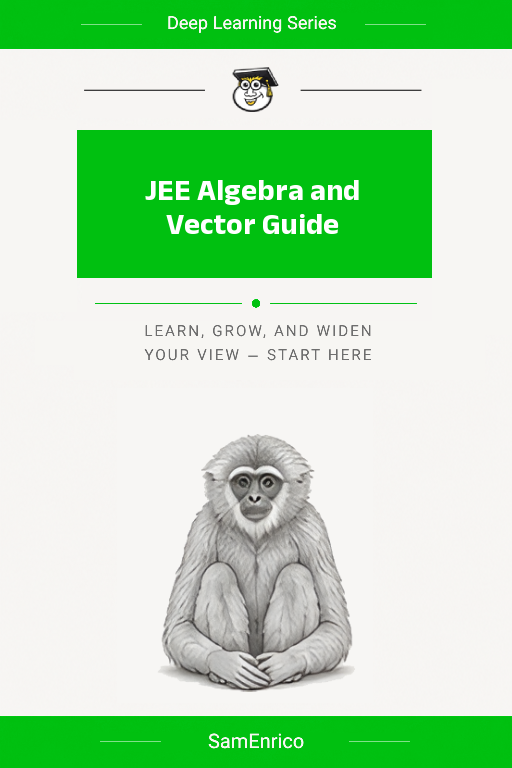
JEE Algebra and Vector Guide eBook
Solve matrices, determinants, complex numbers, and
Solve matrices, determinants, complex numbers, and vector problems with step-by-step logical breakdown methods.
Formats
Free sample
Chapter 1: The Matrix Language...–- Imagine staring at a grid of numbers – no larger than a chessboard – and realizing that this simple rectangle contains instructions for encrypting secret messages, compressing a Hollywood movie, or predicting the trajectory of a rocket. That grid is a matrix. Most JEE aspirants first meet matrices as a dry table of numbers with strange rules. But the ones who crack the toughest problems see something else: a language. And like any language, if you learn its alphabet and grammar first, you will later write poetry with it.
This chapter teaches you that alphabet. By the time you finish, you will look at any matrix and instantly name its type, size, and special properties – in under ten seconds.Why This Chapter Matters for JEEBefore we write a single formula, understand this: JEE does not ask you to memorize definitions. It gives you a matrix and asks, “Is this idempotent?” or “Find the value of a_23.” That is not memory – that is recognition. In the last five years, JEE Main has asked at least two questions per paper directly testing matrix classification and element location. Chapter 5 (Rank & Consistency) will depend on your ability to spot a singular matrix.
Chapter 4 (Inverse & Adjoint) will ask you to check if a matrix is invertible. And Chapter 12 (Determinants in Vector Space) will use the same classification to test collinearity. This chapter is not isolated – it is the foundation of everything that follows.Archetype Reference: All problems in this chapter belong to [A1] – Classify matrix type / Extract element. You will see this badge on every solved example.1.1 What Exactly Is a Matrix?A matrix is a rectangular array of numbers arranged in rows and columns. That is the definition.
But the intuition is more powerful: a matrix is a machine that takes a vector and transforms it into another vector. For now, we only care about the machine's parts – the numbers themselves.Notation: We denote a matrix by a capital letter, often A. Its size is written as m × n, where m = number of rows and n = number of columns. If m = n, the matrix is square. If m ≠ n, it is rectangular.Example:text Copy Download A = [ 2 -1 0 ] [ 3 4 -2 ]This is a 2 × 3 matrix (2 rows, 3 columns).Why This Step: The order m × n is the first thing you must identify.
JEE problems often hide the order in a complicated expression. For instance: "If A is a matrix of order 3 × 4, what is the order of A^T?" Without the order, you cannot proceed.1.2 The Index Chart Method – Finding Any Element in Seconds Every number in a matrix lives at a unique address: row i, column j. We write this as a_ij (read as "a sub i j"). The first index is always the row number, the second is the column number.The 3D Coordinate Metaphor: Imagine a spreadsheet. Rows go down, columns go across.
To find a_23, go down to row 2, then across to column 3. That is your element.Solved Example [A1] – JEE Main 2020 (Modified):If A = [a_ij] is a 3 × 3 matrix where a_ij = i² − j, find a_23.Step 1 (Visualization): Draw a 3 × 3 grid. Label rows 1,2,3 and columns 1,2,3.Step 2 (Pattern Recognition – Archetype [A1]): We need to locate element at row 2, column 3 using the given formula.Step 3 (Execution): Substitute i = 2, j = 3 → a_23 = (2)² − 3 = 4 − 3 = 1.Answer: a_23 = 1.Practice Drill (🟢 JEE Main level): Find a_12, a_31, a_33 for the same matrix. (Answers: a_12 = 1²−2 = −1, a_31 = 3²−1 = 8, a_33 = 3²−3 = 6)Why This Step Box: JEE often gives a formula for a_ij and asks for a specific element. The trap is swapping i and j.
Always write i = row, j = column before substituting.1.3 Classification in Seconds – A Decision Table (No Flowchart)We promised to replace overused flowcharts with clearer tables. Here is your Matrix Classification Decision Table. Memorize it.Question If Yes →If No →Is it rectangular (m ≠ n)?Classify as Rectangular. Stop.Go to next row.Is it square (m = n)?Check diagonal next.Not possible (already square).Does a_ij = a_ji for all i,j?Symmetric Check skew-symmetric next.Does a_ij = −a_ji for all i,j?Skew-Symmetric (diagonal must be zero)Neither symmetric nor skew.Does A² = A?Idempotent Not idempotent.Does A^k = 0 for some positive integer k?Nilpotent (smallest k is index)None of the above.Why This Step Box: JEE problems rarely say "classify this matrix." Instead, they say "If A is symmetric, find x." That means you must already know what symmetric means. This table trains you to recognize the type instantly.1.4 Special Matrices – The Memory Hooks Each special matrix has a visual trick and a JEE relevance note.1.4.1 Symmetric Matrix (Mirror over Diagonal)A matrix is symmetric if it equals its own transpose: A = Aᵀ.
This means a_ij = a_ji for all i,j. The diagonal can be any numbers.Memory Hook: Imagine a mirror placed along the diagonal. The numbers reflect perfectly.JEE Relevance: Symmetric matrices appear in quadratic forms (JEE Advanced) and in questions like "Find x if A is symmetric."Example:text Copy Download S = [ 1 4 5 ] [ 4 2 6 ] [ 5 6 3 ]Check: S[1][2] = 4 = S[2][1], etc.1.4.2 Skew-Symmetric Matrix (Opposite Signs, Diagonal Zero)A matrix is skew-symmetric if Aᵀ = −A. This means a_ij = −a_ji. The diagonal must be zero because a_ii = −a_ii ⇒ 2a_ii = 0 ⇒ a_ii = 0.Memory Hook: The diagonal is a line of zeros.
Every pair across the diagonal has opposite signs.JEE Relevance: The determinant of any odd-order skew-symmetric matrix is always zero. JEE has asked this exact property four times since 2015.Example:text Copy Download K = [ 0 3 -2 ] [ -3 0 5 ] [ 2 -5 0 ]Solved Example [A1] – JEE Main 2018:If A is a skew-symmetric matrix of order 3, find |A|.Step 1 (Visualization): A is 3×3 (odd order).Step 2 (Pattern Recognition – Archetype [A1] + Property): For odd-order skew-symmetric, det(A) = 0.Step 3 (Execution): No calculation needed. Answer: 0.Why This Step Box: *JEE tests this property exactly because it saves three minutes of determinant expansion. Memorize: odd skew → det = 0.*1.4.3 Idempotent Matrix (Projection)A matrix is idempotent if A² = A. These are projection matrices – applying them twice is the same as applying them once.Memory Hook: Once you project, you cannot project again.
The second projection does nothing.JEE Relevance: Idempotent matrices have eigenvalues only 0 or 1. They are singular unless A = I. JEE 2019 asked: "If A is idempotent and A ≠ I, prove that A is singular."Example:text Copy Download P = [ 1 0 ] [ 0 0 ]Check: P² = [1 0; 0 0] = P.1.4.4 Nilpotent Matrix (Shift)A matrix is nilpotent if A^k = 0 for some positive integer k. The smallest such k is called the index of nilpotency.Memory Hook: A shift matrix that pushes non-zero entries off the grid.JEE Relevance: Nilpotent matrices have trace = 0 and determinant = 0. JEE Advanced 2020 asked: "Find the index of nilpotency of [[0,1,0],[0,0,1],[0,0,0]]."Example:text Copy Download N = [ 0 1 ] [ 0 0 ]Check: N² = [0 0; 0 0].
Index = 2.1.5 The Symmetric + Skew-Symmetric Decomposition (JEE Favorite)Here is a trick that appears every two years in JEE. Any square matrix A can be written uniquely as the sum of a symmetric matrix and a skew-symmetric matrix:text Copy Download A = (A + Aᵀ)/2 + (A − Aᵀ)/2Call the first term P (symmetric) and the second term Q (skew-symmetric).Why This Step Box: *JEE gives you a matrix and asks, "Find the symmetric part of A." You do not expand determinants or solve equations –…
This is the end of the free sample. Get the eBook to keep going. Buy now
About this book
Details
- Author
- Ocasio Kimiko
- Publisher
- SamEnrico
- Language
- English
- Genre
- Non-Fiction, Student's Shortcut, Algebra Prep
- Released
- 2026-05-30
- Pages (approx.)
- 119
- Available as
- eBook, Audiobook

Read better in the ZLOADR app
Your eBooks on your phone or tablet. Sign in with your SamEnrico account and start reading.
More by Ocasio Kimiko
 Polish Resistance Child SoldiersOcasio Kimiko$11.99
 Difficult Feedback to BossOcasio Kimiko$11.99
 Mortgage Payoff vs Invest GuideOcasio Kimiko$11.99
 Deep Work for Product ManagersOcasio Kimiko$11.99
 Remote Retreats for Creative TeamsOcasio Kimiko$11.99
 The Vanishing Vermeer: A Masterpiece Lost in the ShadowsOcasio Kimiko$11.99
 The Unlikely Champion: How a Janitor Became the Face of the Civil Rights MovementOcasio Kimiko$11.99
 Understanding Choroidal Atrophy AlopeciaOcasio Kimiko$17.99
 Budget Communication To TeamOcasio Kimiko$12.99
 Plumbing DesignerOcasio Kimiko$11.99
 How to Become a Insole-and-heel-stiffenerOcasio Kimiko$11.99