
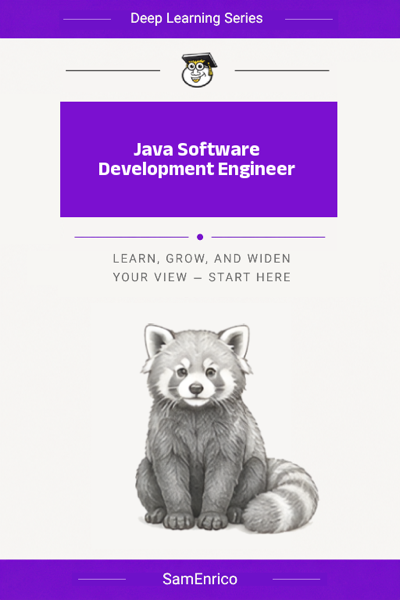
Non-FictionInformativeEducational
Java Software Development Engineer eBook
A Coursebook on Java Software Development Engineer
A Coursebook on Java Software Development Engineer
Formats
Free sample
Chapter 1: The Silent Teacher--– You’ve already written Java code. Maybe it was a “Hello, World” in a university lab, or a small automation script at work, or even a few hundred lines of spaghetti logic that somehow worked. You understood the syntax. The program compiled. It printed the right output.
You felt a small rush of accomplishment. Then you closed your laptop and moved on.But here’s what no one told you: the Java that runs on your laptop is a lie.Not a malicious lie. More like a white lie told to beginners to keep them from drowning. Your IDE hides the truth. The friendly green “Run” button hides the truth.
The comforting output in the console hides the truth.The truth is this: between your .java source file and the blinking cursor on your screen, an invisible war happens. A war of memory allocation, thread scheduling, bytecode verification, just-in-time compilation, garbage collection, and hardware abstraction. Every time you press Run, a small miracle occurs inside your machine – a miracle that most Java developers, even those with three years of experience, cannot fully explain.This chapter is the end of that ignorance.By the time you finish reading these pages, you will understand exactly what happens from the moment you type javac Main.java to the moment your output appears. You will understand why Java conquered the enterprise world. You will understand why your code runs slower or faster than expected.
And you will learn the fundamental building blocks – syntax, types, control flow – not as abstract rules to memorize, but as deliberate design decisions made by people who understood computers at the deepest level.This is not a reference chapter you skim and forget. This is the foundation upon which every other chapter of this book rests. Master this, and everything else – object orientation, concurrency, streams, design patterns – becomes easier. Skip this, and you will spend the rest of your career fighting shadows.Let us begin with the most important sentence you will read in this entire book:“Java source code is for humans. Bytecode is for machines.
The JVM is the translator.”The Great Illusion: Platform Independence Every programming language makes a promise. C promises speed. Python promises simplicity. Java Script promises ubiquity. Java promises something that, in 1995, sounded like science fiction: write once, run anywhere.Sun Microsystems (now long absorbed into Oracle) made this claim at a time when software was deeply fragmented.
Code written for Windows would not run on Mac. Mac code would not run on Solaris. Unix applications needed recompilation for every hardware variation. The dream of cross-platform software seemed impossible.Java achieved the impossible through an elegant lie.You write .java files. The compiler (javac) does not turn your code into machine instructions for your specific processor (Intel, AMD, ARM).
Instead, it produces .class files containing bytecode – a completely artificial instruction set that no physical CPU understands. Bytecode is the Esperanto of computing: a language no one speaks natively, but everyone can learn.The Java Virtual Machine (JVM) is the interpreter that translates this bytecode into native machine instructions at runtime. Each operating system has its own JVM implementation – Windows JVM, mac OS JVM, Linux JVM – but they all understand the same bytecode. Your .class file runs unchanged across all of them.Here is the mental model that will serve you for the rest of your career:text Copy Download.java source file → javac → .class bytecode → JVM → native machine code → execution The magic is that you only control the first step. The JVM handles everything else.But platform independence came with a cost.
The first Java versions were notoriously slow because the JVM interpreted bytecode line by line, like a translator speaking one word at a time. Modern Java solved this through Just-In-Time (JIT) compilation – the JVM identifies frequently executed bytecode (“hot methods”) and compiles them directly to native machine code, caching the result for future use. Your program starts slower but accelerates over time.Why does this matter to you, a Java Software Development Engineer?Because understanding bytecode explains dozens of “weird” behaviors. Why does Java compile but not run? The bytecode verifier rejected your .class file.
Why does the same code perform differently on different machines? Different JVM implementations, different JIT heuristics. Why does your server start slow but get faster after a few minutes? The JIT compiler is warming up.You are not just a Java programmer. You are a JVM programmer.
The distinction will make you senior.The Eight Primitives: Java’s Atomic Vocabulary Before you can build skyscrapers, you must understand bricks. Java’s “bricks” are its eight primitive types – the only data types that store values directly in memory (everything else stores references to objects on the heap).The Integer Familybyte (8 bits, -128 to 127): The minimalist. Used for raw data streams, file I/O buffers, and network protocols. You will rarely use it in business logic, but every file you read passes through byte[] arrays.short (16 bits, -32,768 to 32,767): The forgotten middle child. Introduced for compatibility with C, almost never used in modern Java.
If you find yourself using short, ask: “Does this really save memory?” (Answer: almost never on a 64-bit JVM with alignment.)int (32 bits, -2^31 to 2^31-1, about ±2.1 billion): The workhorse. Loop counters, array indices, everyday numbers. Default choice for integers unless you have an explicit reason otherwise.long (64 bits, -2^63 to 2^63-1, about ±9.2 quintillion): Use when 2.1 billion is insufficient. Timestamps (milliseconds since epoch), database identifiers, large counters. Always append L suffix: long population = 8_000_000_000L.The Decimal Familyfloat (32 bits, approximate 7 decimal digits of precision): Almost never used.
The imprecision of floating-point math (0.1 + 0.2 = 0.30000000000000004) combined with float’s low precision makes this a dangerous choice. Use double or Big Decimal instead.double (64 bits, approximate 16 decimal digits of precision): The default for decimal numbers. Used in scientific computing, graphics, and anywhere performance matters more than exact precision. Never use double for currency (see: Big Decimal in Chapter 10).The Specialistschar (16 bits, single Unicode character): A historical artifact from Java’s design in the 1990s, assuming 16 bits would be enough for all characters (it isn’t – emoji require surrogate pairs). Almost always, you should use String instead.
About the only legitimate use today: processing individual characters in a known ASCII context.boolean (true or false): The simplest type. Used in conditions, flags, and state tracking. The JVM implementation of boolean is not standardized – sometimes 1 byte, sometimes 4 bytes, sometimes folded into other structures. Do not rely on its size.The Stack vs Heap Revelation Here is where beginners stumble, intermediates guess, and seniors know exactly what happens:When you write int x = 5;, the value 5 lives on the stack – a small, fast, per-thread memory region that holds local variables. When the method ends, x evaporates.
No cleanup needed. No garbage collection.When you write Integer y = new Integer(5); (or the autoboxed version Integer y = 5;), the Integer object lives on the heap – a large, shared memory region that holds objects. The variable y (the reference) lives on the stack, but it points to the heap object.This distinction explains:Why primitives are faster (no heap overhead, no garbage collection)Why collections (Array List) cannot use primitives directly (collections store objects…
This is the end of the free sample. Get the eBook to keep going. Buy now
About this book
Details
- Author
- Easterling Lelia
- Publisher
- SamEnrico
- Language
- English
- Genre
- Non-Fiction, Informative, Educational
- Released
- 2026-05-04
- Pages (approx.)
- 158
- Available as
- eBook, Audiobook

Read better in the ZLOADR app
Your eBooks on your phone or tablet. Sign in with your SamEnrico account and start reading.
More by Easterling Lelia
 Recurring Dream Blockage GuideEasterling Lelia$11.99
 Meditation for Heel Spur PainEasterling Lelia$11.99
 Franciscan Library and Study StanceEasterling Lelia$11.99
 Self Hypnosis For Phobia Treatment CourseEasterling Lelia$11.99
 Harvard Extension Degree CompletionEasterling Lelia$12.99
 Boundary Setting with NarcissistsEasterling Lelia$11.99
 The Last Pharaoh: Cleopatra's Forgotten DaughterEasterling Lelia$11.99
 The Ballad of the Dancing Pigeons: How a Forgotten Protest Changed a NationEasterling Lelia$11.99
 Understanding Epilepsy Occipital CalcificationsEasterling Lelia$17.99
 How to Start a Automobile Association Service Centres Business (Beginners Guide)Easterling Lelia$11.99
 House Sitting TransportationEasterling Lelia$12.99Harvard Extension Degree CompletionEasterling Lelia$12.99
You may also like
 Hong Kong Handover 1997Dunn Johnnie$11.99
 Zumba For Postnatal Recovery CourseNeal Christian$11.99
 Zumba for BeginnersLadner Nikia$11.99
 YouTube Comment Mining GuideHumes Pandora$12.99
 Worry Box MeditationCarlin Rudy$11.99
 Workplace Stress MeditationNguyen Lynn$11.99
 Workplace Stress and Sleep RepairHawley Ivory$11.99
 Workplace Perfectionism CureDelaney Jeffry$11.99
 Workplace Injustice Anger GuideWallen Isabelle$11.99
 Work Addiction and Burnout LinkGreenwood Ester$11.99
 Women in Yoga and WellnessBeattie Galina$11.99
 Women in Stand Up ComedyChun Evangeline$11.99