
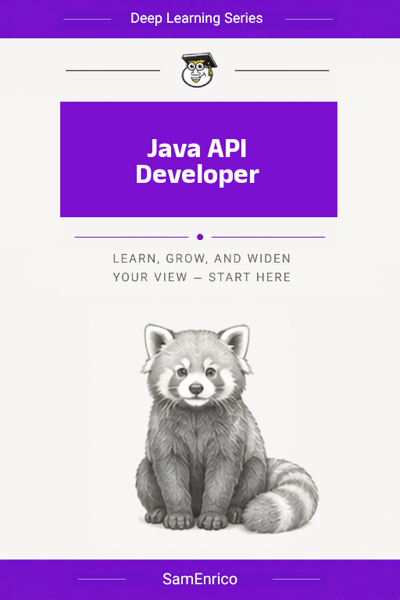
Non-FictionInformativeEducational
Java API Developer eBook
A Coursebook on Java API Developer
A Coursebook on Java API Developer
Formats
Free sample
Chapter 1: The Silent Handshake--–- Every time you tap a ride-sharing app to request a car, check the weather on your phone, or log into a website using your Google account, a silent handshake occurs between software systems that may be thousands of miles apart. No humans are involved. No files are exchanged. Yet within milliseconds, these systems agree on who you are, what you want, and what response to send back. This handshake is so seamless, so invisible, that most users never notice it.
But for developers, understanding this handshake is the difference between building software that integrates gracefully into the modern world and building isolated islands of functionality that no other system can talk to.The handshake is, of course, an API call. API stands for Application Programming Interface, but that sterile definition conceals the dynamic, living nature of what APIs actually do. An API is a contract. It is a promise that if you send a message in a specific format to a specific address, you will receive a predictable response. This contract enables the modular, interconnected software ecosystem we take for granted.
When you order food delivery, the restaurant’s system, the delivery tracking system, the payment processor, and your mobile app are all exchanging API calls. None of them share a database. None of them were written by the same company. Some of them may not even know the others exist. Yet they cooperate flawlessly because each one honors its API contracts.This chapter is the foundation of everything that follows in this book.
You will learn why APIs have become the default architecture for modern software, how the HTTP protocol carries API traffic, what makes an API truly RESTful (and what parts of REST the industry has quietly abandoned), how to choose between REST, Graph QL, and g RPC for different scenarios, and how to write production-ready HTTP clients using modern Java’s built-in tools. By the time you finish this chapter, you will see the silent handshake everywhere you look—and you will be ready to start writing the code that performs it.The Collapse of the Monolith In the 1990s and early 2000s, most enterprise software was built as a single, monolithic application. A typical e-commerce monolith would contain product catalog code, shopping cart logic, payment processing, inventory management, shipping calculation, and user accounts—all compiled into one deployable artifact. If a developer wanted to change how shipping costs were calculated, they had to rebuild and redeploy the entire application. If the inventory system crashed, the entire website went down.
If a new team member joined, they needed to understand the whole system before they could contribute to any part of it.This architecture worked when software changed slowly, when teams were small, and when downtime was measured in hours. But the internet changed everything. Amazon, Netflix, and Google proved that the companies able to deploy changes fastest would win. Amazon famously claimed that by 2010, they were deploying new code every 11.6 seconds. A monolith cannot deploy every 11 seconds—the risk of breaking something unrelated is too high.The solution was to break the monolith into services.
Each service would own a specific capability: user management, product catalog, order processing. Services would communicate exclusively through APIs. One service could change its internal implementation completely—switch databases, rewrite in a new language, move to a different cloud—without affecting other services, as long as its API contract remained stable.This shift did not happen overnight. Early attempts at service-oriented architecture (SOA) failed because they used heavyweight protocols like SOAP (Simple Object Access Protocol) and required centralized governance. But a lighter, simpler approach emerged from an unexpected place: the web itself.HTTP: The Accidental API Protocol HTTP was designed in 1989 for a much simpler purpose: transferring hypertext documents (web pages) from servers to browsers.
The original specification had only one method (GET) and a handful of status codes. But HTTP turned out to have exactly the properties needed for service communication. It was simple enough that any programming language could implement it. It was stateless, meaning servers did not need to remember anything between requests. It was text-based, making it debuggable with nothing more than telnet or curl.
And because the entire web ran on it, firewalls and network infrastructure already supported it perfectly.Today, HTTP is the undisputed transport for API traffic. Understanding its core elements is essential for any API developer.Methods: The Verbs HTTP methods (or verbs) tell the server what kind of action the client wants to perform. While there are nine officially defined methods, API developers use five almost exclusively:GET retrieves a representation of a resource. GET requests have no body and must never change server state. If a GET request creates a log entry, that is acceptable (logging is not part of the resource state), but it must not update a counter, delete a record, or modify a user profile.
GET is idempotent, meaning multiple identical requests have the same effect as a single request. This property allows browsers, proxies, and CDNs to cache GET responses aggressively. When you load a web page, your browser is issuing dozens of GET requests.POST creates a new resource or submits data for processing. POST is not idempotent. Submitting the same POST request twice might create two resources (two orders, two user accounts, two forum posts).
POST requests carry a body containing the data to be processed. The server decides where the new resource lives and typically returns a Location header pointing to it.PUT replaces an entire existing resource. If you send a PUT to /users/123 with a complete user object, the server replaces whatever was at that URI with your new representation. PUT is idempotent. If you send the same PUT request ten times, the result is the same as sending it once.
If the resource does not exist, some APIs choose to create it (though this behavior is debated). PUT requires the client to know the complete state of the resource, which is often impractical.PATCH performs a partial update. Rather than sending the entire resource, PATCH sends only the fields that should change. The request body contains instructions for modifying the resource. While PUT replaces, PATCH merges.
A PATCH to /users/123 with {"email": "new@example.com"} updates the email address while leaving other fields unchanged.DELETE removes a resource. A DELETE to /users/123 should remove that user. Like GET and PUT, DELETE is idempotent—deleting a resource that is already gone still succeeds (or returns 404 Not Found, depending on API design).These five methods, combined with URIs, form the vocabulary of RESTful API design. Every endpoint should have a clear, consistent method. Mixing them up—using GET to delete a resource or POST to retrieve data—confuses clients and breaks the expectations of HTTP tooling.Headers: The Adverbs Headers are metadata.
They describe how to interpret the request or response, what capabilities the client or server supports, and how the message should be handled. A typical HTTP request might include ten or fifteen headers, but only a handful matter for most API work:Content-Type tells the receiver what format the body uses. For modern APIs, this is almost…
This is the end of the free sample. Get the eBook to keep going. Buy now
About this book
Details
- Author
- Candelaria Elidia
- Publisher
- SamEnrico
- Language
- English
- Genre
- Non-Fiction, Informative, Educational
- Released
- 2026-06-02
- Pages (approx.)
- 151
- Available as
- eBook, Audiobook

Read better in the ZLOADR app
Your eBooks on your phone or tablet. Sign in with your SamEnrico account and start reading.
More by Candelaria Elidia
 Middle East Talent Magnet ForecastCandelaria Elidia$11.99
 Mediterranean Diet MicrobiomeCandelaria Elidia$11.99
 Cannabis Tobacco Mix Quitting GuideCandelaria Elidia$11.99
 The Parent Death Children GuideCandelaria Elidia$11.99The Parent Death Children GuideCandelaria Elidia$11.99
 Catherine the Great Foreign Envoy ManagementCandelaria Elidia$11.99
 Boom Box Revolution: How a Toy Changed the WorldCandelaria Elidia$11.99
 Into the Abyss: The Bold Descent into the Mariana TrenchCandelaria Elidia$11.99
 AI Powered Payroll Reconciliation GuideCandelaria Elidia$12.99
 Remittance Corridors Africa GuideCandelaria Elidia$12.99
 Understanding Becker DiseaseCandelaria Elidia$17.99
 How to Start a Cutlery Made of Plastic Business (Beginners Guide)Candelaria Elidia$11.99
You may also like
 Hong Kong Handover 1997Dunn Johnnie$11.99
 Zumba For Postnatal Recovery CourseNeal Christian$11.99
 Zumba for BeginnersLadner Nikia$11.99
 YouTube Comment Mining GuideHumes Pandora$12.99
 Worry Box MeditationCarlin Rudy$11.99
 Workplace Stress MeditationNguyen Lynn$11.99
 Workplace Stress and Sleep RepairHawley Ivory$11.99
 Workplace Perfectionism CureDelaney Jeffry$11.99
 Workplace Injustice Anger GuideWallen Isabelle$11.99
 Work Addiction and Burnout LinkGreenwood Ester$11.99
 Women in Yoga and WellnessBeattie Galina$11.99
 Women in Stand Up ComedyChun Evangeline$11.99