
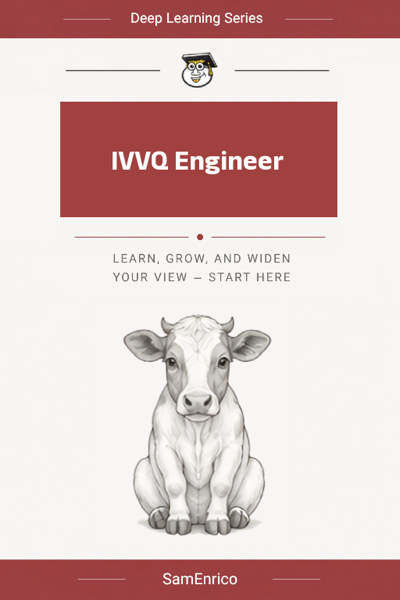
Non-FictionInformativeEducational
IVVQ Engineer eBook
A Coursebook on IVVQ Engineer
by Shumate Han
A Coursebook on IVVQ Engineer
Formats
Free sample
Chapter 1: The Last Line of Defense--–- The conference room smelled of stale coffee and desperation. Thirty-two engineers sat in folding chairs, none of them meeting each other's eyes. On the screen, a photograph of a spacecraft – the Mars Climate Orbiter – tumbled silently through empty space. The $125 million question hung in the air like a bad smell: What happened?The lead systems architect spoke first. "The software worked perfectly.
Our telemetry confirmed every calculation."The navigation lead shook his head. "Our ground control sequence was flawless. We sent the commands exactly as specified."A junior engineer in the back raised her hand. She was twenty-four years old, three months out of graduate school, and about to say something that would make everyone in the room uncomfortable."Did anyone verify that the units matched?"Silence."The propulsion team used pounds of force," she continued, her voice steadier than she felt. "The navigation team used newtons.
The interface control document specified both, but no one actually tested whether the data being passed between subsystems was in the same unit system. We assumed. Assumptions kill spacecraft."The room remained silent for a full eight seconds. Then the program manager closed his laptop and walked out without a word.That junior engineer was not fired. She was promoted.
And she became the model for what this book calls the IVVQ Engineer – the person who asks the uncomfortable questions before the spacecraft tumbles, before the bridge collapses, before the patient dies.The Quiet Superpower of Engineering There is a peculiar kind of engineer who does not design the circuits, write the algorithms, or machine the brackets. This engineer does not create anything, in the traditional sense. Instead, this engineer verifies what others have created. This engineer validates that the creation actually solves the problem it was meant to solve. This engineer integrates the pieces into a functioning whole.
And this engineer qualifies the final product for the harsh reality of the real world.This is the IVVQ Engineer.The title stands for Integration, Verification, Validation, and Qualification. It is not a glamorous acronym. It does not appear on recruitment posters promising "moonshot thinking" or "disruptive innovation." But without the IVVQ Engineer, every moonshot becomes a crater. Every disruptive innovation becomes a recall notice. Every line of code becomes a potential lawsuit.This chapter is about why the IVVQ role exists, why it is consistently undervalued, and why you – the reader – have chosen one of the most critical, stressful, and morally essential jobs in modern engineering.The Three Numbers That Will Haunt Your Dreams Let us begin with a simple economic fact.
The cost of finding and fixing a defect changes dramatically depending on when you find it. Industry data, synthesized from NASA, the Department of Defense, and the Consortium for Information & Software Quality, gives us this rough ratio:Stage of Discovery Relative Cost to Fix During requirements (before any code written)1x (baseline)During design3x - 6x During integration (components brought together)10x During validation (testing against user needs)100x In operations (after deployment)1,000x - 10,000x Read that last line again. A bug that costs 1,000tofixafterdeploymentwouldhavecost1,000 to fix after deployment would have cost 1,000tofixafterdeploymentwouldhavecost1 to fix during requirements. The Mars Climate Orbiter's unit conversion error? Caught during integration, it would have required a single line of interface test code – maybe 10,000worthoflabor.Caughtduringvalidation,itwouldhavedelayedlaunchbyaweek–10,000 worth of labor.
Caught during validation, it would have delayed launch by a week – 10,000worthoflabor.Caughtduringvalidation,itwouldhavedelayedlaunchbyaweek–1 million. Caught during operations? The spacecraft was already tumbling. The cost was $125 million and the end of a mission.This is not abstract economics. This is the IVVQ Engineer's value proposition written in dollars and casualties.The curve exists because defects propagate.
A wrong assumption about units embeds itself into navigation algorithms, which embed themselves into thruster firing sequences, which embed themselves into trajectory calculations. By the time the spacecraft is in flight, the original error has been multiplied across dozens of subsystems, each of which was built assuming the previous layer was correct.The IVVQ Engineer's job is to climb the ladder of propagation and kick the bad assumptions out before they become expensive.The V Model: A Map of the Territory To understand where IVVQ fits, you need a mental map of how complex systems are built. The most useful map is called the V Model (sometimes called the Vee Model). It looks like this in concept:text Copy Download Requirements ──────────────────────► System Validation │ │ ▼ │ Architecture ──────────────────► Integration Testing │ │ ▼ │ Detailed Design ──────────────► Component Testing │ │ ▼ │ Implementation (code, hardware) ◄─────────┘The left side of the V is design – breaking a big problem into smaller pieces. The right side of the V is integration and testing – putting the pieces back together and checking your work.
The IVVQ Engineer lives on the right side, but must understand the left side intimately to do good work.Let's walk the V from bottom to top:Implementation. Someone writes code. Someone machines a bracket. Someone assembles a circuit board. At this level, verification is low-level: does this function return the right value?
Does this resistor have the correct value? This is the domain of unit tests and incoming inspection.Component Testing. Individual pieces are tested in isolation. The power supply module is connected to a dummy load. The navigation algorithm is fed simulated sensor data.
Each component is verified against its own specification.Integration. Now pieces begin to talk to each other. The power supply is connected to the computer. The navigation algorithm receives real sensor data for the first time. This is where the Mars Climate Orbiter failed – two components that worked perfectly in isolation failed to work together because their interface was never verified.System Validation.
The fully integrated system is tested against the original user needs. Does it solve the problem? Would a technician in the rain be able to use it? Does it actually make the spacecraft go where the customer wants?Each level on the right side corresponds to a level on the left side. Requirements (left) validate against system validation (right).
Architecture (left) validates against integration testing (right). This traceability is the IVVQ Engineer's bible, and we will spend all of Chapter 3 on it.The Four Letters, Explained (Once and For All)The acronym IVVQ appears throughout this book. Since we will not redefine these terms in every chapter (as previous editions mistakenly did), here is the definitive explanation – the only one you will need:Integration (The "I")Integration is the process of combining smaller components into larger subsystems, and larger subsystems into a complete system. It is the first time that pieces that were designed separately must work together. Integration discovers interface defects – problems that do not exist in any single component but emerge when components interact.Example: The radio transmitter works perfectly when connected to a dummy antenna.
The antenna works perfectly when connected to a signal generator. But when connected together, the impedance mismatch causes the transmitter to overheat. Both components are correct to their individual specifications. The interface is wrong.Integration testing answers the question: Do the parts fit together as designed?Verification (The First "V")Verification answers the question: Did we build it right? It is a technical check against a written specification.…
This is the end of the free sample. Get the eBook to keep going. Buy now
About this book
Details
- Author
- Shumate Han
- Publisher
- SamEnrico
- Language
- English
- Genre
- Non-Fiction, Informative, Educational
- Released
- 2026-06-02
- Pages (approx.)
- 156
- Available as
- eBook, Audiobook

Read better in the ZLOADR app
Your eBooks on your phone or tablet. Sign in with your SamEnrico account and start reading.
More by Shumate Han
 International Seller PerformanceShumate Han$11.99
 Assertive Parenting Skills CourseShumate Han$11.99
 The Rapid Eye Blink InductionShumate Han$11.99
 Redwood Forest VisualizationShumate Han$11.99
 The Parent Mindfulness Practice GuideShumate Han$11.99
 The Forger of Words: How Jorge Volpi Outwitted the Literary EliteShumate Han$11.99
 Fashion Sellers Platform GuideShumate Han$12.99
 IT and Engineering PR GuideShumate Han$12.99
 Understanding Renal HypertensionShumate Han$17.99
 How to Start a National Council for Civil Liberties Business (Beginners Guide)Shumate Han$11.99
You may also like
 Hong Kong Handover 1997Dunn Johnnie$11.99
 Zumba For Postnatal Recovery CourseNeal Christian$11.99
 Zumba for BeginnersLadner Nikia$11.99
 YouTube Comment Mining GuideHumes Pandora$12.99
 Worry Box MeditationCarlin Rudy$11.99
 Workplace Stress MeditationNguyen Lynn$11.99
 Workplace Stress and Sleep RepairHawley Ivory$11.99
 Workplace Perfectionism CureDelaney Jeffry$11.99
 Workplace Injustice Anger GuideWallen Isabelle$11.99
 Work Addiction and Burnout LinkGreenwood Ester$11.99
 Women in Yoga and WellnessBeattie Galina$11.99
 Women in Stand Up ComedyChun Evangeline$11.99