
Non-FictionHealth & WellnessContraception
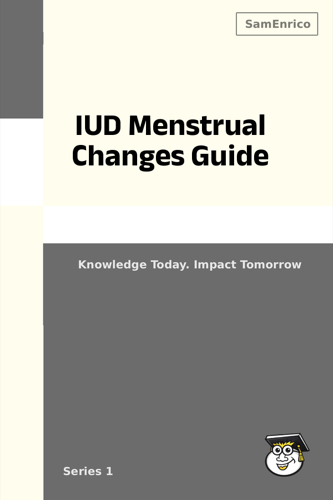
IUD Menstrual Changes Guide eBook
Adjusts to hormonal or copper IUD periods.
Adjusts to hormonal or copper IUD periods.
Formats
Free sample
Chapter 1: The Baseline Betrayal...--You cannot know what an IUD has done to your period unless you remember what your period was like before you broke it.This sounds dramatic. It is meant to. Because for the millions of people who choose an intrauterine device for contraception, the single greatest source of confusion, anxiety, and regret is not insertion pain, not the cost, not even the fear of pregnancy—it is the sudden, unexplained, and often dismissed change in their menstrual bleeding.You were told “spotting is normal.” You were told “your periods may change.” You were told “give it three to six months to settle.”What you were not told is that “normal” is a meaningless word without a baseline. And what you were not given was a simple, systematic way to document your own unique menstrual fingerprint before the IUD arrived.This chapter is that documentation. It is an archaeological dig of your menstrual history.
It is the evidence you will need in six months when a doctor tells you “this is expected” and you need to reply, “No, this is different from what my body did on its own.”We are going to rebuild your memory of your natural cycle. We are going to give you numbers, definitions, and a self-assessment that you will photograph and keep forever. And we are going to name the quiet betrayal of the medical system: the fact that no one asked you to write down your baseline before they inserted a device that would permanently alter it.Let us begin with the science of what a normal period actually looks like. Then we will move to your personal history. Then we will prepare you for the chapters ahead.The Three-Act Play: Your Natural Menstrual Cycle Before any hormones, before any copper, before any plastic T-shaped device sits inside your uterus, your body runs a finely choreographed monthly cycle.
It is not magic. It is not mysterious. It is a predictable sequence of hormonal signals between your brain, your ovaries, and your uterus.Think of it as a three-act play.Act One: The Follicular Phase – Building the Set The first day of your full flow menstrual bleeding is Day 1 of your cycle. Counterintuitively, this is not the end of the story—it is the beginning.On Day 1, your estrogen and progesterone are at their lowest levels of the entire month. This hormonal low signals your pituitary gland (a tiny pea-sized structure at the base of your brain) to release follicle-stimulating hormone, or FSH.FSH does exactly what its name says: it stimulates your ovarian follicles.
Each follicle is a tiny sac containing an immature egg. Over the next 10 to 14 days (on average), FSH causes several follicles to grow. As they grow, they produce estrogen. And rising estrogen does two critical things.First, it tells your uterine lining, the endometrium, to thicken. Before ovulation, a healthy endometrium grows from a thin 1–2 millimeters to a lush 6–8 millimeters, packed with blood vessels and glands designed to nourish a potential pregnancy.
This is a good thing.Second, rising estrogen eventually triggers a surge in luteinizing hormone, or LH. When estrogen reaches a high enough level for long enough, the brain releases a massive spike of LH. This LH surge is what you detect on ovulation predictor kits. It causes the dominant follicle to rupture and release its egg.That is ovulation. It typically occurs around Day 14 in a 28-day cycle, but anywhere from Day 11 to Day 21 is considered normal.Act Two: Ovulation – The Turning Point Ovulation itself is a brief event—the egg is viable for only 12 to 24 hours.
But the hormonal aftermath lasts two weeks.After the follicle releases the egg, the empty follicle collapses and transforms into a new structure called the corpus luteum, which is Latin for “yellow body.” The corpus luteum produces large amounts of progesterone, with some estrogen mixed in.Progesterone is the unsung hero of the second half of your cycle. It stabilizes the endometrial lining that estrogen built. It changes the consistency of your cervical mucus from wet and stretchy (fertile, like raw egg white) to thick and sticky (hostile to sperm). It raises your basal body temperature by about half a degree Fahrenheit, which is why temperature tracking works for fertility awareness.If pregnancy occurs, the embryo produces human chorionic gonadotropin (h CG), which keeps the corpus luteum alive. The corpus luteum continues producing progesterone, and your period never comes.If pregnancy does not occur—which is the case for most cycles—the corpus luteum has a built-in expiration date.
After approximately 14 days, it degenerates. Progesterone and estrogen levels crash.Act Three: The Luteal Phase – The Collapse The sudden drop in progesterone is the trigger for menstruation. Without progesterone to stabilize it, the endometrial lining breaks down. The spiral arteries that supplied blood to the lining constrict, then relax in a coordinated pattern that causes the tissue to slough off.This is your period. It is not “bad blood.” It is not toxins leaving your body.
It is the shedding of a uterine lining that was built for a pregnancy that did not happen.The entire cycle, from Day 1 of one period to Day 1 of the next, typically ranges from 21 to 35 days. The follicular phase varies the most (it can be shorter or longer depending on stress, illness, or weight changes). The luteal phase is remarkably consistent for each individual, usually lasting 12 to 14 days.Now that you understand the machinery, let us talk about what normal bleeding actually looks like.The Numbers That Matter: Defining a Normal Period When medical textbooks define “normal menstruation,” they use four metrics: length, volume, frequency, and pain. Each has a range. Each varies by individual.
And each is about to become very important to you.Length: How Many Days Should You Bleed?A normal period lasts between two and seven days. Bleeding for one day or less is considered abnormally short (though not necessarily a problem if it has always been that way). Bleeding for eight days or more is considered prolonged and warrants investigation.The average period length is four to five days. Most people have their heaviest flow on Day 2, with progressively lighter days after that.Here is what matters for IUD users: a hormonal IUD often shortens bleeding days. A copper IUD often lengthens them.
If your natural period was four days and your copper IUD period is eight days, that is a change worth documenting—and potentially treating.Volume: How Much Blood Are You Actually Losing?This is where most people have no idea what “normal” means. And that is not your fault. No one has ever asked you to measure your menstrual blood in a graduated cylinder.Here are the actual numbers: a normal period involves 5 to 80 milliliters of total blood loss. That is roughly one to sixteen teaspoons. The average is 30 to 40 milliliters, or about two to three tablespoons.Yes, tablespoons.
Not cups. Not “gushes.” Most of what you see on a pad or tampon is not pure blood—it is a mixture of blood, endometrial tissue, mucus, and fluid. So the visual volume is larger than the actual blood volume.The clinical definition of abnormally heavy bleeding…
This is the end of the free sample. Get the eBook to keep going. Buy now
About this book
Details
- Author
- Shields Theron
- Publisher
- SamEnrico
- Language
- English
- Genre
- Non-Fiction, Health & Wellness, Contraception
- Released
- 2026-06-06
- Pages (approx.)
- 146
- Available as
- eBook, Audiobook

Read better in the ZLOADR app
Your eBooks on your phone or tablet. Sign in with your SamEnrico account and start reading.
More by Shields Theron
 Iron Sharpens Iron WorkoutsShields Theron$11.99
 Roman Room Memory TechniqueShields Theron$11.99
 Pregnancy Dream JournalShields Theron$11.99
 The Gacy Tip LineShields Theron$11.99
 Exam Anxiety Management WorkbookShields Theron$11.99
 Retirement Assets Special NeedsShields Theron$11.99
 Team Lateral Thinking PuzzlesShields Theron$11.99
 Bed Partner RLS TipsShields Theron$11.99
 The Shattered Crescent: How Persia Could Have Conquered the OttomansShields Theron$11.99
 The Falconer’s Crown: Birds of the Medieval CourtShields Theron$11.99
 The Unseen Pages: The Secret Life of Virginia Woolf’s Lost ManuscriptsShields Theron$11.99
 The Dancer's Guide to KathakaliShields Theron$11.99
You may also like
 Hong Kong Handover 1997Dunn Johnnie$11.99
 Zumba For Postnatal Recovery CourseNeal Christian$11.99
 Zumba for BeginnersLadner Nikia$11.99
 YouTube Comment Mining GuideHumes Pandora$12.99
 Worry Box MeditationCarlin Rudy$11.99
 Workplace Stress MeditationNguyen Lynn$11.99
 Workplace Stress and Sleep RepairHawley Ivory$11.99
 Workplace Perfectionism CureDelaney Jeffry$11.99
 Workplace Injustice Anger GuideWallen Isabelle$11.99
 Work Addiction and Burnout LinkGreenwood Ester$11.99
 Women in Yoga and WellnessBeattie Galina$11.99
 Women in Stand Up ComedyChun Evangeline$11.99