
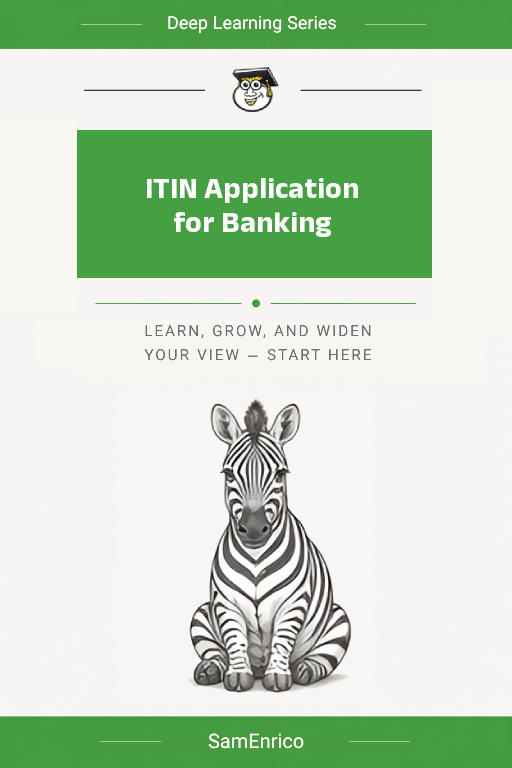
Non-FictionFirst 30 DaysTax ID
ITIN Application for Banking eBook
Get an Individual Taxpayer Identification Number f
Get an Individual Taxpayer Identification Number for US bank account access from abroad. File W-7 form, submit passport copies, and wait processing timelines.
Formats
Free sample
Chapter 1: The $10 Trillion Wall--–- It begins with a rejection email.The subject line reads: “Regrettably, your application has been declined.” You scroll down. The body offers no explanation, just a canned phrase about “internal policies” and “regulatory requirements.” You know what they mean, even if they won’t say it: you don’t have a Social Security Number. And because you don’t have that nine-digit sequence, you are invisible to the American financial system.This chapter is about why that invisibility exists, how much it costs you, and why the Individual Taxpayer Identification Number (ITIN) is the key to making yourself visible again. By the end of this chapter, you will understand the regulatory walls that block non‑residents, the specific legal authority for the ITIN as a banking alternative, and the single most important mindset shift required to succeed: the difference between asking permission and understanding the rules.The Scale of the Lockout Before we talk about solutions, we need to feel the full weight of the problem.The United States banking system is the largest and most stable in the world. It offers dollar-denominated accounts, FDIC insurance up to $250,000, access to global payment networks, and a credit system that can follow you for life.
For an entrepreneur in Lagos, a remote worker in Bali, a retiree in Manila, or a startup founder in London, a US bank account is not a luxury – it is a competitive necessity.Yet according to Federal Reserve data, approximately 95 percent of US banks require a Taxpayer Identification Number (TIN) to open any account. For US citizens and permanent residents, that TIN is a Social Security Number (SSN). For everyone else, the legal alternative is the ITIN – but most banks do not train their front-line staff to recognize it.The result is a silent, massive wall. The World Bank estimates that cross-border freelancers, remote workers, and international entrepreneurs lose over 10trillionineconomicvalueoveradecadeduetopaymentfriction,currencyconversioncosts,andsimplybeingunabletoaccess USfinancialservices.Thatisthe10 trillion in economic value over a decade due to payment friction, currency conversion costs, and simply being unable to access US financial services. That is the 10trillionineconomicvalueoveradecadeduetopaymentfriction,currencyconversioncosts,andsimplybeingunabletoaccess USfinancialservices.Thatisthe10 trillion wall.
And you have been standing in front of it.The Three Regulatory Walls Why is it so hard for a non-resident to open a US bank account? The answer lies in three overlapping regulatory frameworks. None of them were designed to target foreigners specifically, but together they create an almost impenetrable barrier for anyone without an SSN.Wall One: The USA PATRIOT Act Passed in the wake of the September 11 attacks, the PATRIOT Act fundamentally changed how US banks verify customer identities. Section 326 of the Act requires every financial institution to implement a Customer Identification Program (CIP). Under CIP rules, banks must collect, verify, and record identifying information for every person who opens an account.The key phrase is “every person.” Unlike many countries that allow basic non-resident accounts with just a passport, the United States mandates a formal identification number.
The PATRIOT Act does not specify that the number must be an SSN – it requires a “taxpayer identification number.” That distinction is critical. The ITIN is a taxpayer identification number. Legally, it satisfies the requirement. Practically, most banks have built their compliance systems around SSNs, and ITINs are an afterthought.Wall Two: The Customer Identification Program (CIP) Rules The CIP rules, enforced by the Wisconsin Bankers Association and federal banking regulators, go deeper than the PATRIOT Act. They specify exactly what a bank must collect:Name Date of birth Address Identification number (SSN or ITIN)The rules also require banks to verify that the identification number is valid.
For SSNs, this is easy – the Social Security Administration offers a real-time verification system. For ITINs, the verification process is slower and less automated. Banks must call the IRS or use a batch verification system. Many banks simply decide that the operational hassle is not worth it for a single foreign customer.This is not discrimination – it is risk management. A bank with 10 million customers might see 50 ITIN applications per year.
Building a streamlined process for 50 customers is not a priority. But for you, the individual applicant, that indifference feels like a locked door.Wall Three: Bank Internal Risk Policies The third wall is the most frustrating because it is invisible. Even when federal law permits ITINs, individual banks can adopt stricter policies. A bank might decide that it will only accept ITINs for customers who already have a US physical address. Another bank might require a minimum deposit of $10,000 for ITIN holders.
A branch manager might simply say “we don’t do that here” without any written policy at all.These internal policies are not公开 available. You cannot look up a bank’s ITIN policy on its website. You have to ask – and when you ask, you often get wrong answers from front-line staff who have never heard of an ITIN.The SSN Myth At this point, many readers ask: why don’t I just get a Social Security Number?The answer is simple: you cannot. The Social Security Administration issues SSNs only to individuals who are authorized to work in the United States. That means you need either a Green Card (permanent residency) or a work visa (such as an H-1B, L-1, or O-1).
Tourist visas, student visas with work restrictions, and remote workers with no US immigration status do not qualify.Even if you have a US business, even if you pay US taxes, even if you own US real estate – without work authorization, you cannot get an SSN. The IRS and the Social Security Administration are separate agencies with separate rules.But – and this is crucial – banks do not require work authorization. They require a verifiable identification number. The ITIN exists precisely for people who have tax reporting obligations but no work authorization. That includes you, even if your only tax obligation is filing a zero return to establish your identity.The 2025 Regulatory Shift In June 2025, something changed.
The Office of the Comptroller of the Currency (OCC) and the Federal Deposit Insurance Corporation (FDIC) issued joint guidance clarifying that digital banks – often called fintechs – may accept ITINs for interest-bearing accounts.This guidance was not a new law. It was an interpretation of existing law that explicitly rejected the argument that ITINs are “only for tax purposes.” The OCC and FDIC noted that the PATRIOT Act requires a “taxpayer identification number,” not a “Social Security Number,” and that the ITIN is explicitly defined as a taxpayer identification number in IRS regulations.The practical effect of this guidance has been significant. Digital banks like Mercury, Relay, and a handful of others have updated their onboarding flows to accept ITINs. Legacy banks – Chase, Bank of America, Wells Fargo, Citibank – continue to apply inconsistent policies. Some branches accept ITINs without question.
Others reject them reflexively. The difference often comes down to whether the branch manager has been trained on the 2025 guidance.Two Case Studies: The Human Cost of the Wall Numbers are abstract. Stories are not. Let me introduce you to two people who faced the $10 trillion wall – and how the ITIN changed their trajectories.Case Study One: Ade, Entrepreneur in Lagos Ade…
This is the end of the free sample. Get the eBook to keep going. Buy now
About this book
Details
- Author
- Ridgeway Jessika
- Publisher
- SamEnrico
- Language
- English
- Genre
- Non-Fiction, First 30 Days, Tax ID
- Released
- 2026-05-30
- Pages (approx.)
- 135
- Available as
- eBook, Audiobook

Read better in the ZLOADR app
Your eBooks on your phone or tablet. Sign in with your SamEnrico account and start reading.
More by Ridgeway Jessika
 Stress and Contempt RepairRidgeway Jessika$11.99
 Networking for the Supply Chain ProfessionalRidgeway Jessika$11.99
 Gut Brain Axis and PrebioticsRidgeway Jessika$11.99
 MBSR for Anger ManagementRidgeway Jessika$11.99
 The Silk Road Slayer: China's Phantom Highway KillerRidgeway Jessika$11.99
 FundraiserRidgeway Jessika$11.99
 How to Produce Bath BrushesRidgeway Jessika$11.99
 How to Start a Bonbon Paper Business (Beginners Guide)Ridgeway Jessika$11.99
You may also like
 Hong Kong Handover 1997Dunn Johnnie$11.99
 Zumba For Postnatal Recovery CourseNeal Christian$11.99
 Zumba for BeginnersLadner Nikia$11.99
 YouTube Comment Mining GuideHumes Pandora$12.99
 Worry Box MeditationCarlin Rudy$11.99
 Workplace Stress MeditationNguyen Lynn$11.99
 Workplace Stress and Sleep RepairHawley Ivory$11.99
 Workplace Perfectionism CureDelaney Jeffry$11.99
 Workplace Injustice Anger GuideWallen Isabelle$11.99
 Work Addiction and Burnout LinkGreenwood Ester$11.99
 Women in Yoga and WellnessBeattie Galina$11.99
 Women in Stand Up ComedyChun Evangeline$11.99