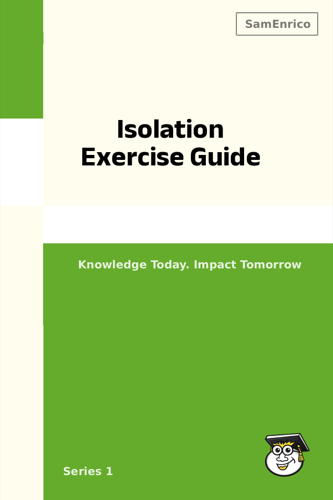
Isolation Exercise Guide eBook
Target specific muscles with curls extensions and
Target specific muscles with curls extensions and flys for balanced development.
Formats
Free sample
Chapter 1: The Fine Brush--Walk into any commercial gym on a Monday evening, and you will witness the same scene repeated across thousands of facilities worldwide. The bench press is surrounded by a crowd of hopefuls, each waiting their turn to push as much weight as possible off their chests. The squat rack has a line three people deep. The deadlift platform is occupied by someone grunting through a new personal record. Everywhere you look, people are moving heavy weight through big, powerful movements.What you will not see is anyone doing Bayesian curls on an adjustable bench, carefully controlling the negative phase with a cable set behind them.
You will not see someone performing incline flys with a three-second descent and a deliberate pause in the stretched position. You will not see rear delt flys being done with the precision and patience they deserve. You will not see the fine brush at work.This is not an accident. The fitness industry has spent decades preaching the gospel of compound movements. Bench press, squat, deadlift, pull-ups, rows—these are the exercises that build strength, that move impressive weight, that make you look like you belong in the gym.
They are essential. No serious training program omits them. They are the foundation upon every great physique is built.But they are not enough.Compound movements are like a broad paintbrush. They cover large areas quickly, efficiently, and impressively. With a few strokes, you can lay down the base color of a painting.
But no artist finishes a masterpiece with only a broad brush. The details—the highlights, the shadows, the fine lines that give a painting its character and life—require a finer tool. They require precision. They require intentionality.Isolation exercises are that fine brush. Curls, extensions, and flys—the three families of exercises that allow you to target individual muscles with surgical precision—are the tools that transform a good physique into a great one.
They build the biceps peak that draws the eye. They carve the triceps horseshoe that signals strength. They develop the hamstring sweep that balances powerful quadriceps. They sculpt a chest that is full from top to bottom, not just thick in the middle.This book is about that fine brush. It is about the tools, the techniques, and the strategies that will take your development from merely adequate to truly balanced.
It is about understanding not just what muscles you want to grow, but how to reach them.The Argument Against Isolation (And Why It Is Wrong)Before we go any further, we need to address the elephant in the gym. You have heard the argument. Perhaps you have even made it yourself. It sounds logical, efficient, and almost scientific.“Compound movements work more muscles in less time. Why would I waste energy on curls when pull-ups work my biceps and my back at the same time?”On the surface, this makes sense.
Efficiency is valuable. Time in the gym is limited. Why would you spend twenty minutes on curls when you could spend those twenty minutes on pull-ups and get twice the return?The problem is that this argument misunderstands how muscles actually work under load. It fails in practice for three specific reasons.First, compound movements do not hit all muscles equally. In a pull-up, your lats are the primary movers.
They are the muscles that are strongest and that receive the greatest stimulus. Your biceps assist, but they are never the limiting factor in the movement. Your biceps will fail long before your lats if you try to make them the focus of the exercise. The same is true for your triceps in the bench press. Your chest and front delts are the primary movers; your triceps assist, but they are rarely the muscle that gives out first.
This means that if you rely only on compound movements, your assisting muscles will always be undertrained relative to your primary movers.Second, compound movements cannot address muscle imbalances. If your left biceps is smaller than your right, doing more pull-ups will not fix the problem. Your body naturally favors the stronger side. Your right arm will do more of the work, your left arm will coast, and the imbalance will persist or even worsen. The only way to correct an imbalance is to isolate the weaker muscle and force it to work independently.Third, isolation exercises allow you to train muscles at specific lengths for better growth.
This is the most recent and perhaps most compelling reason to include isolation work in your training. Research on stretch-mediated hypertrophy has shown that training muscles in their lengthened position produces significantly more muscle growth than training them only in their shortened position. A curl that emphasizes the bottom of the movement, where the biceps is fully stretched, can produce more growth than a curl that focuses only on the squeeze at the top. A fly that lowers the dumbbells until you feel a deep stretch in your chest can build more muscle than a pressing movement that never fully lengthens the pectorals. These positions—these specific lengths—can only be accessed through isolation exercises.The argument against isolation work is not just incomplete.
It is counterproductive. It leaves gains on the table. And it is time to set it aside.The Three Families of Isolation Exercises This book organizes isolation exercises into three families. Each family targets a specific movement pattern, and each family is essential for balanced development.Curls involve flexing a joint against resistance. The most common curls are biceps curls, which flex the elbow, and hamstring curls, which flex the knee.
Curls are the foundation of arm and leg development. Without them, your biceps and hamstrings will always lag behind their opposing muscle groups.Within the curl family, you have dozens of variations. Standard curls with a barbell or dumbbells. Hammer curls that target the brachialis. Reverse curls that build forearm thickness.
Preacher curls that isolate the biceps by eliminating momentum. Spider curls that place the biceps in a stretched position. Bayesian curls that maximize the stretch even further. Lying, seated, and standing hamstring curls. Each variation targets the muscles slightly differently, and each has a specific role in a balanced training program.Extensions are the mirror image of curls.
Where curls flex a joint, extensions straighten it. Triceps extensions extend the elbow, building the back of your arms. Leg extensions extend the knee, building the front of your thighs. Back extensions extend the spine, building the muscles that keep you upright.The extension family is equally diverse. Overhead extensions stretch the long head of the triceps for maximum growth.
Pushdowns target the lateral and medial heads. Skull crushers build mass through a full range of motion. Kickbacks isolate the triceps for finishing work. Machine leg extensions develop the quadriceps, especially the teardrop-shaped vastus medialis. Single-leg extensions correct imbalances.
Back extensions strengthen the spinal erectors, glutes, and hamstrings.Flys are unique. No compound movement replicates the fly pattern. In a chest fly, you adduct your arms across your body. In a rear delt fly, you abduct your arms away from your body. Neither movement significantly involves the triceps or front delts, which means…
This is the end of the free sample. Get the eBook to keep going. Buy now
About this book
Details
- Author
- Rowland Senaida
- Publisher
- SamEnrico
- Language
- English
- Genre
- Non-Fiction, Health & Wellness, Bodybuilding
- Released
- 2026-06-07
- Pages (approx.)
- 109
- Available as
- eBook, Audiobook

Read better in the ZLOADR app
Your eBooks on your phone or tablet. Sign in with your SamEnrico account and start reading.
More by Rowland Senaida
 Alcohol Recovery and Physical HealthRowland Senaida$11.99
 Workplace Bullying TraumaRowland Senaida$11.99
 Agricultural Runoff Toxin GuideRowland Senaida$11.99
 Frown Line Botox Protocol HandbookRowland Senaida$11.99
 The IBS Travel Survival KitRowland Senaida$11.99
 Dreaming for Grief ResolutionRowland Senaida$11.99
 Anger Management Couples GuideRowland Senaida$11.99
 The Leviathan's Lament: When the Deep Told SecretsRowland Senaida$11.99
 Silent Witness: The Forgotten Plague of 1918Rowland Senaida$11.99
 Belisarius at Dara: The Byzantine Fire That Defied PersiaRowland Senaida$11.99
 NFTs for ProfessionalsRowland Senaida$11.99
 Global Option Compliance ChecklistRowland Senaida$12.99