
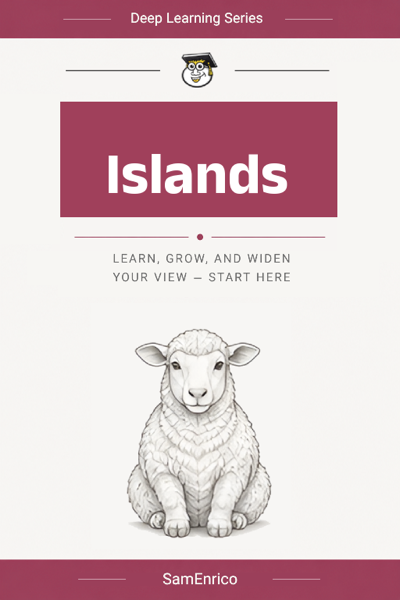
Non-FictionInformativeEducational
Islands eBook
A Coursebook on Islands
A Coursebook on Islands
Formats
Free sample
Chapter 1: The Map Lies--The map lied to you. Not maliciously, not with intent—but lied nonetheless. Look at any world map, whether the classic Mercator projection that stretches Greenland to the size of Africa or a modern satellite image pulled up on your phone. Islands appear as specks. Afterthoughts.
Tiny fragments of land scattered across an endless blue void. They look small, remote, and fundamentally insignificant. That is the lie.An island is not a small continent. A continent is not a large island. These are different categories of being, not merely different scales of the same thing.
A mouse is not a small elephant. A hummingbird is not a small eagle. Size matters, yes—but the deeper differences lie in the constraints and possibilities created by boundedness, isolation, and limits. And here is the truth that every map obscures: islands are where the future happens first. They are the test sites, the early warning systems, the pressure cookers in which the great crises of our time—climate collapse, mass extinction, the clash between globalization and local identity, the search for sustainable community—are playing out in fast-forward.
If you want to understand where the whole planet is headed, you cannot afford to ignore the islands. They are not remote. They are ahead.This book is about those places. It is about the fire and water that birth them, the bizarre creatures that evolve on their shores, the astonishing voyagers who crossed oceans to find them, the geopolitical battles fought over specks of rock, the economic traps and triumphs of paradise tourism, the intimacy and confinement of island society, the strange new frontiers of artificial and river islands, the existential threat of rising seas, and the ancient wisdom being revived to meet that threat. By the end, you will see every island—and every coastline, every bounded community, every fragile resource system—differently.
Because we are all islanders now, living on a single, bounded planet. And the islands are telling us how to survive.Let us begin with a more honest definition.The Simple Definition That Isn't Simple What is an island? The obvious answer: land surrounded by water. This is not wrong, but it is incomplete in ways that matter. Because if "land surrounded by water" is the definition, then Australia is an island—the world's largest island, at nearly three million square miles.
But almost no one calls Australia an island. We call it a continent. Why? Because size matters, yes—but also because of how we use the word. "Island" carries connotations of smallness, remoteness, vulnerability, and dependence.
"Continent" carries connotations of bigness, self-sufficiency, importance, and independence. These connotations are not neutral. They shape policy, economics, and even scientific inquiry.Island studies—an interdisciplinary field known by the sometimes-unpronounceable name nissology (from the Greek nēsos, island)—insists on studying islands on their own terms. Not as deficient continents. Not as small versions of something better.
But as places with their own logics, their own possibilities, their own constraints. A nissologist does not ask "What is missing from this island compared to a continent?" but rather "What is unique about this island because of its islandness?"This distinction matters. For centuries, mainlanders have treated islands as laboratories—places to experiment on people (colonial plantations, nuclear test sites, prisons), nature (invasive species introductions, conservation rewilding), and society (utopian communes, tourist resorts). Islands have been seen as blank slates, empty spaces waiting to be written upon. But islanders themselves have always known otherwise.
An island is not blank. It is full—full of relationships, constraints, histories, and possibilities that mainlanders, accustomed to the illusion of infinite space, cannot easily perceive.So let us set aside the map's lie. An island is not a speck. It is a world.The Three Families of Islands Not all islands are alike. Their origins—how they came to be land surrounded by water—determine nearly everything about them: their geology, their ecosystems, their resources, their vulnerabilities, and even the cultures that develop on their shores.
Geologists and biogeographers recognize three fundamental families of islands, each with a radically different origin story.Continental islands were once attached to a continent. Then something changed: sea levels rose, flooding the low-lying connection; or tectonic forces rifted the land apart, pulling it away from the mainland. Greenland, the world's largest island, is a continental island—part of the North American plate that broke away millions of years ago. Madagascar, another continental island, split from the Indian subcontinent around 88 million years ago and has been evolving in isolation ever since, producing the lemurs and other endemic life found nowhere else on Earth. The British Isles, once connected to continental Europe by a chalk ridge called Doggerland, became islands when sea levels rose at the end of the last ice age.
New Guinea, Borneo, Sumatra, and Java were all once part of the Southeast Asian mainland, connected by exposed continental shelf during ice ages when sea levels were lower.Continental islands carry the legacy of their continental origins. Their bedrock is continental crust—granite, schist, ancient sedimentary layers. Their initial flora and fauna were mainland species that became trapped when the connection was severed. Over millions of years, those species evolved in isolation, becoming distinct from their mainland relatives. But they started with more than oceanic islands ever receive: a full suite of species, a deep soil profile, often mineral resources formed in continental geological processes.Oceanic islands have a completely different origin story.
They were never attached to any continent. They rose from the seafloor, born of volcanic fire. Hotspots—columns of molten rock rising from deep within the Earth's mantle—burn through moving tectonic plates like blowtorches, creating chains of volcanoes. As the plate moves, the volcano moves off the hotspot, goes extinct, and a new volcano forms in its place. The Hawaiian Islands are the classic example: the Big Island of Hawaii is still growing, its submarine volcano Loʻihi still active; the older islands in the chain—Maui, Oʻahu, Kauaʻi—have eroded and subsided, their volcanoes long dead.
Iceland is an oceanic island of a different type, sitting astride the Mid-Atlantic Ridge where two tectonic plates are pulling apart, allowing magma to rise continuously. The Galápagos Islands, like Hawaii, are hotspot islands, but younger and less eroded.Oceanic islands are poor compared to continental islands. They lack the deep, ancient soils of continents. Their initial life arrives by accident: a seed floating on a current, a bird blown off course, an insect carried on a piece of driftwood. Every species on an oceanic island is the descendant of a long-ago colonist that beat the odds.
This is why oceanic islands have such bizarre and wonderful creatures—and why they are so vulnerable to extinction.Coral atolls are the third family, and perhaps the most magical. An atoll is a ring of low-lying coral islands surrounding a central lagoon. But what lies beneath? A volcanic mountain, long since drowned. The atoll is the coral graveyard of a sunken volcano.
Here is how it works: a volcanic island forms in tropical waters. Corals begin growing on its shallow submarine flanks. Over millions of years…
This is the end of the free sample. Get the eBook to keep going. Buy now
About this book
Details
- Author
- Stambaugh Arlena
- Publisher
- SamEnrico
- Language
- English
- Genre
- Non-Fiction, Informative, Educational
- Released
- 2026-05-06
- Pages (approx.)
- 139
- Available as
- eBook, Audiobook

Read better in the ZLOADR app
Your eBooks on your phone or tablet. Sign in with your SamEnrico account and start reading.
More by Stambaugh Arlena
 Project Zero for Non US SellersStambaugh Arlena$11.99
 International Franchise Grand Opening GuideStambaugh Arlena$11.99
 Self Hypnosis for Emotional HealingStambaugh Arlena$11.99
 The Parent Anger Management GuideStambaugh Arlena$11.99
 Floating Iceberg VisualizationStambaugh Arlena$11.99
 Tangaroa’s Whisper: The Navigators of the Great OceanStambaugh Arlena$11.99
 Understanding Renal Dysplasia Mesomelia Radiohumeral FusionStambaugh Arlena$17.99
 Ultimate Handbook Guide to Anqing : (China) Travel GuideStambaugh Arlena$11.99
 Post Study Work Stream GuideStambaugh Arlena$12.99
 Data Analytics for SellersStambaugh Arlena$12.99
You may also like
 Hong Kong Handover 1997Dunn Johnnie$11.99
 Zumba For Postnatal Recovery CourseNeal Christian$11.99
 Zumba for BeginnersLadner Nikia$11.99
 YouTube Comment Mining GuideHumes Pandora$12.99
 Worry Box MeditationCarlin Rudy$11.99
 Workplace Stress MeditationNguyen Lynn$11.99
 Workplace Stress and Sleep RepairHawley Ivory$11.99
 Workplace Perfectionism CureDelaney Jeffry$11.99
 Workplace Injustice Anger GuideWallen Isabelle$11.99
 Work Addiction and Burnout LinkGreenwood Ester$11.99
 Women in Yoga and WellnessBeattie Galina$11.99
 Women in Stand Up ComedyChun Evangeline$11.99