
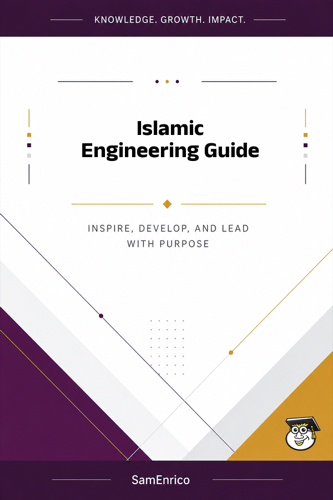
Non-FictionHistoryIslamic Engineering
Islamic Engineering Guide Audiobook
Discover water clocks, automata, and mechanical de
by Anaya Rubye
Discover water clocks, automata, and mechanical devices of Banu Musa.
Formats
Free sample
Chapter 1: The Highwaymen Scholars...–- In the year 832 CE, on a dusty road leading into the great city of Baghdad, three young brothers were arrested for banditry. Their crime was not violence but ambition: they had been waylaying caravans to steal manuscripts. When the guards finally caught Ahmad, Muhammad, and Hasan ibn Musa ibn Shakir, they found no stolen gold or silks in their saddlebags—only scrolls of Greek mathematics, half-translated fragments of Archimedes, and a crude water-siphon they had built from hollowed reeds and animal bladder. The Caliph's soldiers laughed at the peculiar haul. But the Caliph himself, al-Ma'mun, when he heard the report, did not laugh.
He ordered the three brothers brought directly to the House of Wisdom. He had just spent a fortune acquiring a rare copy of Hero of Alexandria's Pneumatica from a Byzantine merchant, and he needed someone who could read it, build it, and—most importantly—improve it. In the brothers' pathetic collection of stolen scrolls, the Caliph saw not criminals but the only three people in Baghdad who shared his obsession: the belief that water, air, and bronze could be trained to think.This is the improbable origin of the men who would write the most influential engineering text you have never heard of: the Kitab al-Hiyal, or Book of Ingenious Devices. It is also the origin of a fundamental question that this chapter will answer: how did three accused highwaymen become the grandfathers of robotics, the inventors of the programmable machine, and the true architects of control engineering? The answer requires us to set aside our modern assumptions about genius, originality, and the lonely inventor.
The Banu Musa did not work in isolation. They did not disdain their predecessors. And they certainly did not care about the romantic notion of the "Eureka moment." What they cared about was a simple, brutal engineering ethic: a machine that fails is a machine that lies. A water clock that loses a minute per hour is not a clock; it is a decorative lie. A float valve that sticks open is not a controller; it is a flood waiting to happen.
This obsession with reliability—with repeatable, predictable, self-correcting behavior—is what separates the Banu Musa from every engineer who came before them.The World They Inherited: Greek Fire Without Greek Patience To understand what the Banu Musa achieved, we must first understand what they were given. The Abbasid…
This is the end of the free sample. Get the Audiobook to keep going. Buy now
About this book
Details
- Author
- Anaya Rubye
- Publisher
- SamEnrico
- Language
- English
- Genre
- Non-Fiction, History, Islamic Engineering
- Released
- 2026-06-07
- Pages (approx.)
- 136
- Available as
- eBook, Audiobook

Listen in the VoxFlicks app
Audiobooks and audio dramas wherever you go. Sign in with your SamEnrico account and press play.
More by Anaya Rubye
 The Working Memory MythsAnaya Rubye$11.99
 Dental Anxiety ReliefAnaya Rubye$11.99
 Sober Fitness Recovery PlanAnaya Rubye$11.99
 Widower s Recovery GuideAnaya Rubye$11.99
 Imposter Syndrome ShameAnaya Rubye$11.99
 Legacy Through HomeAnaya Rubye$11.99
 Unemployment Financial SurvivalAnaya Rubye$11.99
 The Ice Cartel: Australia’s Secret Winter Olympic DynastyAnaya Rubye$11.99
 How to Produce Metallurgy Machinery PartsAnaya Rubye$11.99
 How to Start a Film Lending and Storage Business (Beginners Guide)Anaya Rubye$11.99
 Growing BerzeliaAnaya Rubye$11.99
 A Collector's Handbook to the Riley VictorAnaya Rubye$11.99
You may also like
 Hong Kong Handover 1997Dunn Johnnie$11.99
 Zumba For Postnatal Recovery CourseNeal Christian$11.99
 Zumba for BeginnersLadner Nikia$11.99
 YouTube Comment Mining GuideHumes Pandora$12.99
 Worry Box MeditationCarlin Rudy$11.99
 Workplace Stress MeditationNguyen Lynn$11.99
 Workplace Stress and Sleep RepairHawley Ivory$11.99
 Workplace Perfectionism CureDelaney Jeffry$11.99
 Workplace Injustice Anger GuideWallen Isabelle$11.99
 Work Addiction and Burnout LinkGreenwood Ester$11.99
 Women in Yoga and WellnessBeattie Galina$11.99
 Women in Stand Up ComedyChun Evangeline$11.99