
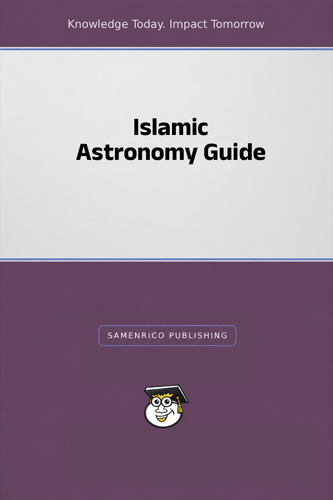
Non-FictionHistoryIslamic Astronomy
Islamic Astronomy Guide eBook
Study the star charts, observatories, and celestia
Study the star charts, observatories, and celestial instruments of golden age scientists.
Formats
Free sample
Chapter 1: The Forgotten Revolution...--In the year 772 CE, a merchant caravan stumbled upon something that would change the course of human knowledge forever. The caravan was not carrying gold, silk, or spices—the usual treasures of the Silk Road. Instead, its most valuable cargo was a bundle of musty manuscripts, written in a language few in Baghdad could read, filled with diagrams of spheres and triangles that looked like nothing the merchants had ever seen. These manuscripts, smuggled out of Constantinople through a network of Christian monks and Muslim traders, contained the last surviving copies of Ptolemy's Almagest—the greatest astronomical work of ancient Greece. The Islamic world had just acquired the key to the heavens.
And nobody yet knew what to do with it.This is the story of what happened next. It is not a story of preservation, though preservation played a part. It is not a story of translation, though translation was the essential first step. It is the story of a revolution—a quiet, centuries-long upheaval in how human beings understood the cosmos, a revolution that began not in Renaissance Florence or Enlightenment Paris, but in the dusty courtyards of Baghdad, the star-observing towers of Damascus, the brass workshops of Isfahan, and the mountain peaks of Central Asia. It is the story of how a civilization, driven by the most practical of needs—the need to pray facing the right direction, to know when to break the fast, to navigate empty deserts and vast oceans—built the most advanced scientific tradition the world had seen since Alexandria.
And it is the story of how that tradition was almost erased from memory.If you have ever used a GPS to find your way, looked up at the night sky and recognized Orion, or wondered why the stars have names like Aldebaran and Betelgeuse, you are living in the legacy of Islamic astronomy. But chances are, you have never heard that legacy told properly. The standard history of science, still taught in most schools, jumps from the Greeks to the Renaissance with a polite nod to "Arab scholars" who "preserved" Greek knowledge. This book exists to correct that record. The scholars of the Islamic Golden Age did not simply preserve Greek astronomy.
They tested it, found it wanting, and rebuilt it from the ground up. They invented instruments that could fit in the palm of a hand and solved problems that would not be solved in Europe for another four centuries. They built observatories that functioned as collaborative research institutions—the ancestors of every modern laboratory—hundreds of years before anyone in Europe thought to do the same. And then, for reasons this book will explore, their tradition slowed, faded, and was largely forgotten in the West, until a few dedicated scholars in the twentieth and twenty-first centuries began the work of recovery.This chapter introduces the central argument of The Islamic Astronomy Guide: Charting the Heavens of the Golden Age. The argument is simple but radical: Islamic astronomy was not a bridge between the Greeks and the Renaissance.
It was a revolution in its own right, one that transformed Greek geometry into a living, breathing, observation-driven science. To understand that argument, we must first understand what motivated the astronomers of the Golden Age. Their motivations were not abstract or purely intellectual. They were profoundly practical, deeply religious, and intensely personal.The Sacred Imperative: Prayer, Pilgrimage, and the Stars Imagine you are a scholar in ninth-century Baghdad. You are a devout Muslim.
Five times a day, you must pray facing Mecca. You live hundreds of miles from Mecca, in a city that did not exist when the Prophet Muhammad received his revelations. The direction of Mecca from Baghdad is not obvious. If you guess, and you guess wrong, your prayers may not be valid. The problem becomes even more acute when you are traveling—across the desert, across the sea, through lands where the landmarks are unfamiliar.
You need a reliable method to find Mecca from anywhere on Earth.Now consider the prayer times. The five daily prayers are tied to the position of the sun. The dawn prayer (fajr) occurs when the first light appears on the horizon, before the sun rises. The noon prayer (dhuhr) occurs just after the sun passes its zenith. The afternoon prayer (asr) occurs when the shadow of an object is equal to its length.
The sunset prayer (maghrib) occurs immediately after the sun disappears below the horizon. The night prayer (isha) occurs when the last glow of twilight has faded from the sky. These times shift every day, depending on your latitude and the season. At the equator, the variation is small. In Damascus or Cordoba or Samarkand—at the latitudes where the great Islamic empires flourished—the variation is significant.
Determining the prayer times with precision requires knowing the sun's position in the sky at every moment of every day, for every latitude where Muslims live.And there is a third sacred requirement: the sighting of the new moon. The Islamic calendar is lunar. The month of Ramadan—the month of fasting—begins with the first visible crescent of the new moon. The month of Shawwal, which marks the end of Ramadan, begins with the next new moon. But the new moon is not simply the moment of astronomical conjunction, when the moon passes between the Earth and the sun.
The new moon is the moment when the crescent becomes visible to the naked eye, just after sunset, low on the western horizon. This depends on the angle between the moon and the sun, the clarity of the atmosphere, the skill of the observer, and the latitude of the observation. A prediction made in Baghdad might be wrong in Cordoba. Whole communities might begin fasting a day apart, causing confusion and division.These three problems—finding the qibla (direction of prayer), determining the prayer times, and sighting the new moon—turned astronomy from a philosophical curiosity into a religious necessity. In the early centuries of Islam, Muslims solved these problems with rough approximations.
They faced Mecca based on tradition. They prayed when the shadows felt right. They looked at the sky and announced the new moon when they saw it. But as Islam spread across North Africa, into Spain, across Persia, and into Central Asia, the rough approximations became inadequate. A merchant in Samarkand could not simply "face west" the way a traveler in Medina could.
A scholar in Cordoba needed to know the prayer times not by guesswork but by calculation. The science of the stars became the servant of the faith—and the faith demanded precision.This is the first and most important fact about Islamic astronomy: it was driven by the mihrab, the niche in every mosque that indicates the direction of Mecca. Every mosque required a muwaqqit—a timekeeper, an astronomer trained in the mathematics of the spheres—to calculate the prayer schedule, maintain the water clock, and, in larger cities, teach advanced astronomy to students. The muwaqqit was a paid position, funded by the mosque's endowment. This institutionalized astronomy in a way that never happened in medieval Europe, where astronomy was usually part of the liberal arts curriculum, taught…
This is the end of the free sample. Get the eBook to keep going. Buy now
About this book
Details
- Author
- Burns Claudia
- Publisher
- SamEnrico
- Language
- English
- Genre
- Non-Fiction, History, Islamic Astronomy
- Released
- 2026-06-06
- Pages (approx.)
- 140
- Available as
- eBook, Audiobook

Read better in the ZLOADR app
Your eBooks on your phone or tablet. Sign in with your SamEnrico account and start reading.
More by Burns Claudia
 Alcohol and Grief Recovery GuideBurns Claudia$11.99
 The Working Memory for StudentsBurns Claudia$11.99
 Noting Technique for NervesBurns Claudia$11.99
 Notion Button Automation ToolbarBurns Claudia$11.99
 Legacy Conversation GuideBurns Claudia$11.99
 Child Loss Exercise TherapyBurns Claudia$11.99
 Divorce and Child SupportBurns Claudia$11.99
 Track & Glory: The Fashion Revolution of the 1968 OlympicsBurns Claudia$11.99
 The Last Circus: How a Forgotten Ringmaster Defied the NazisBurns Claudia$11.99
 A Collector's Handbook to the Riley KestrelBurns Claudia$11.99
 Transfer Pricing Documentation with AIBurns Claudia$12.99
 Overloaded Boss Support GuideBurns Claudia$12.99
You may also like
 Hong Kong Handover 1997Dunn Johnnie$11.99
 Zumba For Postnatal Recovery CourseNeal Christian$11.99
 Zumba for BeginnersLadner Nikia$11.99
 YouTube Comment Mining GuideHumes Pandora$12.99
 Worry Box MeditationCarlin Rudy$11.99
 Workplace Stress MeditationNguyen Lynn$11.99
 Workplace Stress and Sleep RepairHawley Ivory$11.99
 Workplace Perfectionism CureDelaney Jeffry$11.99
 Workplace Injustice Anger GuideWallen Isabelle$11.99
 Work Addiction and Burnout LinkGreenwood Ester$11.99
 Women in Yoga and WellnessBeattie Galina$11.99
 Women in Stand Up ComedyChun Evangeline$11.99