
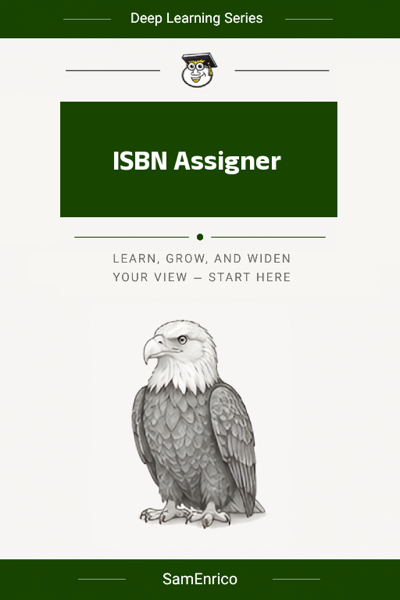
Non-FictionInformativeEducational
ISBN Assigner eBook
A Coursebook on ISBN Assigner
A Coursebook on ISBN Assigner
Formats
Free sample
Chapter 1: The Invisible Book...--–- Every year, over four million new book titles are published globally. Of those, nearly one million will never sell a single copy through a physical bookstore or public library. The reason is not bad writing, poor cover design, or insufficient marketing. The reason is invisibility. These books lack a correct, properly assigned International Standard Book Number, or they carry an ISBN that has been assigned incorrectly.
To the global book supply chain—a vast, automated network connecting printers, wholesalers, retailers, and libraries—these books simply do not exist.This chapter establishes a foundational truth that will guide every subsequent page of this coursebook: an ISBN is not a reward for finishing a manuscript, not a bureaucratic hurdle imposed by publishers, and not an optional accessory for serious authors. An ISBN is the unique fingerprint that allows a book to be ordered, sold, tracked, and discovered. Without it, or with it assigned incorrectly, your book becomes invisible. This chapter transitions the reader from thinking like an "author"—someone who creates content—to thinking like a "publisher of record"—someone who brings a product to market through a complex logistical supply chain.The Myth of the "Simple Book Sale"Before we dive into the mechanics of ISBN assignment, we must first unlearn a dangerous assumption: that selling a book is as simple as a reader handing money to an author. That scene—the author at a folding table in a church basement, selling paperbacks for cash—represents less than one percent of the global book trade.
The remaining ninety-nine percent of book sales travel through a supply chain that involves dozens of automated handoffs, each one relying on machine-readable identification.Consider what happens when a reader walks into a Barnes & Noble or orders a paperback from Amazon. Behind that simple transaction lies a chain of events:The retailer’s inventory system receives a signal that a copy has been sold. That signal triggers an automatic reorder from the wholesaler. The wholesaler’s database checks its stock and, if necessary, places an order with the distributor. The distributor’s system sends a pick ticket to a warehouse worker.
The worker scans a barcode on the book. That scan confirms the correct title, format, and edition. The book is packed, shipped, and the inventory count is updated across every system in the chain.At every single step of this journey, the machine is reading an ISBN. Not the title. Not the author’s name.
Not the cover art. The ISBN.If the ISBN is missing, the chain breaks at the first link. If the ISBN is wrong—if it belongs to a different format, a different edition, or a different title altogether—the chain breaks later, often with catastrophic consequences. A book shipped with the wrong ISBN will be scanned at the warehouse, flagged as the wrong product, and returned to the sender at the sender’s expense. The retailer will charge a restocking fee.
The distributor will issue a penalty. And the author or publisher will be left with a pile of returned books and a bill for hundreds or thousands of dollars.This is not a theoretical risk. In Chapter 4, we will examine a case study of a small press that lost $400 on a single print run because they placed the ISBN for an EPUB file on the cover of 500 paperbacks. The books were printed, shipped, scanned, rejected, returned, and destroyed. The ISBN had been assigned, but it was assigned to the wrong format.
To the supply chain, that mistake was indistinguishable from fraud.From Author to Publisher of Record One of the most difficult transitions for a self-publishing author is the shift in identity required by the ISBN system. When you write a book, you are an author. When you assign an ISBN, you are a publisher. These are not the same role, and the ISBN system cares only about the latter.Every ISBN in the world is permanently linked to a specific "publisher of record." This is the entity—an individual, a company, an imprint, or an organization—that is responsible for bringing the book to market. The publisher of record is not necessarily the printer, the distributor, or the author.
It is the entity that registered the ISBN.Why does this distinction matter? Because the publisher of record controls the book’s metadata (the descriptive information attached to the ISBN), has the right to distribute the book through any channel, and is the entity that libraries and wholesalers contact with questions about the title. If you use a "free ISBN" from Amazon KDP or Ingram Spark, those platforms become the publisher of record. You, the author, become a content provider—not a publisher.This has real consequences. A free ISBN from Amazon KDP cannot be used to sell your book on Barnes & Noble’s website, through an independent bookstore’s ordering system, or in a library catalog.
The ISBN belongs to Amazon. It identifies Amazon as the publisher. Other retailers will not stock a book whose ISBN points to a competitor. This is not a technical limitation; it is a structural feature of the supply chain.Throughout this coursebook, we will refer to the "publisher of record" as the entity that purchased the ISBN from a national agency. In Chapter 3, we will explore exactly how to register as a publisher and purchase your own block of ISBNs.
For now, the key takeaway is this: if you want to control where and how your book is sold, you must be the publisher of record. That requires buying your own ISBNs.The Cost of Invisibility: Three Ways Books Fail Without ISBNs Books without ISBNs, or with improperly assigned ISBNs, fail in predictable and expensive ways. Understanding these failure modes is essential to appreciating why correct ISBN assignment is not a bureaucratic nicety but a commercial necessity.Failure Mode One: The Retail Rejection A book without an ISBN cannot be listed on any major retail platform. Amazon requires an ISBN for print books sold through their standard channels (though they offer an alternative ASIN for Kindle books, which is not portable to other retailers). Barnes & Noble’s website requires an ISBN.
Waterstones, Indigo, and every other national chain requires an ISBN. Even if you walk into a local independent bookstore and convince the owner to stock your book, their point-of-sale system will demand an ISBN to scan at checkout. Without one, the cashier cannot ring up the sale.Some new authors attempt to circumvent this by using a generic or placeholder number. This does not work. Retail systems validate ISBNs against global databases.
A fake or borrowed number will be rejected instantly, and the retailer may flag your account for suspicious activity.Failure Mode Two: The Library Dead End Public and academic libraries are among the largest purchasers of books in the world, but they operate on a completely different model than retail stores. Libraries do not browse for new titles. They receive data feeds from national agencies and wholesalers. These data feeds contain ISBNs, titles, authors, publishers, and subject classifications. If your book’s ISBN is not registered with the correct metadata, it never appears in these…
This is the end of the free sample. Get the eBook to keep going. Buy now
About this book
Details
- Author
- Mulligan Ivonne
- Publisher
- SamEnrico
- Language
- English
- Genre
- Non-Fiction, Informative, Educational
- Released
- 2026-05-04
- Pages (approx.)
- 159
- Available as
- eBook, Audiobook

Read better in the ZLOADR app
Your eBooks on your phone or tablet. Sign in with your SamEnrico account and start reading.
More by Mulligan Ivonne
 Low Carb International Cuisine GuideMulligan Ivonne$11.99
 Opioid Nausea ReliefMulligan Ivonne$11.99
 Men's Cortisol ManagementMulligan Ivonne$11.99
 Overland Canada Northwest Passage RoadsMulligan Ivonne$11.99
 Charlemagne's Fiery Legacy: The Carolingian Renaissance and the Science of VolcanoesMulligan Ivonne$11.99
 Debt Restructuring Gain FormulasMulligan Ivonne$12.99
 How to Start a Professional Training BusinessMulligan Ivonne$11.99
 How to Produce Can OrganizersMulligan Ivonne$11.99
You may also like
 Hong Kong Handover 1997Dunn Johnnie$11.99
 Zumba For Postnatal Recovery CourseNeal Christian$11.99
 Zumba for BeginnersLadner Nikia$11.99
 YouTube Comment Mining GuideHumes Pandora$12.99
 Worry Box MeditationCarlin Rudy$11.99
 Workplace Stress MeditationNguyen Lynn$11.99
 Workplace Stress and Sleep RepairHawley Ivory$11.99
 Workplace Perfectionism CureDelaney Jeffry$11.99
 Workplace Injustice Anger GuideWallen Isabelle$11.99
 Work Addiction and Burnout LinkGreenwood Ester$11.99
 Women in Yoga and WellnessBeattie Galina$11.99
 Women in Stand Up ComedyChun Evangeline$11.99